- Animals
- ›Arthropods
- ›Hexapods
- ›Insects
- ›Winged and Once-winged Insects
- ›True Bugs, Hoppers, Aphids, and allies
- ›True Bugs
- ›Water Bugs
- ›Nepoidea
- ›Giant Water Bugs
- ›Lethocerinae
- ›Lethocerus
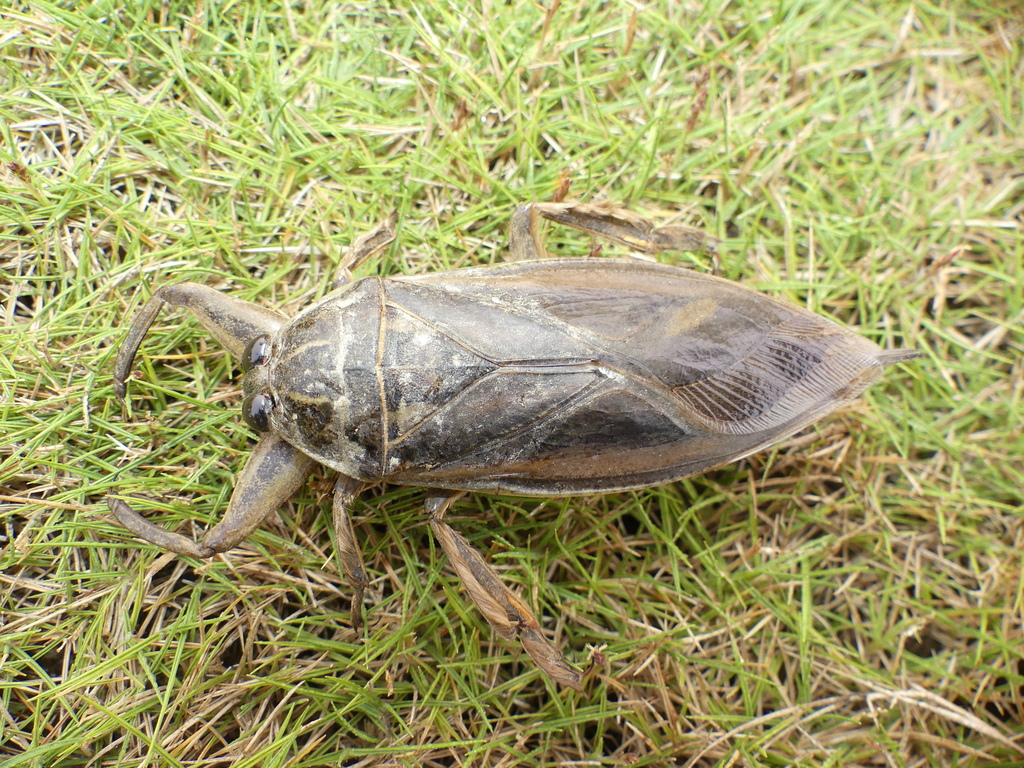
Indo-East Mediterranean Giant Water Bug
Lethocerus patruelis
Lethocerus patruelis is a giant water bug in the family Belostomatidae. It is native to southeastern Europe, through Southwest Asia, to Pakistan, India and Burma. It is the largest European true bug and aquatic insect. Adult females are typically 7–8 cm (2.8–3.1 in) long, while the adult males are 6–7 cm (2.4–2.8 in).
From the article Lethocerus patruelis on Wikipedia (CC BY-SA), quoted section by section
Description
Giant water bugs are large insects, brown to green in color, which helps the bugs to better camouflage themselves in their environment. The shape of the body is elliptical to oblong, dorso-ventrally flattened. Some specimen reach a length of up to 8 centimeters, although some other species in this genus can reach a length of up to 12 centimeters. Like other representatives of the Cryptocerata suborder, the antennae are short and invisible. The first pair of legs is adapted for catching and holding prey. The hemelytra are large and cover almost the entire abdomen of the animal. Beneath the hemelytra is another pair of wings, which allows these large insects to fly and migrate from one water surface to another if conditions become unsatisfactory. At the end of the abdomen, there are two tubular spiracles that serve to absorb oxygen from the surface, while the animal is immersed with its whole body and is waiting for prey.
Range & habitat
Lethocerus patruelis inhabits a large territory, from southeastern Europe and the south of the Balkan Peninsula through Asia Minor, Pakistan, India all the way to Myanmar. Due to the recent climate changes, the progress of this species in the direction of the north on the territory of the Balkan Peninsula has been noticed.
Wikipedia: “Distribution”
Listen
Looking for field recordings…
Where it lives
Recorded sightings
—
geo-referenced records in GBIF, from museums, herbaria and field observers.
Drag the globe to turn it. Dots are where records exist, not a range map; darker means more records.
In the stacks
Searching the stacks…
Every page naming Lethocerus patruelis in the Biodiversity Heritage Library →
This page is assembled live from iNaturalist, GBIF, Wikipedia, the Source Library and the Internet Archive. It is not yet part of the hand-edited codex. iNaturalist taxon 541422.