- Animals
- ›Chordates
- ›Vertebrates
- ›Birds
- ›Cranes, Rails, and Allies
- ›Rails, Gallinules, and Coots
- ›Coturnicops
On eBird ↗
Yellow Rail
Live sightings near you, the range map, bar charts of when it is seen, and Macaulay Library photos and recordings.
Yellow Rail
Coturnicops noveboracensis
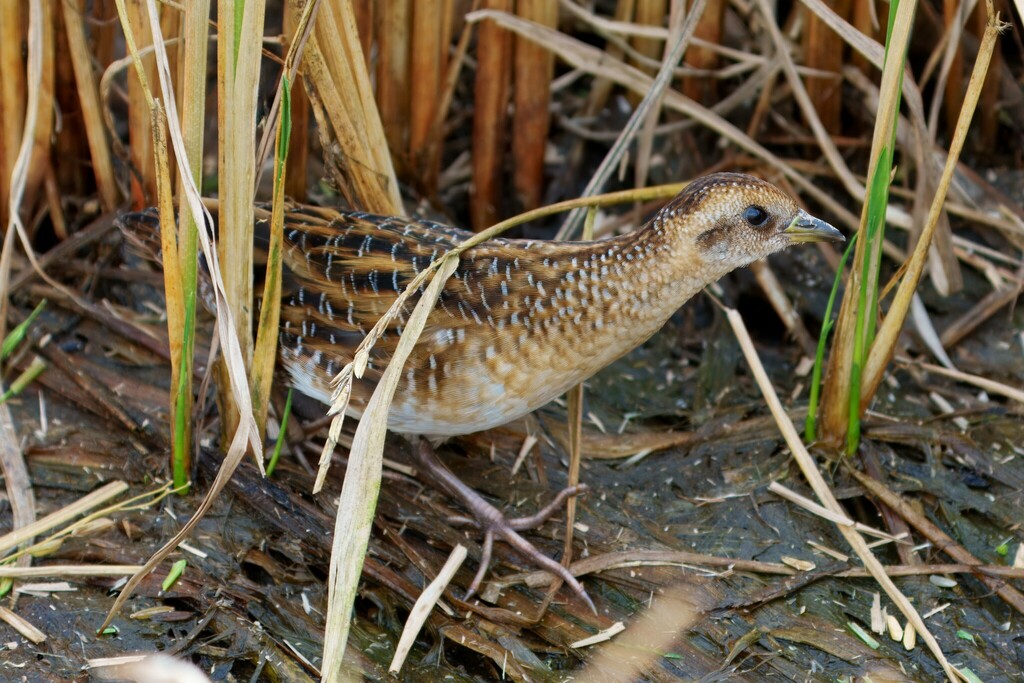
The yellow rail (Coturnicops noveboracensis) is a small secretive marsh bird of the family Rallidae that is found in North America.
From the article Yellow rail on Wikipedia (CC BY-SA), quoted section by section
Description
Adults have brown upperparts streaked with black, a yellowish-brown breast, a light belly and barred flanks. The short thick dark bill turns yellow in males during the breeding season. The feathers on the back are edged with white. There is a yellow-brown band over the eye and the legs are greenish-yellow. The birds measure 16–19 cm (6.3–7.5 in) in overall length; males have an average weight of 59 g (2.1 oz), females an average weight of 52 g (1.8 oz).
Range & habitat
The nominate subspecies' breeding habitat is wet meadows, fens and shallow marshes across Canada east of the Rockies; also the northeastern United States and the entire northern Canada–US border Great Plains to the Great Lakes. These northern populations of yellow rail migrate to the southeastern coastal United States. Little is known about the yellow rail's winter habits beyond sites along coastal Texas, southeast Oklahoma, and coastal South Carolina. However, researchers have concluded through observational studies that the relative abundance of yellow rails increased in relation to the size of the area surveyed and was higher at sites burned within 3 years. Across sites, each additional hour of survey effort increased the number of birds detected by 0.66 rails/h. Findings indicate yellow rails overwinter in wet pine savanna habitats along the northern Gulf Coast region. The subspecies Coturnicops noveboracensis goldmani is known only from marshes on the upper Río Lerma (Lerma River) around 2,500 m in elevation in State of Mexico, Mexico, where it was last recorded in 1964.
Wikipedia: “Distribution and habitat”
What it does
The yellow rail are very elusive and seldom seen. They generally call at night resembling the sound of two stones being clicked together "tik-tik tik-tik-tik" in repetition. When approached, they are more likely to rely on camouflage and escaping on foot through dense vegetation, rather than flushing.
Breeding. The nest is a shallow cup built with marsh vegetation on damp ground under a canopy of dead plants. It is made out of woven grasses and leaves. This rail lays a clutch of five to 10 oval or elongate eggs that usually measure around 29 by 21 millimetres (1.14 by 0.83 in). These eggs are creamy, and spotted with both reddish spots that form a ring at one end, and small black spots that are scattered over the egg. They are incubated by the female for a period of 16 to 18 days. If the first set of eggs are destroyed, the female will generally lay another clutch. After the chicks hatch, the female will either crush the eggshells and hide them from view at the bottom of the nest, or remove the eggshells from the nest, dropping them along the paths leading away from the nest.
Food and feeding. The yellow rail feeds primarily on small invertebrates and complements its diet with plant seeds. …
Wikipedia: “Behaviour”
Listen
Looking for field recordings…
Where it lives
Recorded sightings
—
geo-referenced records in GBIF, from museums, herbaria and field observers.
Drag the globe to turn it. Dots are where records exist, not a range map; darker means more records.
In the stacks
Searching the stacks…
Every page naming Coturnicops noveboracensis in the Biodiversity Heritage Library →
This page is assembled live from iNaturalist, GBIF, Wikipedia, the Source Library and the Internet Archive. It is not yet part of the hand-edited codex. iNaturalist taxon 542.