- Fungi Including Lichens
- ›Basidiomycete Fungi
- ›Higher Basidiomycetes
- ›Mushrooms, Bracket Fungi, Puffballs, and Allies
- ›Agaricomycetidae
- ›boletes and allies
- ›boletes
- ›Suillelloideae
- ›Suillellus
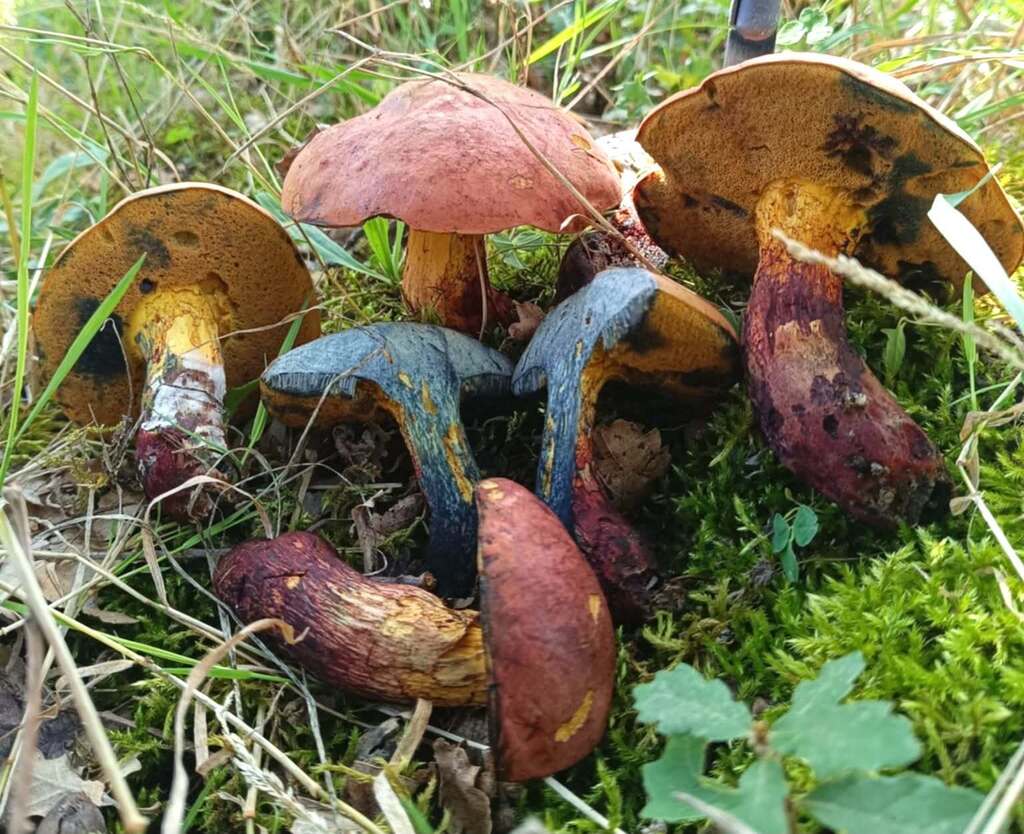
Suillellus adonis
Suillellus adonis is a species of bolete fungus described from Croatia in 2002 and named after the Greek mythological figure Adonis for its striking beauty and vibrant red colouration. The mushroom produces fruiting bodies with deep red caps that fade to reddish-orange or yellow-orange at the margins, yellow pores that turn intensely blue when bruised, and stipes with yellow to golden colours with a dark wine-red base and powdery surface. Its flesh quickly turns blue when cut, and it has a distinctive microscopic characteristic of staining deep turquoise to blackish blue with Melzer's reagent. This apparently rare fungus has been found in Mediterranean regions of Croatia, Italy, and Cyprus, where it grows in groups near holm oak and European black pine, suggesting it forms mycorrhizal relationships with these trees.
From the article Suillellus adonis on Wikipedia (CC BY-SA), quoted section by section
Description
Suillellus adonis has a striking appearance with its vibrant colouration and distinctive features. The cap ranges from 4.5 to 11 cm in diameter and has a convex shape with an uneven surface. It has a dry, finely velvety-tomentose texture and is predominantly deep red. The colour becomes paler toward the margin, transitioning to reddish orange or yellow orange. Some specimens may display purplish-black streaks or spots across the cap surface. The underside of the cap reveals yellow to olive pores that are about 1 mm wide and distinctly maze-like (labyrinthiform). These pores stain intensely blue when bruised or damaged, a characteristic reaction in many bolete mushrooms. The tubes connected to these pores attach to the stipe (adnate) or are slightly depressed near it, measuring up to 17 mm long near the stipe but becoming shorter (3–5 mm) toward the cap margin. The stipe measures 3.5–6.5 cm in length and 1–4 cm in thickness. It can be cylindrical or taper toward the base and is solidly constructed. The stipe colouration ranges from pale yellow to golden yellow, sometimes matching the cap colour partially or completely, while the base displays a dark wine-like (vinaceous) colour. The stipe surface is dry and distinctly covered with a powdery bloom (pruinose), which varies in colour from yellow to orange to red. …
Range & habitat
Suillellus adonis is found in Mediterranean regions, specifically recorded from Croatia and Italy. The type specimens were collected in Croatia on the island of Cres, growing among grass in a small sheep pasture near holm oak (Quercus ilex) and European black pine (Pinus nigra) at an elevation of 100 metres above sea level. This apparently rare fungus was later reported from Cyprus. The species grows in groups (gregariously), sometimes in small clusters of two or three fruiting bodies. It appears to form mycorrhizal associations with Mediterranean trees, particularly holm oak.
== References ==
Wikipedia: “Habitat and distribution”
Where it lives
Recorded sightings
—
geo-referenced records in GBIF, from museums, herbaria and field observers.
Drag the globe to turn it. Dots are where records exist, not a range map; darker means more records.
In the stacks
Searching the stacks…
Every page naming Suillellus adonis in the Biodiversity Heritage Library →
This page is assembled live from iNaturalist, GBIF, Wikipedia, the Source Library and the Internet Archive. It is not yet part of the hand-edited codex. iNaturalist taxon 542722.