- Fungi Including Lichens
- ›Basidiomycete Fungi
- ›Higher Basidiomycetes
- ›Mushrooms, Bracket Fungi, Puffballs, and Allies
- ›Agaricomycetidae
- ›boletes and allies
- ›boletes
- ›Suillelloideae
- ›Suillellus
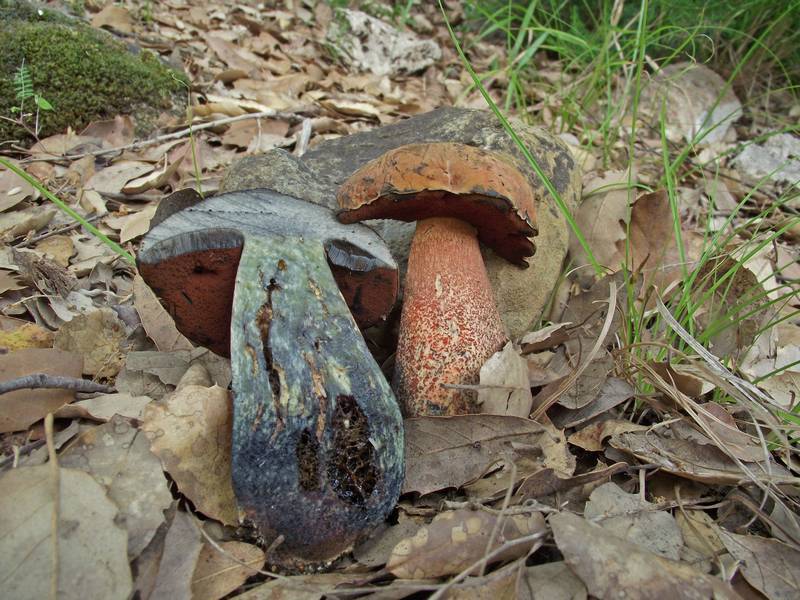
Suillellus mendax
Suillellus mendax is a species of bolete fungus found in Europe that forms beneficial relationships with beech, oak, and sweet chestnut trees. First described scientifically in 2013, the fungus produces mushrooms with olive-buff to crimson-red caps, bright yellow pores that turn scarlet-red, and stipes adorned with a crimson network pattern on an orange-red background. Its species epithet mendax, meaning "false" or "deceptive" in Latin, alludes to its close resemblance to the widespread Suillellus luridus, from which it differs by its preference for acidic soils, velvety cap texture, and more elongated spores. The species has been confirmed through DNA studies in Italy, France, and Cyprus, where it typically grows in acidic woodland habitats.
From the article Suillellus mendax on Wikipedia (CC BY-SA), quoted section by section
Description
The fruit bodies have caps (pilei) 4–12 cm across, initially hemispherical to convex before flattening, with a distinctly velvety to tomentose surface. Cap colours vary from pale olive-buff in young specimens to deep crimson-red or brownish-red in mature or wet conditions. The stipe measures 4–12 cm long by 0.8–3 cm thick, cylindrical to slightly swollen or tapered at the base, and bears a variable reticulation (net-like pattern) of crimson network on an orange-red ground; the lower stipe often shows fine dark granules or a brown tomentum. The pore surface consists of small, round pores that are bright yellow at first, soon turning vivid scarlet-red, and bruise blue when pressed. The flesh is pale yellow but almost immediately turns indigo-blue on exposure. Spore prints are olive-brown. Microscopically, spores are elongated—about 13–15 × 5–5.7 μm—and the stipe base context shows a strong amyloid reaction.
Range & habitat
Suillellus mendax forms ectomycorrhizal associations with beech (Fagus), oak (Quercus) and sweet chestnut (Castanea). So far, it has been molecularly verified from Italy, France, and the island of Cyprus.
== References ==
Wikipedia: “Habitat and distribution”
Where it lives
Recorded sightings
—
geo-referenced records in GBIF, from museums, herbaria and field observers.
Drag the globe to turn it. Dots are where records exist, not a range map; darker means more records.
In the stacks
Searching the stacks…
Every page naming Suillellus mendax in the Biodiversity Heritage Library →
This page is assembled live from iNaturalist, GBIF, Wikipedia, the Source Library and the Internet Archive. It is not yet part of the hand-edited codex. iNaturalist taxon 542911.