- Animals
- ›Arthropods
- ›Hexapods
- ›Insects
- ›Winged and Once-winged Insects
- ›Flies
- ›Brachyceran Flies
- ›Cyclorrhaphan Flies
- ›Aschizan Flies
- ›Hover Flies
- ›Drone Flies and Allies
- ›Cerioidini
- ›Sphiximorpha
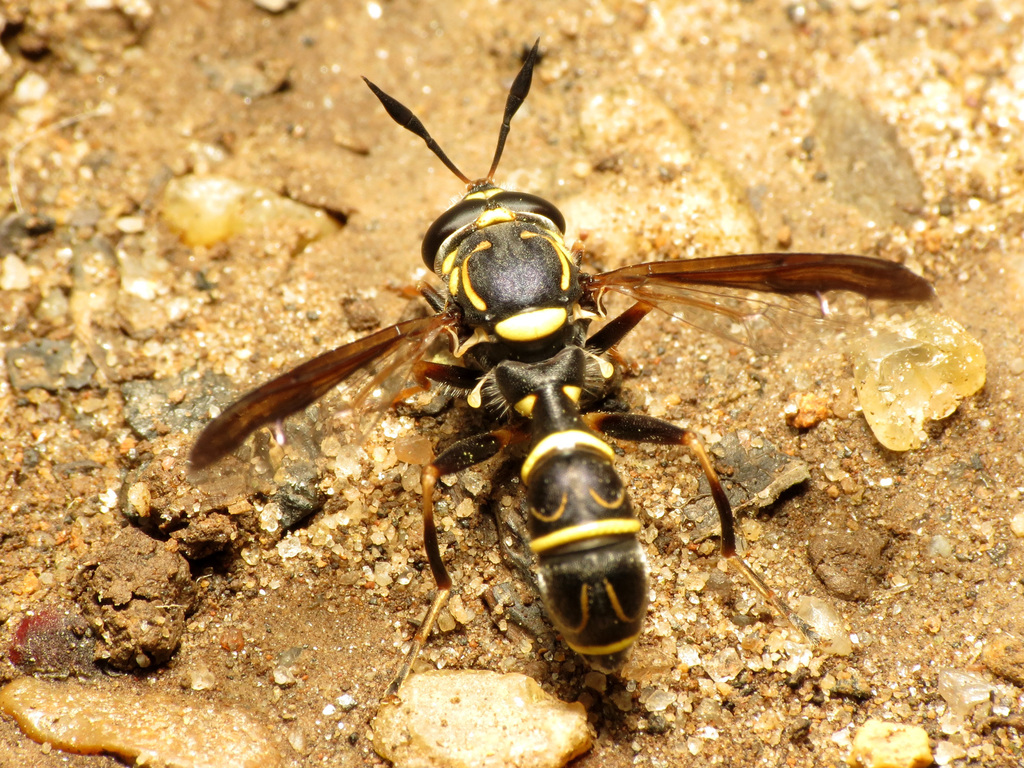
Williston's Wasp Fly
Sphiximorpha willistoni
Sphiximorpha willistoni (Kahl, 1897), or Williston's wasp fly, is a rare species of syrphid fly found in eastern North America (see map). It is a strong wasp mimic. Hoverflies can remain nearly motionless in flight. The adults are also known as flower flies for they are commonly found on flowers, from which they get both energy-giving nectar and protein-rich pollen. Larvae in this genus are found in sap runs of trees.
From the article Sphiximorpha willistoni on Wikipedia (CC BY-SA), quoted section by section
Description
Size Between 11–14 mm (0.43–0.55 in).
In overall appearance this species mimics a wasp with the darkened forewing, elongate antennae, black and yellow markings on the thorax and banded yellow markings on a thin-wasted abdomen.
Head
The face is long, flat, black with varying yellow marks.It is yellow in the middle with a large black arrowhead shaped spot and the broadly rounded apex rests on the oral margin and its base and is narrowly connected with the broad black field below the antennae. This black field extends transversely to the orbit of the eye, separating the yellow of the face and from a small yellow somewhat triangular spot situated at the orbit of the eye and opposite the base of antennae. From the antennal process to the middle of the arrowhead shaped spot there is a yellowish line, very narrow above, widening below. Some have either a few yellow spots or a transverse stripe below antenna base. Above the base either a yellow V-shaped stripe (usually on male), or another series of 4 spots (usually on female). The front is black, broadly connected with the black below the antennae. A little below the middle are two small, narrowly separated, reddish brown, transverse spots. The opaque portion of the front is thinly white pollinose, and can be seen only in certain lights, most conspicuously at the orbit of the eye. …
Listen
Looking for field recordings…
Where it lives
Recorded sightings
—
geo-referenced records in GBIF, from museums, herbaria and field observers.
Drag the globe to turn it. Dots are where records exist, not a range map; darker means more records.
In the stacks
Searching the stacks…
Every page naming Sphiximorpha willistoni in the Biodiversity Heritage Library →
This page is assembled live from iNaturalist, GBIF, Wikipedia, the Source Library and the Internet Archive. It is not yet part of the hand-edited codex. iNaturalist taxon 543029.