- Plants
- ›Vascular Plants
- ›flowering plants
- ›Dicots
- ›beeches, oaks, walnuts, and allies
- ›walnut family
- ›Juglans
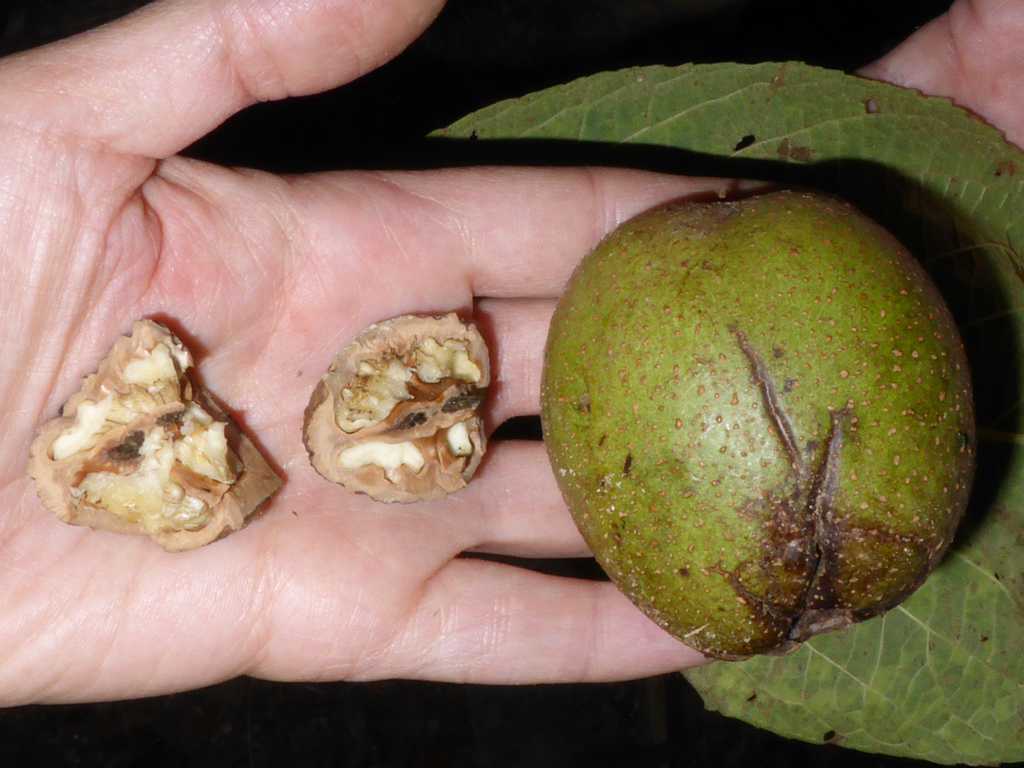
iron walnut
Juglans sigillata
Juglans sigillata, known as the iron walnut, is a species of walnut tree. The tree has been cultivated for its edible nuts. The nuts are oval-shaped with bumps and ridges. The tree is also used for its wood. It is commonly found in Yunnan, but are also found in Guizhou, Sichuan and Xizang in China. It is sometimes grown in gardens and parks as an ornamental plant.
From the article Juglans sigillata on Wikipedia (CC BY-SA), quoted section by section
Description
Iron walnut is a medium-sized deciduous tree reaching heights up to 25 metres. The leaves are 15–50 centimetres long, alternate, compound, with 9–11(–15) leaflets, each 6–18 cm long and 3–8 cm wide. The leaflets have entire or minutely serrated margins. The nuts are globose to oval, with a pointed apex and bumps and seal-like depressions (sigillatae, from which the scientific name derives) in the very thick, hard shell (from which the common name "iron walnut" derives).
At the table
The tree has been cultivated for its edible nuts, and there have been at least 80 authorised or approved cultivars produced after successful implementation of grafting technology. It is widely cultivated in China for walnut production and wood. It is commonly found in Yunnan, China's top walnut producing region in terms of acreage and yield, but also is found in Guizhou, Sichuan and Tibet in China. It is sometimes grown in gardens and parks as an ornamental plant. Outside of its native range, it was first cultivated at Hackfalls Arboretum in New Zealand in about 2000, and then more widely from 2005. J. sigillata is closely related to the Persian walnut Juglans regia. A 536.50-Mb genome has been sequenced to provide a solid foundation for additional genomic studies in nut crops and related species, as well providing valuable resources for plant breeders. Demonstrating an estimated divergence time between J. sigillata and the more widely cultivated Juglans regia 49 million years ago.
== References ==
Wikipedia: “Uses”
Where it lives
Recorded sightings
—
geo-referenced records in GBIF, from museums, herbaria and field observers.
Drag the globe to turn it. Dots are where records exist, not a range map; darker means more records.
In the stacks
Searching the stacks…
Every page naming Juglans sigillata in the Biodiversity Heritage Library →
This page is assembled live from iNaturalist, GBIF, Wikipedia, the Source Library and the Internet Archive. It is not yet part of the hand-edited codex. iNaturalist taxon 544425.