- Fungi Including Lichens
- ›Basidiomycete Fungi
- ›Higher Basidiomycetes
- ›Mushrooms, Bracket Fungi, Puffballs, and Allies
- ›Agaricomycetidae
- ›boletes and allies
- ›boletes
- ›Suillelloideae
- ›Rubroboletus
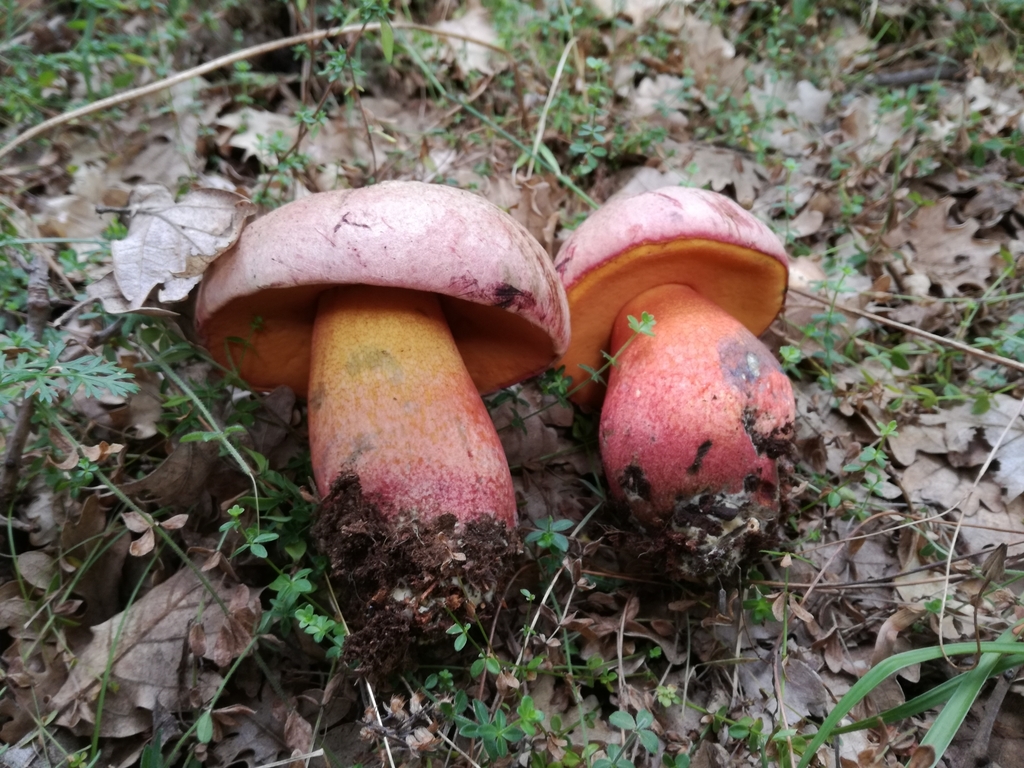
bilious bolete
Rubroboletus legaliae
Rubroboletus legaliae, previously known as Boletus splendidus, B. satanoides, and B. legaliae is a basidiomycete fungus of the family Boletaceae. It is poisonous, with predominantly gastrointestinal symptoms, and is related to Rubroboletus satanas.
It's uncommon in Southern England, and Europe, and grows with oak (Quercus) and beech (Fagus) often on neutral to acid soils. It is considered vulnerable in the Czech Republic. In Britain, all of the boletes in the Satanas group are either very rare, endangered, or extinct.
From the article Rubroboletus legaliae on Wikipedia (CC BY-SA), quoted section by section
Description
The cap is initially off-white, or coffee-coloured at the button stage. In mid life it often (but not always) turns a pale mouse grey. In old age the cap turns reddish, or what has been described as 'old rose'. It may reach 14 cm (5.5 in) in diameter. The stipe is stocky, with a narrow red reticulation (net pattern) on an orange ground at the apex. This orange ground colour fades gradually towards the midsection, making the red reticulation more pronounced. At the base the reticulation is absent, and the stipe turns dark vinaceous. Sometimes the stipe detail can be faint, or even absent when covered with earth or leaf litter. The pores are initially red, but have an overall orange colour when mature, and they bruise blue. The flesh turns pale blue on cutting / dark vinaceous in the stipe base. Often this blueing process is very slow, sometimes taking a minute or so for the flesh to turn a light blue. In other situations, blueing is near-instant. The flesh is said to smell of chicory.
Where it lives
Recorded sightings
—
geo-referenced records in GBIF, from museums, herbaria and field observers.
Drag the globe to turn it. Dots are where records exist, not a range map; darker means more records.
In the stacks
Searching the stacks…
Every page naming Rubroboletus legaliae in the Biodiversity Heritage Library →
This page is assembled live from iNaturalist, GBIF, Wikipedia, the Source Library and the Internet Archive. It is not yet part of the hand-edited codex. iNaturalist taxon 544555.