- Plants
- ›Vascular Plants
- ›flowering plants
- ›monocots
- ›Agaves, Orchids, Irises, and Allies
- ›iris family
- ›Iridoideae
- ›Irideae
- ›Iris
- ›Iris
- ›Iris
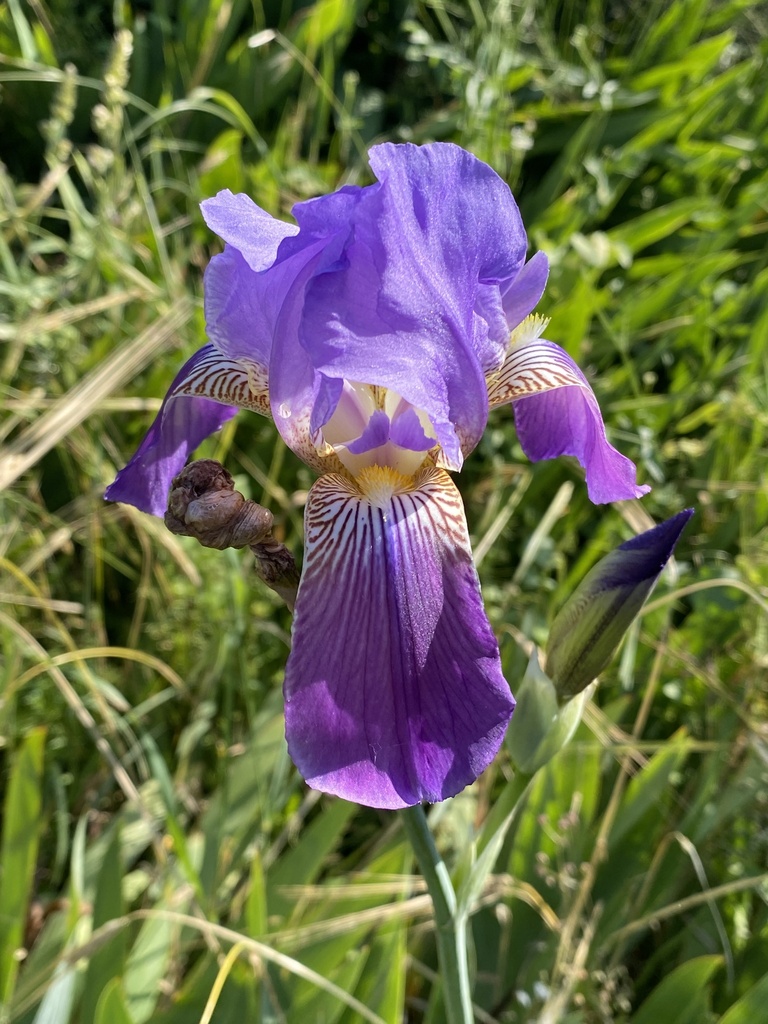
Mesopotamian Iris
Iris mesopotamica
Iris mesopotamica, the Mesopotamian iris, is a species in the genus Iris, it is also in the subgenus Iris. It is a rhizomatous perennial, from the middle East, within the countries of Iraq, Turkey, Syria and Israel. It has linear, grey-green or green broad leaves, tall stem with 2–3 branches, holding up to 9 scented flowers, in shades of violet, purple, lavender blue and light blue, with a yellow and white or orange and white beard. It is listed as a synonym of Iris × germanica in some sources. It is cultivated as an ornamental plant in temperate regions, including being planted in graveyards and cemeteries but may also be used for celebrations and decoration.
From the article Iris mesopotamica on Wikipedia (CC BY-SA), quoted section by section
Description
It is often confused with Iris trojana (now classed as a synonym of Iris × germanica) and Iris cypriana. It is also similar in form to Iris cypriana but outer bract (spathe) is brown and papery in the upper third only. It is a geophyte, that has thick rhizomes, which are stoloniferous, and semi-buried in the ground. It has linear, green, or grey-green, glaucous leaves. The sheathing leaves, can grow up to between 30–70 cm (12–28 in) long, and 5 cm wide. The leaves are wider than Iris cypriana. It has a tall stem, or peduncle, that can grow up to between 90–150 cm (35–59 in) tall. It has 2 or 3 branched stems. The stem has broad, spathes (leaves of the flower bud), which are green in the lower half, and (scarious) membranous or brown and papery, in the upper third of the leaf. The stems (and the branches) hold between 3 and 8, or 9 flowers. Each stem carries 2–3 flowers, at the terminal end of each branch, there is always a single flower per stem. It blooms early in the season, between late spring and early summer, between May, and June. The large flowers, are scented, and come in shades of violet, purple, lavender blue (similar in shade to Iris junonia), and light blue. There are occasionally bi-toned flowers. Like other irises, it has 2 pairs of petals, 3 large sepals (outer petals), known as the 'falls' and 3 inner, smaller petals (or tepals), known as the 'standards'. …
Range & habitat
It is native to Asia, within the Middle East, or the Levant, (eastern Mediterranean,).
Range. It is found in Turkey (including the region of Hatay Province,), Syria, and Israel (within Mount Hermon, Galilee, and Golan). It is endemic in Israel. It was originally found in Armenia, and Cyprus, but not any more. Paul Mouterde (French botanist 1892–1972) stated that wild populations exist in the mountains of north Syria.
Habitat. It grows on dry rocky slopes, grasslands, and on the semi-steppe shrublands. They can be found at an altitude of above 600–1,400 m (2,000–4,600 ft) above sea level.
Wikipedia: “Distribution and habitat”
At the table
Iris mesopotamica has been used in the past in folk medicine, for various uses including; treating animals bites and poisons, treating Haemorrhoids and sexual diseases, treating Internal diseases, treating inflammations and skin diseases. The rhizomes also contain a plenty of starch, including isoflavone and essential oils which are used in perfumery, similar to Iris florentina.
Wikipedia: “Uses”
Toxicity
Like many other irises, most parts of the plant are poisonous (rhizome and leaves), if mistakenly ingested can cause stomach pains and vomiting. Also handling the plant may cause a skin irritation or an allergic reaction.
How it is grown
It is hardy, to European Zone H2, meaning Hardy to −15 to −20 °C (5 to −4 °F). or RHS Hardiness Rating H5 (−15 to −10 °C; 5 to 14 °F). It prefers well drained soils, but can tolerate heavy soils. It prefers positions in full sun. The rhizomes can be susceptible to 'iris root rot', also the leaves may also be affected by leaf spot (heterosporium gracile). The leaves can also be eaten by slugs and snails. Dykes recommends a planting time of between August and September. It can be found for sale in some specialised nurseries, in Europe.
Propagation. Irises can generally be propagated by division, or by seed growing. It sometimes produces tall seedlings with tall widely branching stems, that are sometimes too weak to hold up the flower.
Hybrids and cultivars. Michael Foster was the first to use the species in hybridisation. He crossed with Iris × germanica to create larger plants. …
Wikipedia: “Cultivation”
In human culture
In the past, up to hundreds of years ago, in the Levant, Arabs, and Muslims, planted Iris albicans, (another white flowering bearded iris) and Iris mesopotamica in cemeteries, and graveyards, beside the graves, as an ornamental. Including in Israel, Palestine, North Africa and Syria (since the 16th century). Some graveyards and cemeteries were later abandoned, allowing the iris to become naturalised in some sites.
Wikipedia: “Culture”
Where it lives
Recorded sightings
—
geo-referenced records in GBIF, from museums, herbaria and field observers.
Drag the globe to turn it. Dots are where records exist, not a range map; darker means more records.
In the stacks
Searching the stacks…
Every page naming Iris mesopotamica in the Biodiversity Heritage Library →
This page is assembled live from iNaturalist, GBIF, Wikipedia, the Source Library and the Internet Archive. It is not yet part of the hand-edited codex. iNaturalist taxon 544685.