- Plants
- ›Vascular Plants
- ›flowering plants
- ›Dicots
- ›Mints, Plantains, Olives, and Allies
- ›Verbena Family
- ›Lantaneae
- ›Aloysia
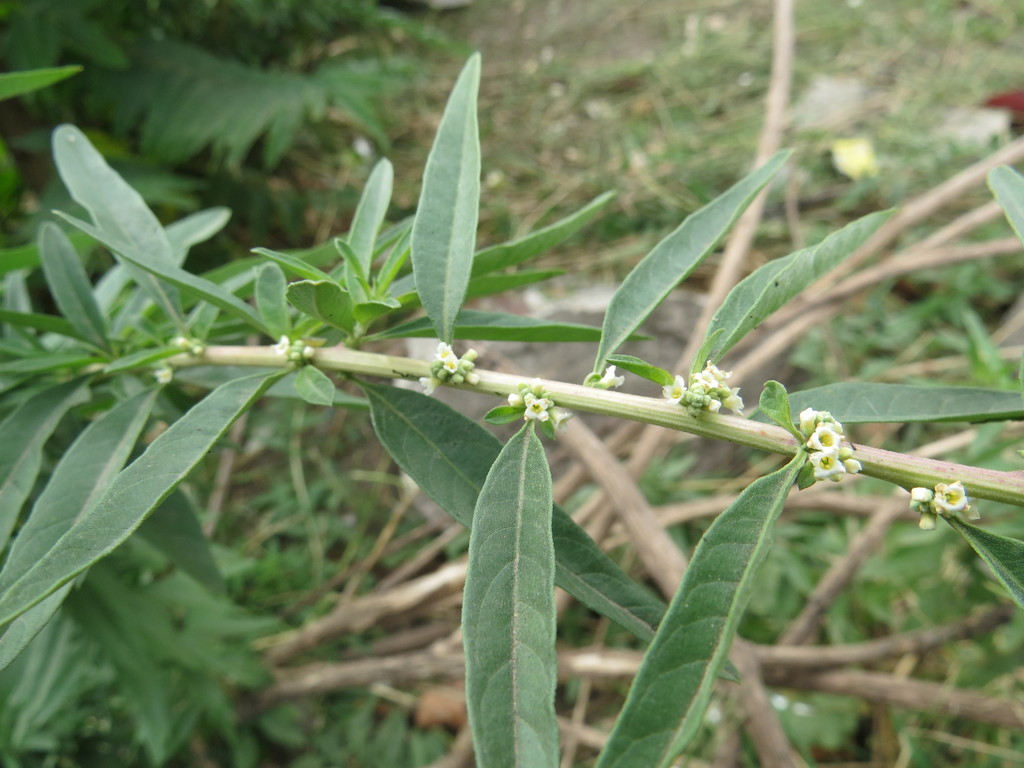
Aloysia polystachya
Aloysia is a genus of flowering plants in the verbena family, Verbenaceae. They are known generally as beebrushes. They are native to the Americas, where they are distributed in temperate climates, as well as in subtropical and desert climates. The genus is named for Maria Luisa of Parma (1751-1819), wife of King Charles IV of Spain.
From the article Aloysia on Wikipedia (CC BY-SA), quoted section by section
Description
These plants are subshrubs, shrubs, or trees growing 0.5 meters to 15 meters tall. Many are very aromatic. The stems may be four-angled and smooth when new, becoming more angular or rounded and often furrowed or striated with age. The leaves are evergreen or deciduous in the dry season. They are often oppositely arranged or whorled, but can be alternate or clustered. The blades are variable in shape, toothed or smooth-edged, and hairless to rough-haired on the upper surfaces. The undersides may have glandular hairs. The inflorescence is usually a raceme of widely spaced clusters of 3 to 6 flowers each. There are leaflike bracts under the flowers which can be showy in some species. The calyx of sepals has 2 or 4 lobes and is persistent, enclosing the fruit as it develops. The flower corolla is tubular with a wider mouth divided into four lobes, one of which may be cleft. The corolla can be white, purplish, blue, or pink. The narrow style is tipped with a bilobed stigma and there are 4 stamens. The fruit is a schizocarp.
Where it lives
Recorded sightings
—
geo-referenced records in GBIF, from museums, herbaria and field observers.
Drag the globe to turn it. Dots are where records exist, not a range map; darker means more records.
In the stacks
Searching the stacks…
Every page naming Aloysia polystachya in the Biodiversity Heritage Library →
This page is assembled live from iNaturalist, GBIF, Wikipedia, the Source Library and the Internet Archive. It is not yet part of the hand-edited codex. iNaturalist taxon 545360.