- Plants
- ›Vascular Plants
- ›flowering plants
- ›Dicots
- ›carrots, ivies, and allies
- ›carrot family
- ›Apioideae
- ›Selineae
- ›Cymopterus
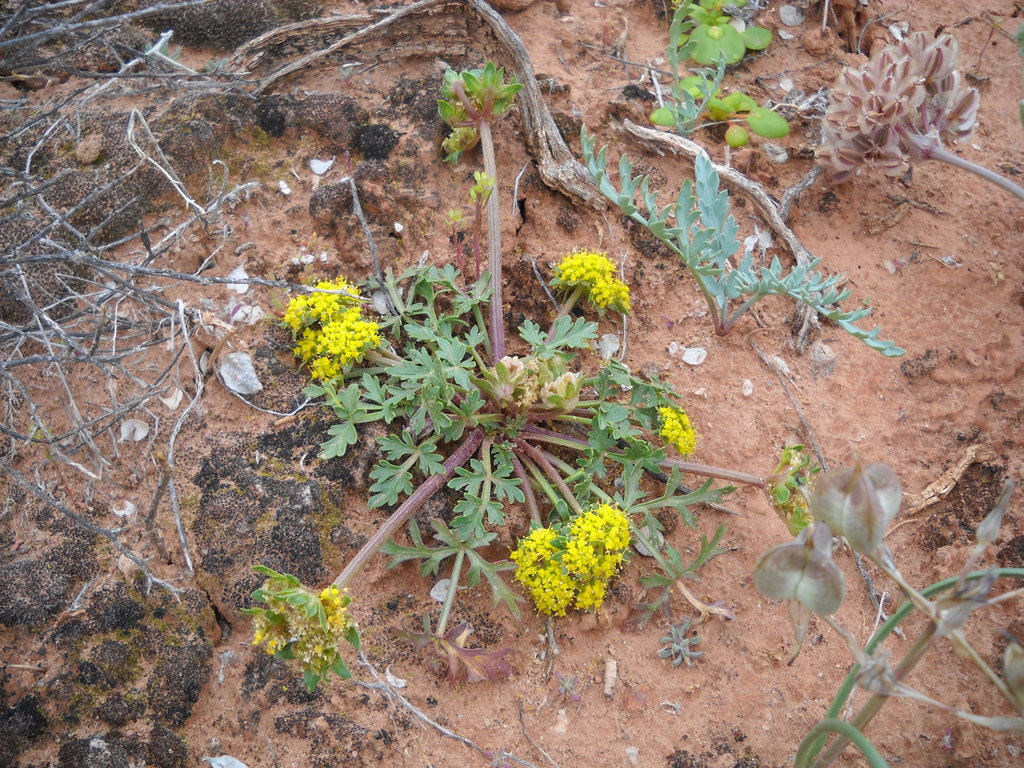
Plains Cymopterus
Cymopterus glomeratus
Cymopterus glomeratus (Fendler's spring-parsley, Fendler's cymopterus, plains springparsley), now including Cymopterus acaulis, is a flowering plant. This plant is an aromatic plant of the family Apiaceae, a family of commonly known as the “celery, carrot, or parsley” family. The genus name comes from the Greek word, “Cyma” which means “wave” and “Pteron” which means “wing”, and combines to form the genus “Cymopterus”.
Incorrectly known as Cymopterus acaulis, a multivariate and phylogenic analysis of this plant species found that there were “not geographically distinguishable based on their overlapping or adjacent distributions” and proposed to recognize as Cymopterus acaulis and all of its varieties as one species as Cymopterus glomeratus. There were five varieties of Cymopterus acaulis, which include var. C. acaulis, var. C. fendleri, var. C. greeleyorum, var. C. higginsii, and var. C. parvus.
From the article Cymopterus glomeratus on Wikipedia (CC BY-SA), quoted section by section
Description
They have taproots which are large roots which grow downward laterally. They also create peduncles which are stems which support the inflorescences, clusters of small flowers. Their leaves generally grow from the base and generally split two or three times. The leaves are also pinnately split two or three times and form a rosette around the base.
Wikipedia: “Morphology”
Range & habitat
Cymopterus glomeratus are found in a large variety of environments, ranging from southern Canada to south-western North America to northern Mexico. They are generally specifically found in northern Chihuahua, Mexico, to Oklahoma and Texas in the United States, and southern Alberta, Saskatchewan, Canada. It is generally found on plains or mountain meadows up to 7,500 feet (2,300 m) in elevation.
Wikipedia: “Distribution”
What it does
Cymopterus glomeratus is found in open the foothills and valleys, It is also found scattered over the high deserts in sandy, loamy, and clay soil in particular. They can stand elevations up to 2000m. In general it prefers well-drained soils with light shade in dry or moist soils in cultivated beds.
Wikipedia: “Habitat and ecology”
At the table
Because of its aromatic tendency, it is eaten raw or cooked. Raw, the leaves are eaten as greens, and cooked they are used in condiments, and as a flavoring in soups.
== References ==
Wikipedia: “Food”
Where it lives
Recorded sightings
—
geo-referenced records in GBIF, from museums, herbaria and field observers.
Drag the globe to turn it. Dots are where records exist, not a range map; darker means more records.
In the stacks
Searching the stacks…
Every page naming Cymopterus glomeratus in the Biodiversity Heritage Library →
This page is assembled live from iNaturalist, GBIF, Wikipedia, the Source Library and the Internet Archive. It is not yet part of the hand-edited codex. iNaturalist taxon 545744.