- Fungi Including Lichens
- ›Basidiomycete Fungi
- ›Higher Basidiomycetes
- ›Mushrooms, Bracket Fungi, Puffballs, and Allies
- ›Phallomycetidae
- ›stinkhorns and allies
- ›stinkhorns
- ›Phallus
- ›Phallus indusiatus
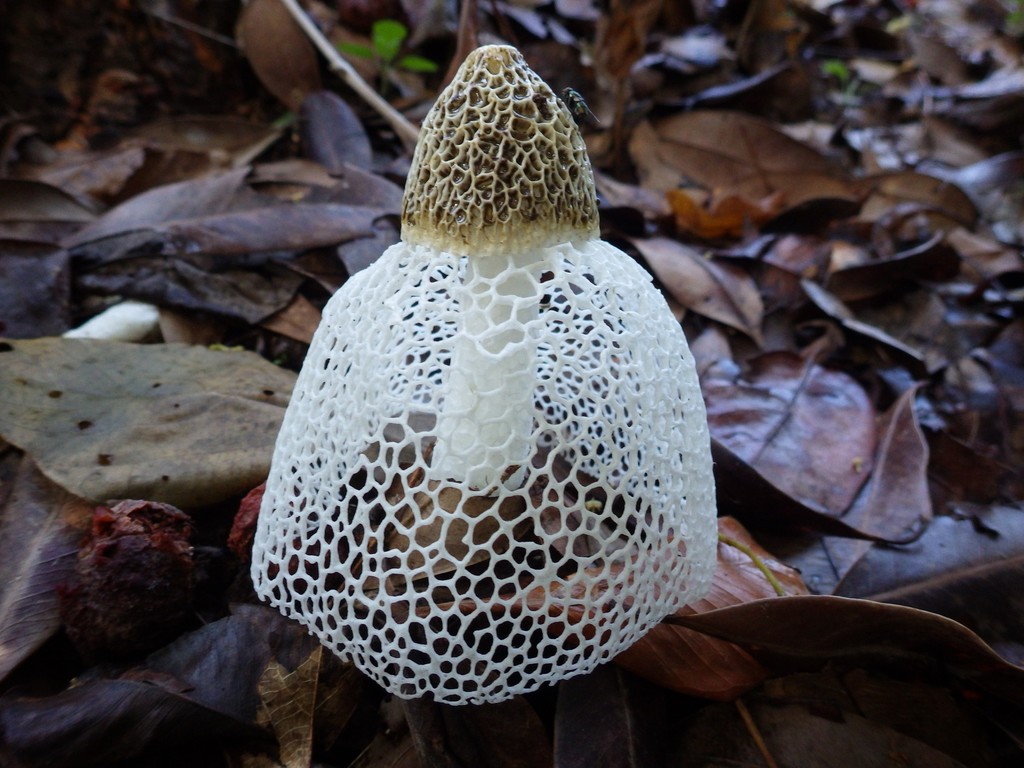
bridal veil stinkhorn
Phallus indusiatus
Phallus indusiatus, commonly called the basket stinkhorn, bamboo mushrooms, bamboo pith, long net stinkhorn, crinoline stinkhorn, bridal veil, or veiled lady, is a species of fungus in the family Phallaceae, known as stinkhorns. First described scientifically in 1798 by French botanist Étienne Pierre Ventenat, the species has often been referred to a separate genus Dictyophora along with other Phallus species featuring an indusium.
The fruit body is characterised by a conical to bell-shaped cap on a stalk and a delicate lacy "skirt", or indusium, that hangs from beneath the cap and reaches nearly to the ground. The mature fruit bodies are up to 25 centimetres (10 inches) tall with a conical to bell-shaped cap that is 1.5–4 cm (1⁄2–1+1⁄2 in) wide. The cap is covered with a greenish-brown spore-containing slime, which attracts flies and other insects that eat the spores and disperse them. P. indusiatus can be distinguished from similar species by differences in distribution, size, colour, and indusium length.
From the article Phallus indusiatus on Wikipedia (CC BY-SA), quoted section by section
Description
Immature fruit bodies of P. indusiatus are initially enclosed in an egg-shaped to roughly spherical subterranean structure encased in a peridium. The "egg" ranges from whitish to buff to reddish-brown, measures up to 6 centimetres (2+1⁄4 inches) in diameter, and usually has a thick mycelial cord attached at the bottom. As the mushroom matures, the pressure caused by the enlargement of the internal structures cause the peridium to tear and the fruit body rapidly emerges from the "egg". The mature mushroom is up to 25 cm (10 in) tall and girded with a net-like structure called the indusium (or less technically a "skirt") that hangs down from the conical to bell-shaped cap. The netlike openings of the indusium may be polygonal or round in shape. Well-developed specimens have an indusium that reaches to the volva and flares out somewhat before collapsing on the stalk. The cap is 1.5–4 cm (1⁄2–1+1⁄2 in) wide and its reticulated (pitted and ridged) surface is covered with a layer of greenish-brown and foul-smelling slime, the gleba, which initially partially obscures the reticulations. The top of the cap has a small hole. The stalk is 7–25 cm (3–10 in) long, and 1.5–3 cm (1⁄2–1+1⁄4 in) thick. The hollow stalk is white, roughly equal in width throughout its length, sometimes curved, and spongy. The ruptured peridium remains as a loose volva at the base of the stalk. …
Range & habitat
The range of Phallus indusiatus is tropical, including Africa (Congo, Nigeria, Uganda, and Zaire), South America (Brazil Guyana, and Venezuela), Central America (Costa Rica), and Tobago. In North America, its range is restricted to Mexico. Asian localities include Indonesia, Nepal, Malaysia, India, Southern China, Japan, and Taiwan. It has also been collected in Australia.
Wikipedia: “Distribution”
What it does
Like all Phallus species, P. indusiatus is saprobic—deriving nutrients from breaking down wood and plant organic matter. The fruit bodies grow singly or in groups in disturbed ground and among wood chips. In Asia, it grows among bamboo forests, and typically fruits after heavy rains. The method of reproduction for stinkhorns, including P. indusiatus, is different from most agaric mushrooms, which forcibly eject their spores. Stinkhorns instead produce a sticky spore mass that has a sharp, sickly-sweet odour of carrion. The cloying stink of mature fruit bodies—detectable from a considerable distance—is attractive to certain insects. Species recorded visiting the fungus include stingless bees of the genus Trigona, and flies of the families Drosophilidae and Muscidae. Insects assist in spore dispersal by consuming the gleba and depositing excrement containing intact spores to germinate elsewhere. Although the function of the indusium is not known definitively, it may visually entice insects not otherwise attracted by the odour, and serve as a ladder for crawling insects to reach the gleba.
Wikipedia: “Ecology”
At the table
In eastern Asia, P. indusiatus is considered a delicacy and an aphrodisiac. Previously only collected in the wild, where it is not abundant, it was difficult to procure. The mushroom's scarcity meant that it was usually reserved for special occasions. In the time of China's Qing dynasty, the species was collected in Yunnan Province and sent to the Imperial Palaces to satisfy the appetite of Empress Dowager Cixi, who particularly enjoyed meals containing edible fungi. It was one of the eight featured ingredients of the "Bird's Nest Eight Immortals Soup" served at a banquet to celebrate her 60th birthday. This dish, served by descendants of the Confucius family in celebrations and longevity banquets, contained ingredients that were "all precious food, delicacies from land and sea, fresh, tender, and crisp, appropriately sweet and salty". Another notable use was a state banquet held for American diplomat Henry Kissinger on his visit to China to reestablish diplomatic relations in the early 1970s. One source writes of the mushroom: "It has a fine and tender texture, fragrance and is attractive, beautiful in shape, fresh and crispy in taste." The dried fungus, commonly sold in Asian markets, is prepared by rehydrating and soaking or simmering in water until tender. Sometimes used in stir-frys, it is traditionally used as a component of rich chicken soups. …
Wikipedia: “Culinary”
In medicine
Traditional medicine properties have been ascribed to Phallus indusiatus in a Chinese Tang dynasty pharmacopoeia. The fungus was used to allegedly treat inflammatory, stomach, and neural diseases. Southern China's Miao people continue to use it traditionally for a number of afflictions. It has been prescribed as Traditional Chinese Medicine as a treatment for laryngitis, leucorrhea, fever, and oliguria (low urine output), diarrhea, hypertension, cough, hyperlipidemia, and in anticancer therapy.
Wikipedia: “Traditional medicine”
In human culture
The specific epithet is the Latin adjective indūsǐātus, "wearing an undergarment". The former generic name Dictyophora is derived from the Ancient Greek words δίκτυον[link removed] (diktyon, "net"), and φέρω[link removed] (pherō, "to bear"), hence "bearing a net". Phallus indusiatus has many common names based on its appearance, including long net stinkhorn, crinoline stinkhorn, basket stinkhorn, bridal veil fungus, and veiled lady. The Japanese name Kinugasatake (衣笠茸 or キヌガサタケ), derived from the word kinugasa, refers to the wide-brimmed hats that featured a hanging silk veil to hide and protect the wearer's face. A Chinese common name that alludes to its typical growth habitat is "bamboo mushroom" (simplified Chinese: 竹荪; traditional Chinese: 竹蓀; pinyin: zhúsūn).
Wikipedia: “Etymology”
Where it lives
Recorded sightings
—
geo-referenced records in GBIF, from museums, herbaria and field observers.
Drag the globe to turn it. Dots are where records exist, not a range map; darker means more records.
In the stacks
Searching the stacks…
Every page naming Phallus indusiatus in the Biodiversity Heritage Library →
This page is assembled live from iNaturalist, GBIF, Wikipedia, the Source Library and the Internet Archive. It is not yet part of the hand-edited codex. iNaturalist taxon 54591.