- Plants
- ›Vascular Plants
- ›flowering plants
- ›Dicots
- ›Mints, Plantains, Olives, and Allies
- ›Mint Family
- ›Lamioideae
- ›Marrubieae
- ›Marrubium
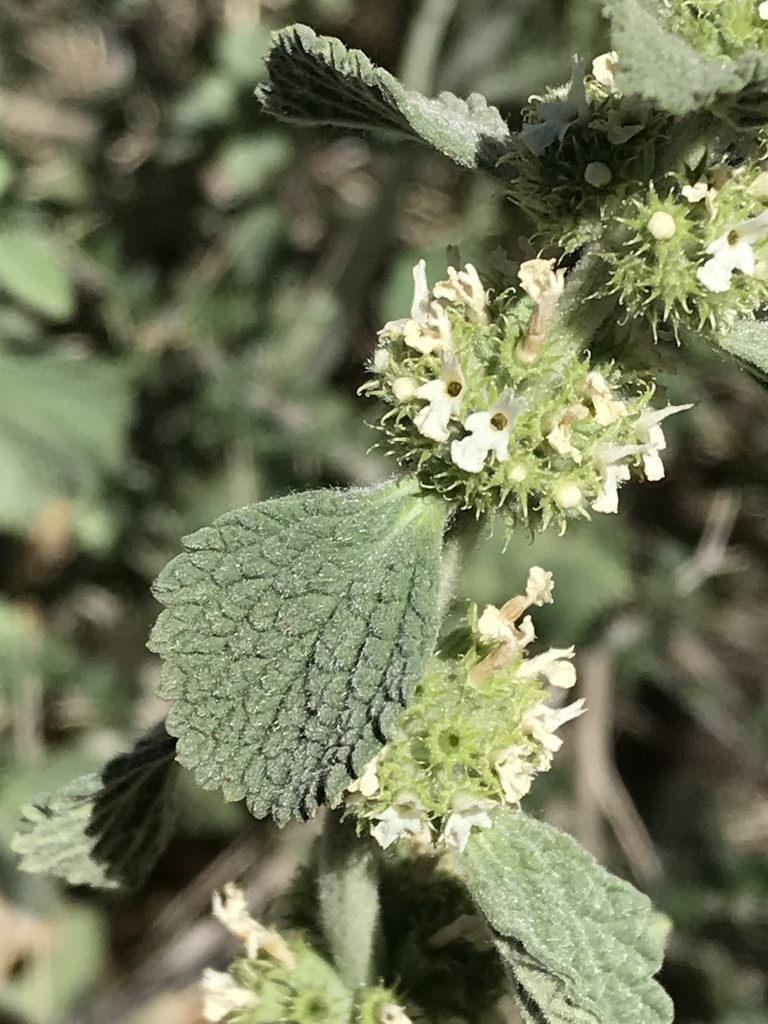
White Horehound
Marrubium vulgare
Marrubium vulgare (white horehound or common horehound) is a flowering plant in the mint family (Lamiaceae), native to Europe, northern Africa, and southwestern and central Asia. Specifically, it emerged in the region between the Mediterranean Sea and Central Asia and now inhabits all continents save Antarctica. It is also widely naturalized in many places, including most of North and South America.
It is a grey-leaved herbaceous perennial plant, and grows to 25–45 centimetres (10–18 in) tall. The leaves are 2–5 cm (0.8–2.0 in) long with a densely crinkled surface, and are covered in downy hairs. The flowers are white, borne in clusters on the upper part of the main stem.
From the article Marrubium vulgare on Wikipedia (CC BY-SA), quoted section by section
At the table
Horehound candy drops are bittersweet hard candies like cough drops made with sugar and an extract of M. vulgare. They are dark-colored, dissolve in the mouth, and have a flavor that has been compared to menthol and root beer. Like other products derived from M. vulgare, they are sometimes used as an unproven folk treatment for coughs and other ailments. M. vulgare is used to make beverages such as horehound beer (similar to root beer), horehound herbal tea (similar to the Maghrebi mint tea), and the rock and rye cocktail.
Wikipedia: “Culinary”
In medicine
White horehound has been mentioned in conjunction with use as a folk medicine dating at least back to the 1st century BC, where it appeared as a remedy for respiratory ailments in the treatise De Medicina by Roman encyclopaedist Aulus Cornelius Celsus. The Roman agricultural writer Columella lists it as a remedy for expelling worms in farm animals in his important first-century work On Agriculture. Since then, white horehound has appeared for similar purposes in numerous herbals over the centuries, such as The Herball, or, Generall historie of plantes by John Gerard, and Every Man His Own Doctor: or, The Poor Planter's Physician. M. vulgare has been described in monographs of the German Commission E as a treatment for colds, as a digestive, and as a choleretic. It is one of the ingredients of the Ricola throat lozenge. The U.S. Food and Drug Administration does not endorse the plant for use as a drug, but includes it as a safe food additive.
Wikipedia: “Folk medicine”
In human culture
The Oxford English Dictionary derives the word horehound from Old English hoar (furry, as in "hoarfrost") and hune (a word of unknown origin designating a class of herbs or plants). The second element was altered by folk etymology. The word "white" is generally used in botanical contexts, to distinguish it from black horehound (Ballota nigra), a similar-looking herb.
Wikipedia: “Etymology”
Where it lives
Recorded sightings
—
geo-referenced records in GBIF, from museums, herbaria and field observers.
Drag the globe to turn it. Dots are where records exist, not a range map; darker means more records.
In the old herbals & bestiaries

Living Images of Plants
Otto Brunfels · 1532 · p.166

Notable Commentaries on the History of Plants
Leonhart Fuchs · 1542 · p.624

Notable Commentaries on the History of Plants
Leonhart Fuchs · 1549 · p.622

On the Names of Plants
Hieronymus Bock (Tragus) · 1552 · p.80

A New Herbal, or History of Plants
Rembert Dodoens (trans. Henry Lyte) · 1578 · p.281

History of Rare Plants
Carolus Clusius · 1601 · p.410

Rariorum Plantarum Historia (with Fungorum Historia)
Carolus Clusius · 1601 · p.416

Hortus Eystettensis
Basilius Besler · 1640 · p.249
In the stacks
Searching the stacks…
Every page naming Marrubium vulgare in the Biodiversity Heritage Library →
This page is assembled live from iNaturalist, GBIF, Wikipedia, the Source Library and the Internet Archive. It is not yet part of the hand-edited codex. iNaturalist taxon 54605.