- Plants
- ›Vascular Plants
- ›flowering plants
- ›Dicots
- ›Mallows, Rock Roses, and Allies
- ›Mallow and Hibiscus Family
- ›Malvoideae
- ›Malveae
- ›Alcea
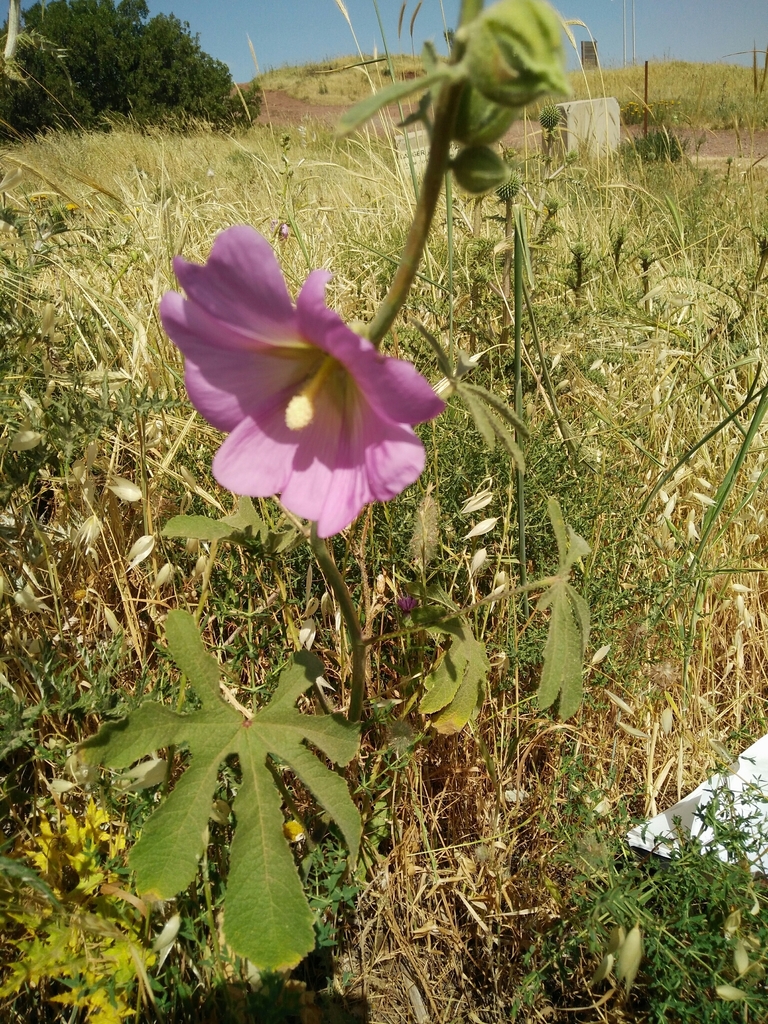
Fingered Hollyhock
Alcea digitata
Alcea digitata, the fingered hollyhock, is a tall hollyhock with large flowers native to the Middle East.
From the article Alcea digitata on Wikipedia (CC BY-SA), quoted section by section
Description
A medium to tall (up to 3 m), hairy hollyhock with large, pinkish, or pale flowers (petals to 50 mm). The leaves (particularly upper ones) are distinctively divided into spreading finger-like lobes whose edges are irregular and at times sublobed, the lobes at the base of the leaf tending to point rather backward. Whilst the leaf-end lobe is larger than the others but not hugely so. The low leaves can be well-divided into fingers or just shallowly lobed. The stem is narrow (to 12 mm) and branched only at the base.The hairs are star-like (sparse or dense). When tall, its height mostly comprises a long flower stalk with little leafage. It is found at roadsides, fields, rocky slopes, steppe, and maquis. The epicalyx is large (>=50% calyx). The fruit segments with wingless edges, conspicuously wrinkled, pilose hairy (the sides sparsely).
Range & habitat
The plant's range includes Iran, Lebanon, Palestine, Syria, and Turkey. In Turkey, it has been found growing at an elevation range of 20–2400 metres.
Wikipedia: “Distribution”
Where it lives
Recorded sightings
—
geo-referenced records in GBIF, from museums, herbaria and field observers.
Drag the globe to turn it. Dots are where records exist, not a range map; darker means more records.
In the stacks
Searching the stacks…
Every page naming Alcea digitata in the Biodiversity Heritage Library →
This page is assembled live from iNaturalist, GBIF, Wikipedia, the Source Library and the Internet Archive. It is not yet part of the hand-edited codex. iNaturalist taxon 546087.