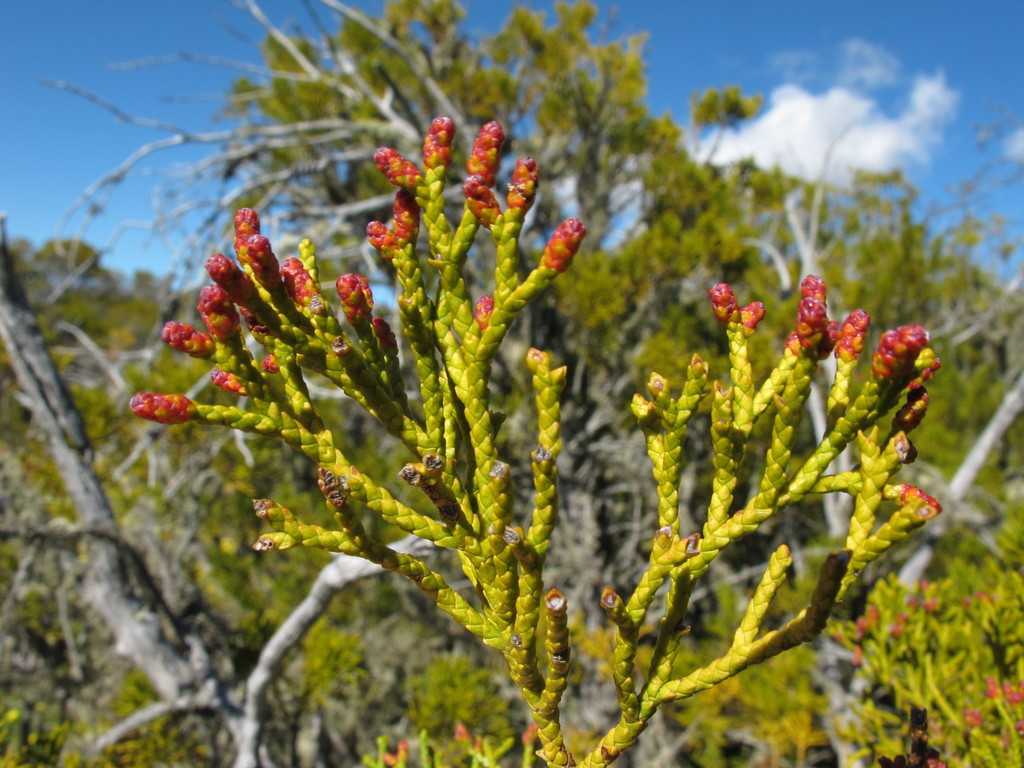
bog pine
Halocarpus bidwillii
Halocarpus bidwillii, commonly known as the mountain pine or bog pine, is a species of dioecious conifer in the family Podocarpaceae. It is endemic to New Zealand and can be found throughout the North and South Islands.
It is a shrub favouring both bogs and dry stony ground, seldom growing to more than 3.5 m (11 ft) high. The leaves are scale-like on adult plants, 1–2 mm (0.039–0.079 in) long, arranged spirally on the shoots; young seedlings and occasional shoots on older plants have soft strap-like leaves 5–10 mm (0.20–0.39 in) and 1–1.5 mm (0.039–0.059 in) broad. The seed cones are highly modified, berry-like, with a white aril surrounding the single 2–3 mm (0.079–0.118 in) long seed.
From the article Halocarpus bidwillii on Wikipedia (CC BY-SA), quoted section by section
Description
H. bidwillii grows as a shrub. It grows up to 4.8 m (15.7 ft) tall and has a short trunk that Kirk noted "rarely exceeds" 1 foot in diameter, and more commonly has a thickness between 30–40 cm (12–16 in) at breast height. Its bark is red to brown and trunks have multiple branches, though will occasionally have just one. In some rare cases, as the horizontal branches grow, their roots will form a "bush" around the parent shrub. This creates a vast mini-forest that looks like a huge low tree or shrub. The parent tree may die, leaving its outliers intact which are thin and red. Depending on the maturity of a mountain pine, the shrubs take on rather drastic differences in leaf appearance. In the juvenile state, leaves are linear, flat, and spreading, much like a pine tree, while in the mature state, its leathery leaves, 1–2 mm long, take on an overlapping scaled appearance, much like the scales of a fish. The leaves are green when fresh, but can become brown to red when they are dried out. During the flowering months of October to December, small male cones, 3–5 mm in length, are brown to red at the end of the pine's scale-like leaves. Stomata can be seen by the naked eye and seen as white spots. Pollen particles are solitary, terminal, ca. 3–5 mm long. Appendage is adnate to base of carpel, cortex, inverted, with a drooping ovule. …
Range & habitat
Halocarpus bidwillii is endemic to New Zealand and grow from Coromandel to the extreme south; as the latitude increases, they are found at lower altitudes. In the North Island, it can be found in Taupō county near Rotoaira and in the central volcanic plateau and Kaingaroa plains. In the South Island, as the name implies, mountain pine are common in mountainous regions in Nelson, Canterbury, and Otago, with some plants found as high as 4,500 ft (1,400 m) above sea level in the Canterbury alps. Mountain pine can also be found on Stewart Island directly at sea level. The mountain pine has a wide range of habitats, but mostly prefers montane to subalpine habitats from 39º latitude southward. Within its range, the annual average temperature is 8.5°C, the coldest month average minimum temperature is −0.8°C, and the annual average precipitation is 2,458 mm (2.458 m). In the North Island, mountain pine are found exclusively in montane to alpine habitats and usually between 600 and 1500 m elevation. However, mountain pine can also thrive in lowland conditions, and its presence on Stewart Island at sea level is an example of this. Mountain pine are also hardy plants growing in a wide range of ground conditions. …
Wikipedia: “Distribution and habitat”
What it does
Thriving without true fruits, the mountain pine has few predators which are mostly herbivorous insects. Briefly, the 4 main categories of insects that prey on mountain pine are: beetles, sucking bugs, caterpillars, and mites. Weevils, a specific type of beetle, feed on all Podocarpaceae (mountain pine's taxonomic family), and larvae thrive in any kind of decaying wood, including mountain pine. More specific, scale insects, Eriococcus dacrydii, live on the stems and leaf scales of the Halocarpus species, and even more specific, (Dugdale, 1996) found a species of conifer associated moth that uses the mountain pine as its host plant, appropriately named Chrysorthenches halocarpi. The caterpillars of Chrysorthenches halocarpi feed on the mountain pine shoots and when too many are present, the mountain pine appears bronze and growth can be stunted. Finally, Tuckerella flabellifera, red mites with white scales from Tasmania, live on young mountain pine plants and presumably feed on the young leaves and wood.
Wikipedia: “Ecology”
At the table
When Kirk first described the mountain pine, he declared it to be of "little economic value" except perhaps for firewood. Perhaps he was unaware at the time, but Kirk should've specified that mountain pine could only be used for firewood without its bark. Mountain pine is one of the few New Zealand conifers that is able to resist fire, mostly because of its thick bark, but also because of its ability to recover through basal resprouting after a fire event. Other uses of the raw wood include timber production for use in buildings and railway sleepers. Another potential use for mountain pine could be for decoration. Kirk commented on the "attractive character" of mountain pine, citing its symmetrical growth, and suggested that it could become an ornamental plant. Aside from decoration and perhaps firewood, no other uses of mountain pine or its products have been described to date.
Insecticidal activity. One trait of the mountain pine that is recently receiving academic attention, but has not yet been realized by the commercial sector is the use of mountain pine plant extract as an insecticide. Extracts of mountain pine foliage have shown the presence of organic compounds like diterpenes, phyllocladane and isophyllocladene and extracts of mountain pine leaves were shown to have been toxic to the codling moth, and partially toxic to the housefly. …
Wikipedia: “Uses”
In human culture
The specific epithet bidwillii is in honor of John Carne Bidwill (1815–1853) who was an Australian botanist born in England and became the first director of the Royal Botanic Gardens, Sydney.
Wikipedia: “Etymology”
Where it lives
Recorded sightings
—
geo-referenced records in GBIF, from museums, herbaria and field observers.
Drag the globe to turn it. Dots are where records exist, not a range map; darker means more records.
In the stacks
Searching the stacks…
Every page naming Halocarpus bidwillii in the Biodiversity Heritage Library →
This page is assembled live from iNaturalist, GBIF, Wikipedia, the Source Library and the Internet Archive. It is not yet part of the hand-edited codex. iNaturalist taxon 54695.