- Plants
- ›Vascular Plants
- ›flowering plants
- ›Dicots
- ›honeysuckles, moschatels, and allies
- ›elder family
- ›Viburnum
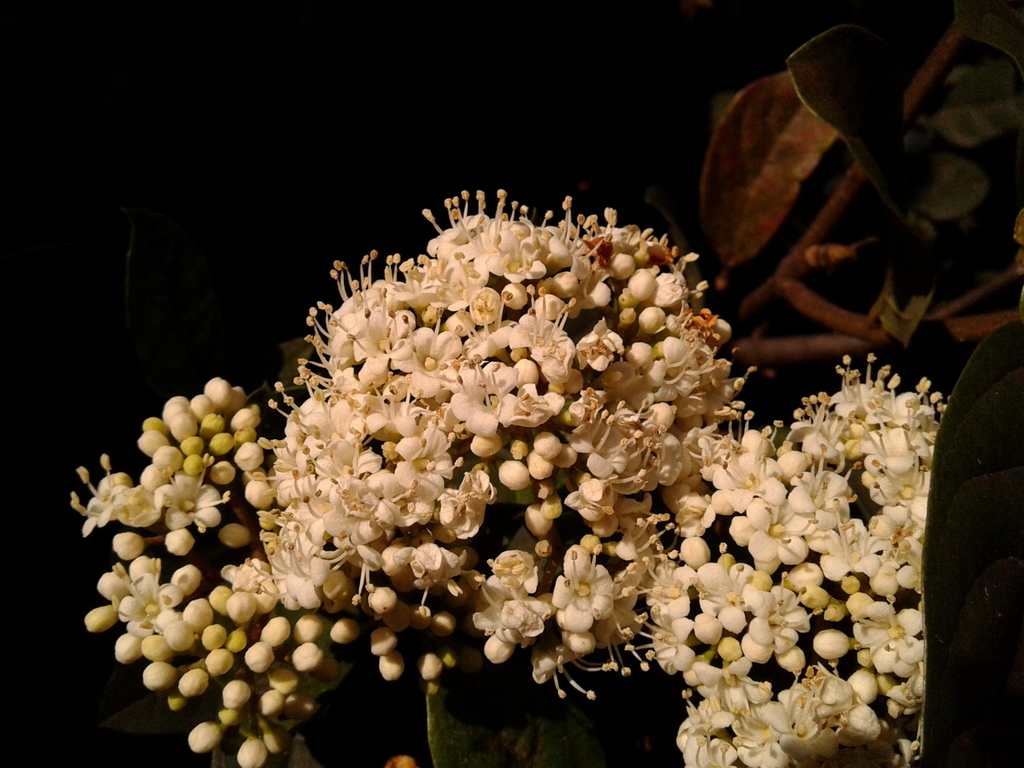
Viburnum triphyllum
Viburnum triphyllum is a plant of the family Viburnaceae, native to South America. Commonly known in Spanish as chuchua or chuque.
From the article Viburnum triphyllum on Wikipedia (CC BY-SA), quoted section by section
Description
It is a tree that can reach up to 15 meters high, has a crooked trunk that is a characteristic of the vegetation of the high Andean forests. Its leaves are lemon green and pale green on the underside and its texture is similar to that of cardboard paper. Its flowers are white, grouped in an umbrella-shaped inflorescence (umbel), which exhales a pleasant smell. The fruits are fleshy, their color is red wine when ripe.
Range & habitat
It is distributed in the Andean forest areas at a height of between 2400 and 3400 meters above sea level; in Bolivia, Colombia, Ecuador and Peru.
Wikipedia: “Distribution”
What it does
This species is of great importance in ecological restoration due to its high rate of foliar exchange, its association with fungi (mycorrhizae) and nitrogen fixing bacteria. In addition, they usually support nutrient-poor, shallow and eroded soils.
Wikipedia: “Ecology”
At the table
Its wood is used in construction and as fuel for wood furnaces, the tree has tannins in its bark, used in tanneries; from its fruits a violet dye is obtained that can be used in handicraft work. Ornamental is planted in parks and road separators. Ecologically provides good food for birds and insects, especially bee). It is useful in watershed protection, and is an inductor of restoration processes. It is also used as a live fence and windbreaker.
Wikipedia: “Uses”
Where it lives
Recorded sightings
—
geo-referenced records in GBIF, from museums, herbaria and field observers.
Drag the globe to turn it. Dots are where records exist, not a range map; darker means more records.
In the stacks
Searching the stacks…
Every page naming Viburnum triphyllum in the Biodiversity Heritage Library →
This page is assembled live from iNaturalist, GBIF, Wikipedia, the Source Library and the Internet Archive. It is not yet part of the hand-edited codex. iNaturalist taxon 547408.