- Fungi Including Lichens
- ›Ascomycete Fungi
- ›Sac Fungi and Lichens
- ›Common Lichens
- ›Shield Lichens, Sunburst Lichens, Rosette Lichens, and Allies
- ›shield lichens, rim lichens, and allies
- ›bushy lichens, sea-fog lichens, and allies
- ›Ramalina
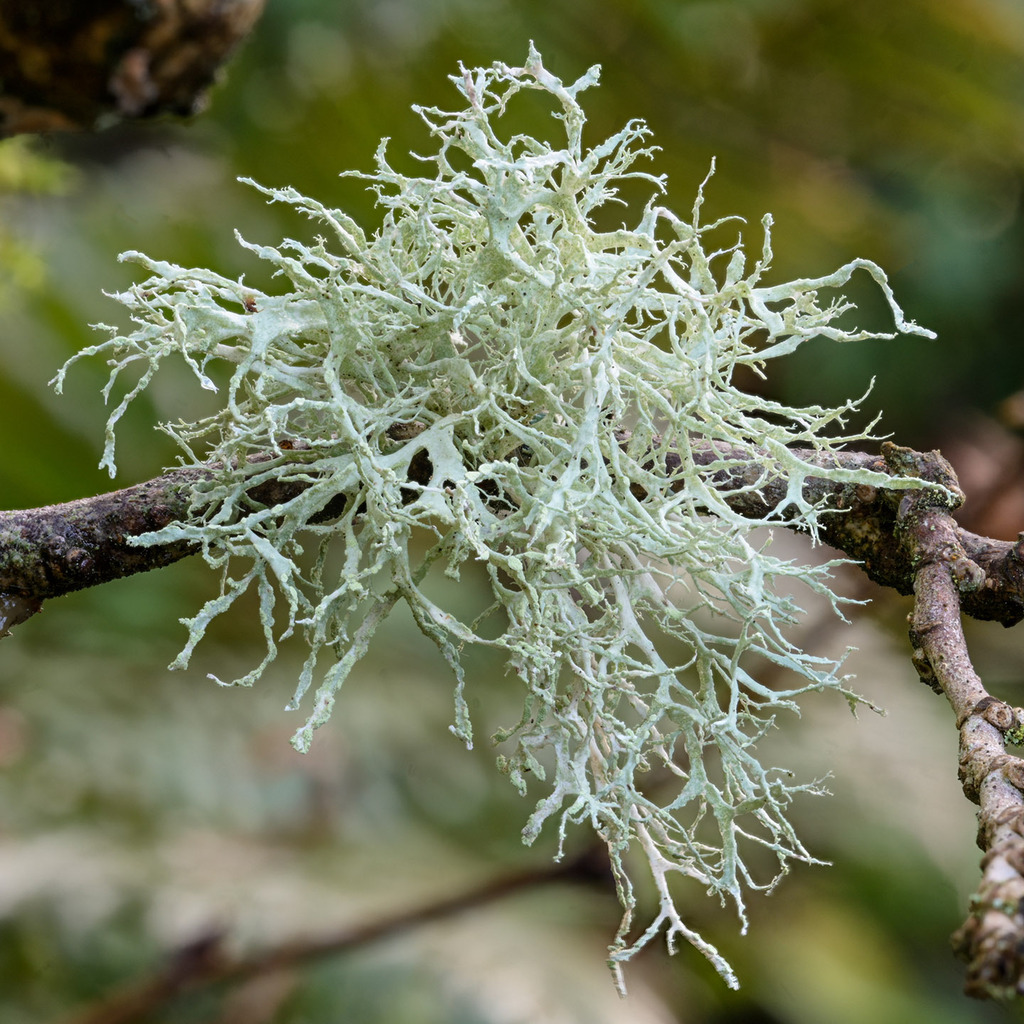
Farinose Cartilage Lichen
Ramalina farinacea
Ramalina farinacea is a species of fruticose lichen in the family Ramalinaceae. It appears as small, shrub-like tufts typically 3–6 cm (1.2–2.4 in) long that hang from tree branches and trunks, particularly in woodland areas and on isolated trees. Distinguished by its flattened, yellow-green to grey-green branches with powdery white spots along the edges, this lichen is widespread throughout temperate regions, especially in coastal areas with oceanic climates. First scientifically described by Carl Linnaeus in 1753 and later reclassified by Erik Acharius in 1810, it is remarkably tolerant of air pollution compared to other lichens, which enables it to thrive in environments where similar species cannot survive. While primarily reproducing through the dispersal of powdery particles called soredia, it occasionally produces disc-shaped fruiting bodies (apothecia) along its branches.
From the article Ramalina farinacea on Wikipedia (CC BY-SA), quoted section by section
Description
Ramalina farinacea typically grows 3–6 cm long, though it can reach up to 10 cm in some specimens. It forms tufted, hanging structures that originate from a clearly defined holdfast (attachment point). The lichen often divides into numerous flattened branches measuring up to 3 mm in width, which may occasionally appear slightly concave. Its colour ranges from yellow-green to dark grey-green.
The surface of Ramalina farinacea is matt and smooth, with a firm texture. Internally, it possesses a solid medulla (inner tissue layer) and a cartilaginous subcortex (supportive layer beneath the outer surface). A distinctive feature of this lichen is its numerous soralia—specialised structures for asexual reproduction—which are located along the margins of the branches. These soralia are discrete, circular to elliptical, saucer-shaped when young, and become flat with maturity. They produce fine, powdery soredia (reproductive propagules) measuring 20–30 μm in diameter that are pale yellow-green in colour. Sexual reproductive structures called apothecia are rarely observed and, when present, develop laterally on the branches. The ascospores (spores produced in sacs called asci) are broadly ellipsoidal and measure 8–15 by 5–7 μm. Chemically, Ramalina farinacea has four distinct chemotypes (chemical variants), all containing usnic acid in the medulla and soralia. …
Range & habitat
Ramalina farinacea occupies a diverse range of habitats and substrates. It commonly grows on trunks and twigs within shaded deciduous woodlands, but also thrives on sun-exposed, wind-swept isolated trees, hedgerows, and scrub. The species can colonise wooden posts and is occasionally found free-living on sand dunes, though it very rarely occurs on rock surfaces. In North America, it is most abundant along coastal regions from approximately 30–60°N latitude, with several races extending inland. The species shows a strong preference for oceanic climates along both the Atlantic and Pacific coasts. In the United Kingdom, it is found throughout Britain, Ireland, and Wales. In Europe, R. farinacea ranges from the boreal north through the mountains of central and southern Europe into xeric Mediterranean areas, occurring on a variety of shrubs and trees and often in oak forests. The morphology of Ramalina farinacea shows distinct variation in response to environmental conditions. In air-polluted environments, specimens often develop as dark green, tufted forms with short, decumbent (lying flat), contorted or recurved branches. By contrast, in deeply shaded woodland settings, the lichen typically grows more elongated and pale in colour, with sparse, narrow branching patterns. …
Wikipedia: “Habitat and distribution”
Where it lives
Recorded sightings
—
geo-referenced records in GBIF, from museums, herbaria and field observers.
Drag the globe to turn it. Dots are where records exist, not a range map; darker means more records.
In the stacks
Searching the stacks…
Every page naming Ramalina farinacea in the Biodiversity Heritage Library →
This page is assembled live from iNaturalist, GBIF, Wikipedia, the Source Library and the Internet Archive. It is not yet part of the hand-edited codex. iNaturalist taxon 54758.