Bay laurel
Laurus nobilis
Laurus nobilis is an aromatic evergreen tree or large shrub with green, glabrous (smooth) leaves. Common names include bay tree (especially in the United Kingdom), bay laurel, sweet bay, true laurel, Grecian laurel, or simply laurel.
It is in the flowering plant family Lauraceae. The stem can be 1 metre in diameter and the tree can be as high as 20 metres. Native to the Mediterranean region, Laurus nobilis figures prominently in classical Greco-Roman culture and served various medicinal, religious, and symbolic purposes. Bay leaves are widely used as seasoning in cooking.
From the article Laurus nobilis on Wikipedia (CC BY-SA), quoted section by section
Description
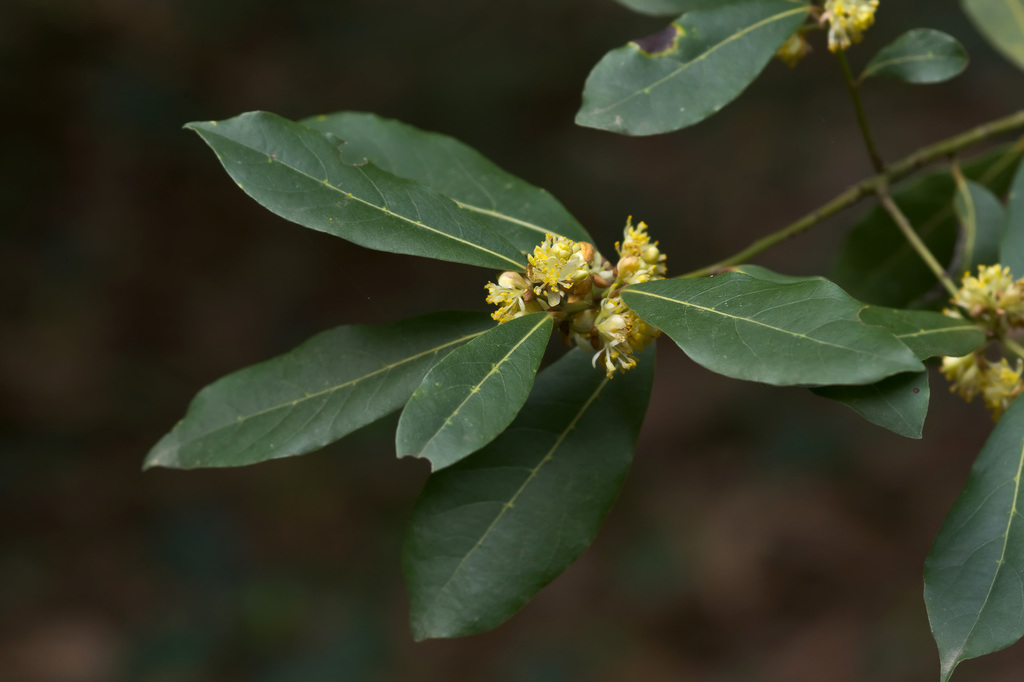
The laurel is an evergreen shrub or small tree, variable in size and sometimes reaching 7–18 m (23–59 ft) tall. The genus Laurus includes three accepted species, whose diagnostic key characters often overlap. The bay laurel is dioecious (unisexual), with male and female flowers on separate plants. Each flower is pale yellow-green, about 1 cm (3⁄8 in) diameter, and they are borne in pairs beside a leaf. The leaves are glabrous, 6–12 cm (2–5 in) long and 2–4 cm (3⁄4–1+5⁄8 in) broad, with an entire (untoothed) margin. On some leaves the margin undulates. The fruit is a small, shiny black drupe-like berry about 1 cm (3⁄8 in) long that contains one seed.
What it does
Laurus nobilis is a widespread relict of the laurel forests that originally covered much of the Mediterranean Basin when the climate of the region was more humid. With the drying of the Mediterranean during the Pliocene era, the laurel forests gradually retreated, and were replaced by the more drought-tolerant sclerophyll plant communities familiar today. Most of the last remaining laurel forests around the Mediterranean are believed to have disappeared approximately ten thousand years ago, although some remnants still persist in the mountains of southern Turkey, northern Syria, southern Spain, north-central Portugal, northern Morocco, the Canary Islands and in Madeira.
Wikipedia: “Ecology”
At the table
The plant is the source of several popular herbs and one spice used in a wide variety of recipes, particularly among Mediterranean cuisines. They are typically removed from dishes before serving, although they may also be used as a simple garnish. Whole bay leaves have a long shelf life of about one year, under normal temperature and humidity. Whole bay leaves are used almost exclusively as flavor agents during the food preparation stage. Ground bay leaves, however, can be ingested safely and are often used in soups and stocks, as well as being a common addition to a Bloody Mary. Dried laurel berries and pressed leaf oil can both be used as robust spices, and the wood can be burnt for strong smoke flavoring.
Wikipedia: “Food”
In medicine
In herbal medicine, aqueous extracts of bay laurel have been used as an astringent and salve for open wounds. It is also used in massage therapy and aromatherapy. A folk remedy for rashes caused by poison ivy, poison oak, and stinging nettle is a poultice soaked in boiled bay leaves. The Roman naturalist Pliny the Elder listed a variety of conditions which laurel oil was supposed to treat: paralysis, spasms, sciatica, bruises, headaches, catarrhs, ear infections, and rheumatism.
Wikipedia: “Alternative medicine”
In human culture
Early evidence of the use of the plant has been found at Ashkelon in modern Israel, dating to 7th century BC Judea/Assyria.
Wikipedia: “History”
Where it lives
Recorded sightings
—
geo-referenced records in GBIF, from museums, herbaria and field observers.
Drag the globe to turn it. Dots are where records exist, not a range map; darker means more records.
In the old herbals & bestiaries


In the stacks
Searching the stacks…
Every page naming Laurus nobilis in the Biodiversity Heritage Library →
This page is assembled live from iNaturalist, GBIF, Wikipedia, the Source Library and the Internet Archive. It is not yet part of the hand-edited codex. iNaturalist taxon 54759.