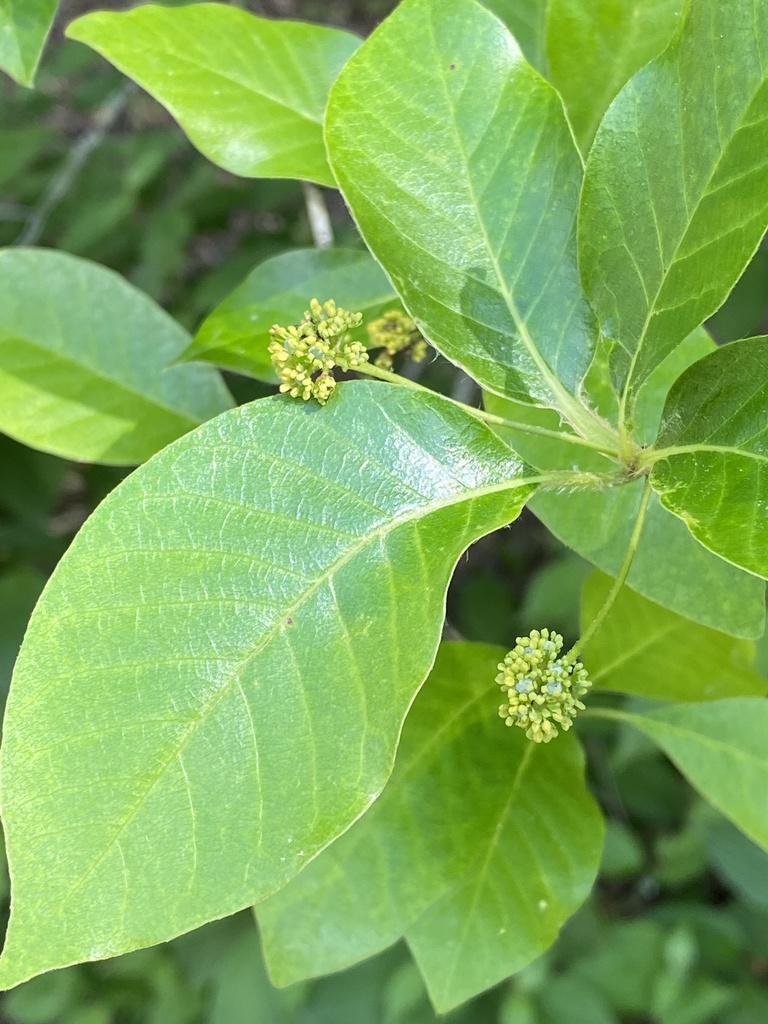
Black Tupelo
Nyssa sylvatica
Nyssa sylvatica, commonly known as tupelo, black tupelo, black gum or sour gum, is a medium-sized deciduous tree native to eastern North America from the coastal Northeastern United States and southern Ontario south to central Florida and eastern Texas, as well as Mexico.
From the article Nyssa sylvatica on Wikipedia (CC BY-SA), quoted section by section
Description
Nyssa sylvatica grows to 20–25 meters (66–82 ft) tall, rarely to 35 meters (115 ft), with a trunk diameter of 50–100 centimeters (20–39 in), rarely up to 170 cm (67 in). These trees typically have a straight trunk with the branches extending outward at right angles. The bark is dark gray and flaky when young, but it becomes furrowed with age, resembling alligator hide on very old stems. The twigs of this tree are reddish-brown, usually hidden by a greyish skin. The pith is chambered with greenish partitions. The leaves vary in size and shape. They can be oval, elliptical, or obovate, and 5–12 cm (2–4.5 in) long. They have lustrous upper surfaces, with entire, often wavy margins. The foliage turns purple in autumn, eventually becoming an intense bright scarlet. Deer are extremely fond of the leaves on seedlings and saplings, to the point where large populations of them can make establishment of the tree almost impossible. For comparison, mature trees are largely left alone. The flowers are very small, in greenish-white in clusters at the top of a long stalk and a rich source of nectar for bees. They are often dioecious so a male and female tree in proximity is required to set seed, however, many trees are also polygamo-dioecious, which means they have both male and female flowers on the same tree. …
Range & habitat
Nyssa sylvatica grows in various uplands and in alluvial stream bottoms from southwestern Maine and New York, to extreme southern Ontario, central Michigan, Illinois, and central Missouri, south to southern Florida, eastern Texas, and eastern Oklahoma. Optimum development is made on lower slopes and terraces in the Southeastern United States. It also occurs locally in the mountains of eastern and southern Mexico, where it is found in the southern Sierra Madre Oriental and Sierra Madre de Oaxaca of Hidalgo, Puebla, and Veracruz states and the Chiapas Highlands of Chiapas. Nyssa sylvatica is found in a wide range of climates, including upland and wetland habitats, in its extensive range. It commonly grows in both the creek bottoms of the southern coastal plains, to altitudes of about 900 m (3,000 ft) in the Southern Appalachians. These trees grow best on well-drained, light-textured soils on the low ridges of second bottoms and on the high flats of silty alluvium. In the uplands it grows best on the loams and clay loams of lower slopes and coves. The species occurs in 35 different forest cover types. When found on drier upper slopes and ridges, it is seldom of log size or quality. In Mexico it is a common species in montane cloud forests, particularly in moist or riparian habitats, between 1,000 and 2,200 m (3,300 and 7,200 ft) in elevation.
Wikipedia: “Distribution and habitat”
What it does
The flowers are an important source of nectar and its fruits are important to many birds and mammals. Hollow trunks provide nesting or denning opportunities for bees and various mammals. It is among the longest living non-clonal flowering plants in eastern North America, capable of obtaining ages of over 650 years.
Wildlife. Nyssa sylvatica is an important food source for many migrating birds in the fall [autumn]. Its early color change (foliar fruit flagging) is thought to attract birds to the available fruit, which ripen before many other fall fruits and berries. The fruit is quite marked, dark blue, in clusters of two or three. The sour fruits are eagerly sought by many kinds of birds, including: American robin, Swainson's thrush, gray-cheeked thrush, hermit thrush, wood thrush, northern cardinal, northern mockingbird, blue jay, red-bellied woodpecker, yellow-bellied sapsucker, northern flicker, pileated woodpecker, eastern phoebe, brown thrasher, eastern bluebird, European starling, scarlet tanager, gray catbird, cedar waxwing, and American crow, all primarily eastern North American birds migrating or residing year-round within the tree's range. The limbs of these trees often deteriorate early, and the decayed holes make excellent dens for squirrels, raccoons, Virginia opossums, as well as nesting sites for feral honeybees. The leaves are mined by larvae of the tupelo leaf …
Wikipedia: “Ecology”
How it is grown
Nyssa sylvatica is cultivated as an ornamental tree in parks and large gardens, where it is often used as a specimen or shade tree. The tree is best when grown in sheltered but not crowded positions, developing a pyramidal shape in youth, and spreading with age. The stem rises to the summit of the tree in one tapering unbroken shaft, the branches come out at right angles to the trunk and either extend horizontally or droop a little, making a long-narrow, cone-like head. The leaves are short-petioled and so have little individual motion, but the branches sway as a whole. The spray is fine and abundant and lies horizontally so that the foliage arrangement is not unlike that of the beech (Fagus). Its often spectacular autumnal coloring, with intense reds to purples, is highly valued in landscape settings. It is claimed to be the most fiery and brilliant of the 'brilliant group' that includes maple, dogwood, sassafras, and sweet gum, as well as various species of tupelo. In the UK the cultivar 'Wisley Bonfire' has gained the Royal Horticultural Society's Award of Garden Merit.
Wikipedia: “Cultivation”
Where it lives
Recorded sightings
—
geo-referenced records in GBIF, from museums, herbaria and field observers.
Drag the globe to turn it. Dots are where records exist, not a range map; darker means more records.
In the stacks
Searching the stacks…
Every page naming Nyssa sylvatica in the Biodiversity Heritage Library →
This page is assembled live from iNaturalist, GBIF, Wikipedia, the Source Library and the Internet Archive. It is not yet part of the hand-edited codex. iNaturalist taxon 54802.