- Plants
- ›Vascular Plants
- ›flowering plants
- ›Dicots
- ›carrots, ivies, and allies
- ›cheesewood family
- ›Pittosporum
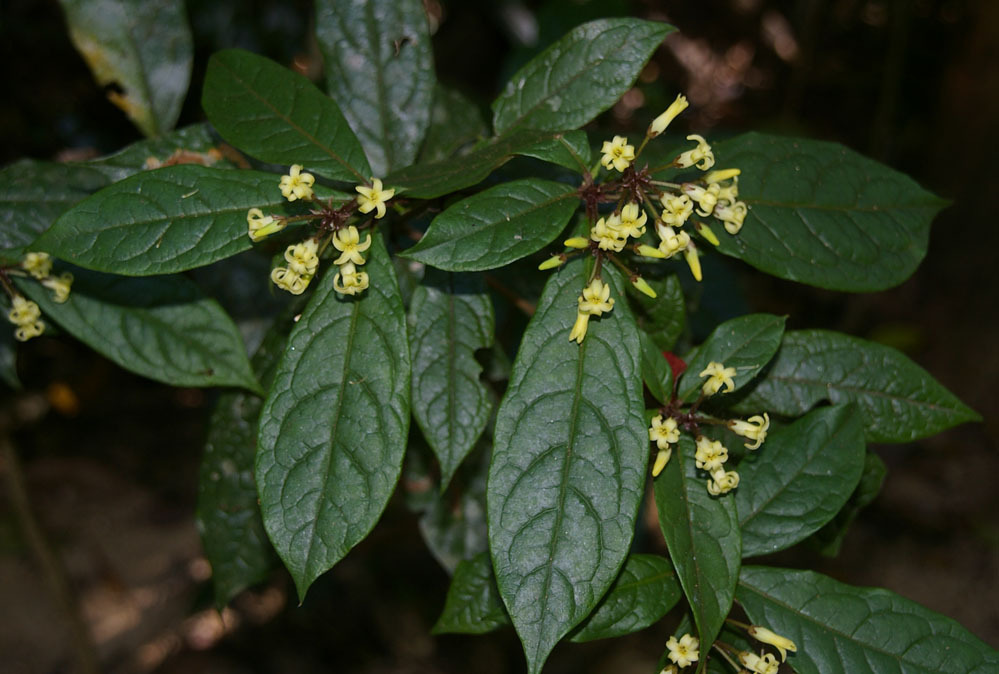
Hairy Red Pittosporum
Pittosporum rubiginosum
Pittosporum rubiginosum, commonly known as hairy red pittosporum, is an evergreen shrub in the family Pittosporaceae which is endemic to northeastern Queensland, Australia. It was first described in 1840.
From the article Pittosporum rubiginosum on Wikipedia (CC BY-SA), quoted section by section
Description
The hairy red pittosporum is a spindly shrub with a variable appearance as it matures. It usually grows up to about 3 m (9.8 ft) in height, however it may (rarely) reach 6 m (20 ft). The leaves are dark green above and usually purple underneath. Both sides of the leaves are glabrescent, meaning that they are initially hairy but become hairless with age. The size and shape of the leaves differ markedly from the juvenile stage to maturity − seedling leaves are densely hairy, those on a juvenile plant measure around 2.5 by 1.3 cm (1.0 by 0.5 in) while those of mature plants are about 24 by 8 cm (9.4 by 3.1 in). All stages have very short petioles and are mucronate, that is, they have a fine sharp point at the tip of the leaf. This species exhibits varying forms at different altitudes - in upland forest it is more likely to have the juvenile appearance, while in the lowlands it will tend to show the mature forms. The inflorescence may consist of a single flower or an umbel with numerous flowers. They are produced either terminally or in the leaf axils and measure up to 9.5 cm (3.7 in) long. The white flowers are held on densely hairy pedicels about 20 mm (0.8 in) long — the sepals are up to 9 mm (0.4 in) long, petals about 16 mm (0.6 in) long. The fruit is an ellipsoid (i.e. like a rugby ball) orange-yellow capsule about 23 mm (0.9 in) long and 15 mm (0.6 in) wide. …
Range & habitat
The natural range of Pittosporum rubiginosum is from Cape York Peninsula to Tully, and from sea level to about 1,500 m (4,900 ft) altitude. It is an understorey shrub in lowland and upland rainforest.
Wikipedia: “Distribution and habitat”
What it does
The fruit of the hairy red Pittosporum are eaten by cassowaries (Casuarius casuarius), giant white-tailed rats (Uromys caudimaculatus), and other native rodents.
Wikipedia: “Ecology”
In human culture
The genus name Pittosporum comes from the Ancient Greek words πίττα (pítta) meaning "resin", and σπορά (sporā́), meaning "seed", and is a reference to the sticky seeds. The species epithet rubiginosum is derived from the Latin robiginosus, meaning "rusty red", which may be a reference to the colour of the seeds, or to the colour of the hairs on new growth.
Wikipedia: “Etymology”
Where it lives
Recorded sightings
—
geo-referenced records in GBIF, from museums, herbaria and field observers.
Drag the globe to turn it. Dots are where records exist, not a range map; darker means more records.
In the stacks
Searching the stacks…
Every page naming Pittosporum rubiginosum in the Biodiversity Heritage Library →
This page is assembled live from iNaturalist, GBIF, Wikipedia, the Source Library and the Internet Archive. It is not yet part of the hand-edited codex. iNaturalist taxon 548194.