- Plants
- ›Vascular Plants
- ›flowering plants
- ›Dicots
- ›Roses, Elms, Figs, and Allies
- ›rose family
- ›Amygdaloideae
- ›Maleae
- ›Malus
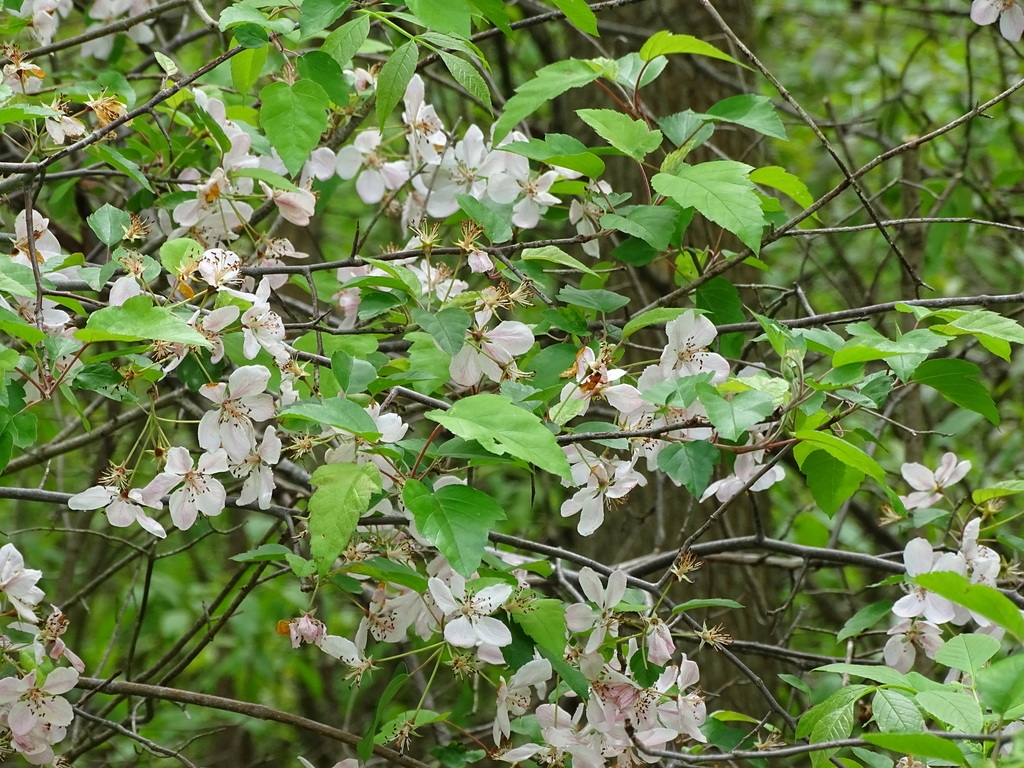
sweet crabapple
Malus coronaria
Malus coronaria, also known by the names sweet crabapple or garland crab, is a North American species of Malus (crabapple). It grows primarily in the Great Lakes Region and in the Ohio Valley, with outlying populations as far away as Alabama, eastern Kansas, and Long Island.
From the article Malus coronaria on Wikipedia (CC BY-SA), quoted section by section
Description
Malus coronaria often is a bushy shrub with rigid, contorted branches, but frequently becomes a small tree up to 10 metres (33 feet) tall, with a broad open crown. Its flowering time is about two weeks later than that of the domestic apple, and its fragrant fruit clings to the branches on clustered stems long after the leaves have fallen. The bark is reddish brown, longitudinally fissured, with surface separating in narrow scales. Branchlets at first coated with thick white wool, later they become smooth reddish brown; they develop in their second year long, spur-like branches and sometimes absolute thorns 2.5 centimetres (1 inch) or more in length. The wood is reddish brown, the sapwood yellow; it is heavy, close-grained, not strong. Used for the handles of tools and small domestic articles. It has a specific gravity of 0.7048; and density 703.5 kilograms per cubic metre (43.92 pounds per cubic foot). Its winter buds are bright red, obtuse, minute. Inner scales grow with the growing shoot, become 15 millimetres (1⁄2 in) long and bright red before they fall. Its leaves alternate, and are simple, ovate, 7.5–10 cm (3–4 in) long, 4–5 cm (1+1⁄2–2 in) broad, obtuse, subcordate or acute at base, incisely serrate, often three-lobed on vigorous shoots, acute at apex. Feather-veined, midrib and primary veins grooved above, prominent beneath. …
Range & habitat
The species grows primarily in the Great Lakes Region and in the Ohio Valley, with outlying populations as far away as Alabama, eastern Kansas, and Long Island. It prefers rich moist soil.
Wikipedia: “Distribution and habitat”
At the table
The fruit is made into both preserves and cider. Pehr Kalm, a disciple of 18-century botanist Carl Linnaeus, wrote of the fruit:
The apples, or crabs, are small, sour and unfit for anything but to make vinegar of. They lie under the trees all winter and acquire a yellow color. They seldom begin to rot before spring comes on.
== References ==
Wikipedia: “Uses”
Where it lives
Recorded sightings
—
geo-referenced records in GBIF, from museums, herbaria and field observers.
Drag the globe to turn it. Dots are where records exist, not a range map; darker means more records.
In the stacks
Searching the stacks…
Every page naming Malus coronaria in the Biodiversity Heritage Library →
This page is assembled live from iNaturalist, GBIF, Wikipedia, the Source Library and the Internet Archive. It is not yet part of the hand-edited codex. iNaturalist taxon 54831.