- Plants
- ›Vascular Plants
- ›flowering plants
- ›Dicots
- ›Mallows, Rock Roses, and Allies
- ›Mallow and Hibiscus Family
- ›Grewioideae
- ›Goethalsia
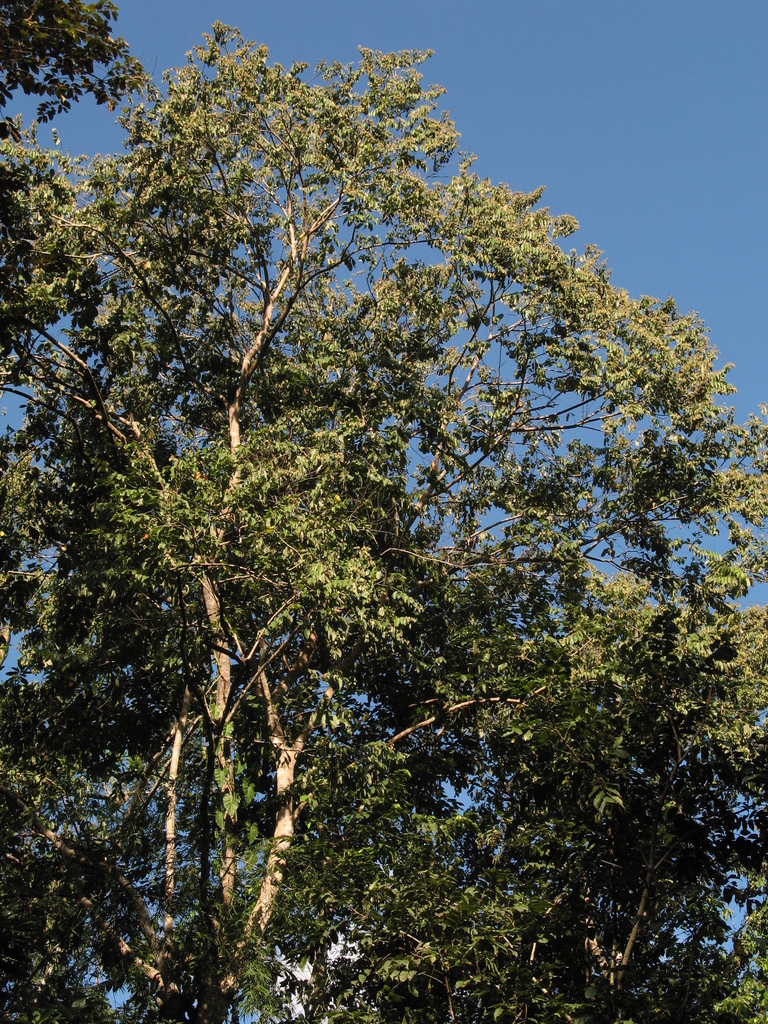
Goethalsia meiantha
Goethalsia is a monotypic genus of flowering plants belonging to the family Malvaceae. It only contains one species, Goethalsia meiantha (Donn.Sm.) Burret. It is within the Grewioideae subfamily.
From the article Goethalsia meiantha on Wikipedia (CC BY-SA), quoted section by section
Description
Goethalsia meiantha is a fast growing, tree reaching to 15–40 m (49–131 ft) in height. It is buttressed at the base, and has thin bark which whitish or pale, and smooth. The trunk can be up to 40 cm (16 in) in diameter and straight. Inside, the trunk is fibrous material, sometimes hanging in strips. The tree branches are coffee-coloured, with numerous whitish lenticules (lens-shaped, porous tissue). Young branches have sparse simple hairs among a dense coat of short fasciculate (in clusters or bunckes) hairs. The leaves are alternate arranged and ranked along the twigs. They are elliptic-oblong to obovate-oblong shaped. Situated on 10–12 mm long petioles, with small, caducous (falling off early), stipules (small appendage at the bases of leaf). The leaf-blades are 7–22 cm (3–9 in) long, and 3–8 cm (1–3 in) wide. The apex of the leaf is narrowly acuminate (tapering gradually to a point), while the base is cuneate (wedge-shaped) to rounded. It has a toothed margin. The upper surface of the leaf, has stellate (star shaped) hairs along the veins. While, the lower surface is off-white in colour, and densely covered with appressed (pressed closely but not fused) stellate hairs. There are 2 to 3 pairs of lateral or major veins, the basal pair of veins, being almost as well developed as the principal vein. …
Range & habitat
It is native range is the neotropics, from Central America to Venezuela. It is also found in the countries of Colombia, Costa Rica, Honduras, Nicaragua and Panama. It is very common to the second-growth forests in Costa Rica, and other forests in humid regions. Goethalsia meiantha of the most common trees in the Golfo Dulce, Costa Rica region and it also grows in La Selva Biological Station. It is also known as a pioneer tree.
Habitat. It is found growing in clay-like soils, in moist to very wet lowland in open sites. It is also found at the edges of forest and in light gaps (within a forest). The tree grows at elevations from 0–900 m (0–2,953 ft) in areas where annual rainfall is about 4000 mm and the average temperature is 26°C.
Wikipedia: “Range and habitat”
At the table
It has low to moderate timber value, The wood is white when green, it is classified as light (with a specific gravity is 0.35) and soft, and it also dries quickly without the appearance of major defects. It is deemed easy to work and preserve, and it can be finished well, but it has a low resistance to biodegrading organisms (i.e. woodworm, etc.). It is often used for making fenceposts, handles for light tools, boxes, cases, broomsticks and roof boards and in interior and external construction. The species ranks second in demand in the match industry (within South America), because it is very abundant and grows fast. It also has a thick fibrous bark which can be torn into long strips and is used in the manufacture of local handicrafts. It has been evaluated for an early species selected for tropical reforestation. The fruit can be collected between February and April and also in October. The fruits can then be collected directly from the tree, when they start to turn dark brown. They are then spread over the ground to dry and then can be planted.
Wikipedia: “Uses”
How it is grown
It can be affected by fungal species, such as Diaporthe. Nymphs of cicada species of Zammara smaragdina burrow into the earth beside the roots of this tree and those of Pentaclethra macroloba.
Wikipedia: “Cultivation”
Where it lives
Recorded sightings
—
geo-referenced records in GBIF, from museums, herbaria and field observers.
Drag the globe to turn it. Dots are where records exist, not a range map; darker means more records.
In the stacks
Searching the stacks…
Every page naming Goethalsia meiantha in the Biodiversity Heritage Library →
This page is assembled live from iNaturalist, GBIF, Wikipedia, the Source Library and the Internet Archive. It is not yet part of the hand-edited codex. iNaturalist taxon 548391.