- Plants
- ›Vascular Plants
- ›flowering plants
- ›Dicots
- ›begonias, gourds, and allies
- ›gourd family
- ›Benincaseae
- ›Cucumis
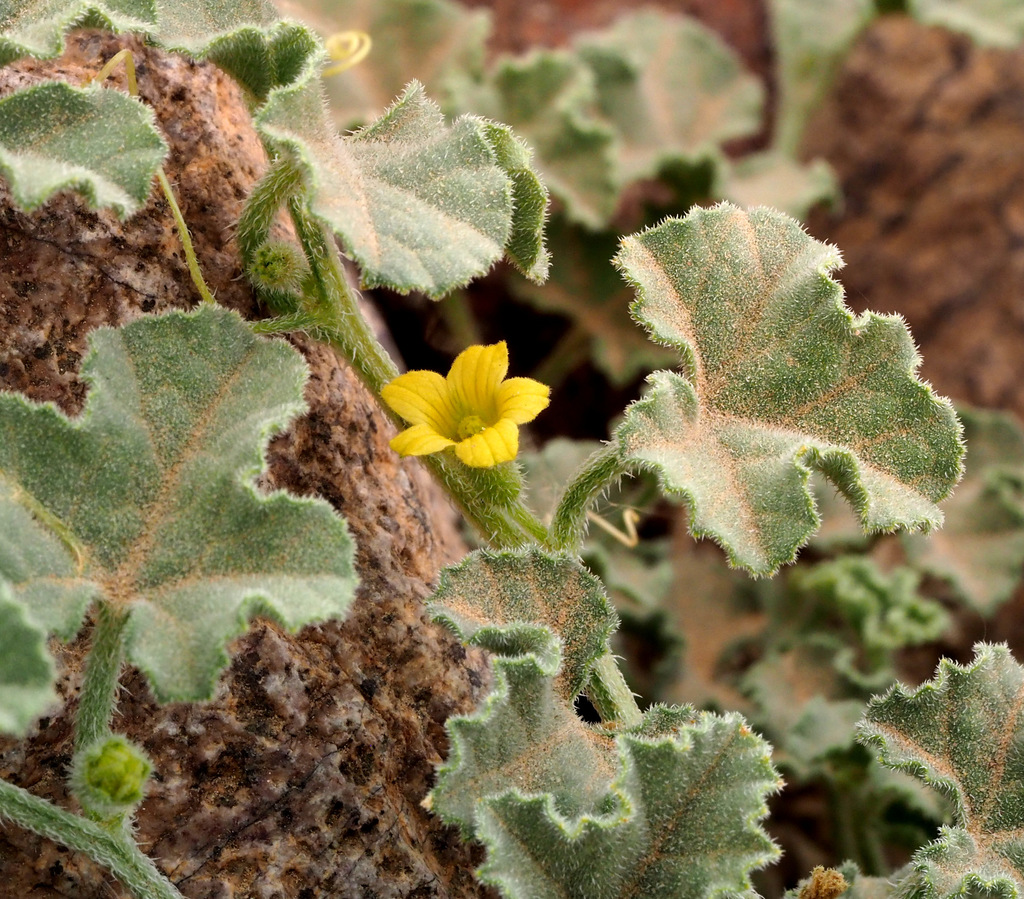
Wild Cucumber
Cucumis prophetarum
Cucumis prophetarum is a dioecious and prostrate or climbing perennial vine in the family Cucurbitaceae. The specific epithet (prophetarum) comes from Latin propheta, meaning "prophet".
From the article Cucumis prophetarum on Wikipedia (CC BY-SA), quoted section by section
Description
Its stems and leaves are hairy and the leaves are ovate to round in shape and cordate at the base and measure 2–4 centimeters in length. The margins are dentate or lobulate. They have 3–5 blunt-toothed, obtuse or subacute lobes, and the petioles measure 6–87 millimeters (0.24–3.43 inches) in length. Male flowers occur in clusters of 2–3 on pedicels measuring 3–25 millimeters (0.12–0.98 inches) in length, and are rarely solitary. Female flowers are always solitary and have peduncles measuring 6–30 millimeters (0.24–1.18 inches) in length. They have five yellow petals measuring 5–8 millimeters in length and 2.5–3.5 millimeters in width. The fruit is slightly ovoid and is vertically striped and yellow in color when ripe. It measures 3–4 centimeters in length and is covered in spike-like pustules.
Range & habitat
Cucumis prophetarum is native to Africa and the Middle East, from Mauritania east to the Horn of Africa and southwest to Angola then southeast to South Africa, as well as Israel south to Yemen and Oman and east to northwestern India. It has been introduced to Qatar. It grows wild in semi-desert bushland and grassland up to 6,594 feet (2,010 meters) in elevation, often with acacia trees.
Wikipedia: “Distribution”
At the table
The fruit has a bitter flavor when raw and is sometimes boiled or pickled and the leaves are cooked and served with a staple. The fruit is eaten across its native range and occasionally cultivated and sold in local markets. The fruit is also used in folk medicine in Saudi Arabia to treat liver disorders.
Wikipedia: “Uses”
Where it lives
Recorded sightings
—
geo-referenced records in GBIF, from museums, herbaria and field observers.
Drag the globe to turn it. Dots are where records exist, not a range map; darker means more records.
In the old herbals & bestiaries

Notable Commentaries on the History of Plants
Leonhart Fuchs · 1549 · p.737

Six Groups of the History of Plants
Rembert Dodoens · 1583 · p.673

The Anatomy of Plants (Vol. 2)
Nehemiah Grew · 1682 · p.528

Notable Commentaries on the History of Plants
Leonhart Fuchs · 1542 · p.739

On Medical Materials in Six Books
Dioscorides · 1550 · p.630

De medicinali materia libri sex
Dioscorides · 1552 · p.638

On the Names of Plants
Hieronymus Bock (Tragus) · 1552 · p.904

Commentaries on the Six Books of Dioscorides
Pietro Andrea Mattioli · 1560 · p.784

Commentaries on the Six Books of Dioscorides on Medical Matter
Pietro Andrea Mattioli · 1563 · p.699

A New Herbal, or History of Plants
Rembert Dodoens (trans. Henry Lyte) · 1578 · p.398

Six Groups of the History of Plants
Rembert Dodoens · 1583 · p.399

Notable Commentaries on the History of Plants
Leonhart Fuchs · 1549 · p.736
In the stacks
Searching the stacks…
Every page naming Cucumis prophetarum in the Biodiversity Heritage Library →
This page is assembled live from iNaturalist, GBIF, Wikipedia, the Source Library and the Internet Archive. It is not yet part of the hand-edited codex. iNaturalist taxon 54917.