- Plants
- ›Vascular Plants
- ›flowering plants
- ›Dicots
- ›begonias, gourds, and allies
- ›gourd family
- ›Benincaseae
- ›Cucumis
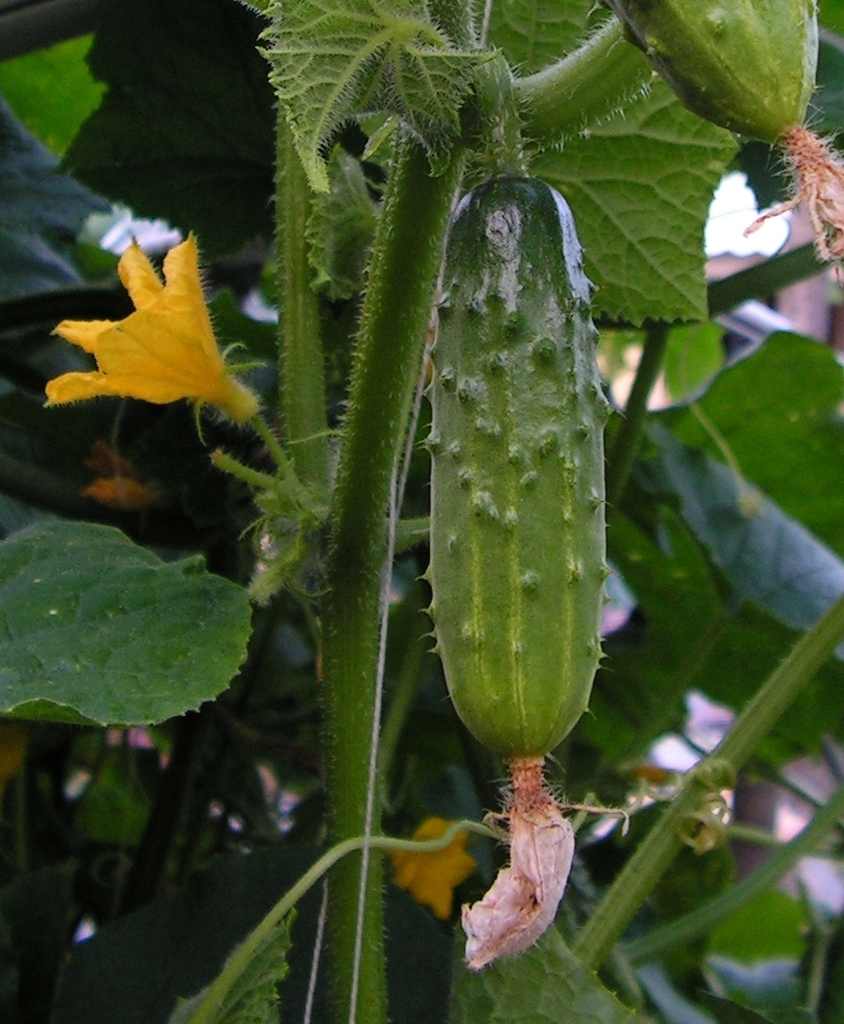
Cucumber
Cucumis sativus
The cucumber (Cucumis sativus) is a widely-cultivated creeping vine plant in the family Cucurbitaceae that bears cylindrical to spherical fruits, used as culinary vegetables. Considered an annual plant, there are three main types: slicing, pickling, and seedless.
The cucumber originates in Asia, in a region extending from India, Nepal, Bangladesh, China (Yunnan, Guizhou, Guangxi), and Northern Thailand, but now grows on most continents, and many different types of cucumber are grown commercially and traded on the global market. In North America, a wild cucumber is a plant in the genera Echinocystis and Marah, though these are not closely related to the cucumber.
From the article Cucumber on Wikipedia (CC BY-SA), quoted section by section
Description
The cucumber is an annual creeping vine that roots in the ground and grows up trellises or other supporting frames, wrapping around supports with thin, spiraling tendrils. The plant can root in a soilless medium, then sprawl along the ground in the absence of a supporting structure. The vine has large leaves that form a canopy over the fruits. The fruit of typical cultivars of cucumber is roughly cylindrical, but elongated with tapered ends, and may be as large as 62 centimeters (24 in) long and 10 centimeters (4 in) in diameter. Cucumber fruits consist of 95% water (see nutrition table). In botanical terms, the cucumber is classified as a pepo, a type of botanical berry with seeds and an outer rind. In a culinary context, it is considered a vegetable.
Cultivars and pollination. Most cucumber cultivars are seeded and require pollination. For this purpose, thousands of honey beehives are carried to cucumber fields each year just before bloom. Cucumbers can be pollinated by bumblebees and several other wild bee species. Most cucumbers that require pollination are self-incompatible, thus requiring the pollen of another plant in order to form seeds and fruit. Some self-compatible cultivars exist that are related to the 'Lemon cucumber' cultivar. Some cultivars are parthenocarpic, creating seedless fruit without pollination; these are often grown in greenhouses. …
At the table
Raw cucumber (with peel) is 95% water, 4% carbohydrates, 1% protein, and contains negligible fat (table). In a reference amount of 100 grams (3+1⁄2 ounces), raw cucumber provides 65 kilojoules (16 kilocalories) of food energy, and has a low content of micronutrients notable only for vitamin K at 14% of the Daily Value (table).
Wikipedia: “Nutrition”
How it is grown
Cultivated for at least 3,000 years, "Cucumis sativus" were domesticated in India from wild "C. sativus var. hardwickii". where a great many varieties have been observed, along with its closest living relative, Cucumis hystrix. The three main cultivar groups of cucumber are Eurasian cucumbers (slicing cucumbers eaten raw and immature), East Asian cucumbers (pickling cucumbers), and Xishuangbanna cucumbers. Based on demographic modelling, the East Asian C. sativus cultivars diverged from the Indian cultivars about 2,500 years ago. It was probably introduced to Europe by the Greeks or Romans. Records of cucumber cultivation appear in France in the 9th century, England in the 14th century, and in North America by the mid-16th century.
Roman Empire. According to Pliny the Elder, the Emperor Tiberius had the cucumber on his table daily during summer and winter. …
Wikipedia: “Cultivation history”
Where it lives
Recorded sightings
—
geo-referenced records in GBIF, from museums, herbaria and field observers.
Drag the globe to turn it. Dots are where records exist, not a range map; darker means more records.
In the old herbals & bestiaries

The History of Japan, Vol. 1
Engelbert Kaempfer · 1727 · p.516

Book of Herbs
Hieronymus Bock (Tragus) · 1546 · p.662

Notable Commentaries on the History of Plants
Leonhart Fuchs · 1549 · p.737

Herbarius
1485 · p.104

Latin Herbal with German Synonyms
1486 · p.104

On Medical Materials in Six Books
Dioscorides · 1550 · p.297

Commentaries on the Six Books of Pedanius Dioscorides on Medical Matter
Pietro Andrea Mattioli · 1565 · p.684

Six Groups of the History of Plants
Rembert Dodoens · 1583 · p.673

The Anatomy of Plants (Vol. 2)
Nehemiah Grew · 1682 · p.528

Latin Herbal
1484 · p.103

Latin Herbal with German Synonyms
1484 · p.131

Herbarius latinus (with Dutch synonyms)
1486 · p.101
In the stacks
Searching the stacks…
Every page naming Cucumis sativus in the Biodiversity Heritage Library →
This page is assembled live from iNaturalist, GBIF, Wikipedia, the Source Library and the Internet Archive. It is not yet part of the hand-edited codex. iNaturalist taxon 54919.