- Plants
- ›Vascular Plants
- ›flowering plants
- ›Dicots
- ›pinks, cactuses, and allies
- ›knotweed family
- ›Eriogonoideae
- ›Eriogoneae
- ›Eriogonum
- ›Eucycla
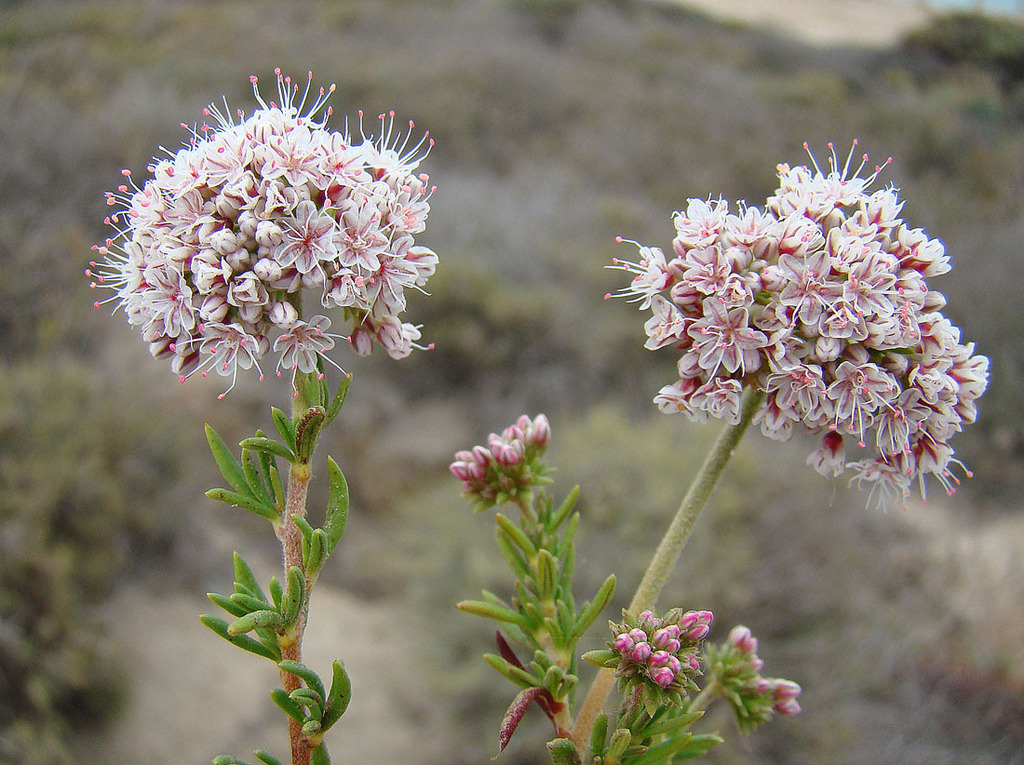
California Buckwheat
Eriogonum fasciculatum
Eriogonum fasciculatum is a species of wild buckwheat known by the common names California buckwheat and flat-topped buckwheat. Characterized by small, white and pink flower clusters that give off a cottony effect, this species grows variably from a patchy mat to a wide shrub, with the flowers turning a rusty color after blooming. This plant is of great benefit across its various habitats, providing an important food resource for a diversity of insect and mammal species. It also provides numerous ecosystem services for humans, including erosion control, post-fire mitigation, increases in crop yields when planted in hedgerows, and high habitat restoration value.
From the article Eriogonum fasciculatum on Wikipedia (CC BY-SA), quoted section by section
Description
Eriogonum fasciculatum is variable in appearance, forming a patchy, compact mat or shrub approaching 1.5 metres (4.9 ft) in height and 2.5 m (8.2 ft) across. The stems are up to 25 centimetres (9.8 in) long, and may be wooly, hairy, or smooth depending on the variety. The leaves are up to 1.5 cm (0.59 in) long and 4 mm (0.16 in) wide, with a long, narrow linear shape, and the edges of the leaves (margins) are rolled under. The inflorescence is up to 20 cm (7.9 in) tall by 15 cm (5.9 in) wide, with 3 to 8 involucres that are up to 4 mm (0.16 in) tall and 3 mm (0.12 in) wide. The flowers appear in dense, frilly clusters, with each individual flower colored pink and white and only a few millimeters across. The fruit is an achene, up to 2.5 mm (0.098 in) large and lacking any hair. After the fruits are set, the dry calyx provides buoyancy to the detached achenes, assisting in their dispersal by wind and water.
Range & habitat
This common shrub is native to the Southwestern United States, California, and northwestern Mexico. It is found from the coasts and deserts of California and Baja California; eastwards through the Southern California Coast Ranges, Transverse Ranges, and Peninsular Ranges; and further east into the Sonoran and Mojave deserts and the Great Basin. It is also distributed into Baja California Sur south to the Tres Virgenes and Vizcaino peninsula. It grows on slopes and dry washes in diverse habitats, including chaparral, coastal sage scrub, grasslands, sagebrush scrub, pinyon-juniper woodland, and creosote bush scrub.
Wikipedia: “Distribution and habitat”
How it is grown
Eriogonum fasciculatum is cultivated as an ornamental plant, for planting in native plant, drought tolerant, and wildlife gardens, and for larger designed natural landscaping and habitat restoration projects. It is also used in hedgerows to increase the yield of crops, to mitigate post-fire areas, and for erosion control.
Wikipedia: “Cultivation”
Where it lives
Recorded sightings
—
geo-referenced records in GBIF, from museums, herbaria and field observers.
Drag the globe to turn it. Dots are where records exist, not a range map; darker means more records.
In the stacks
Searching the stacks…
Every page naming Eriogonum fasciculatum in the Biodiversity Heritage Library →
This page is assembled live from iNaturalist, GBIF, Wikipedia, the Source Library and the Internet Archive. It is not yet part of the hand-edited codex. iNaturalist taxon 54999.