- Plants
- ›Vascular Plants
- ›flowering plants
- ›Dicots
- ›Gentians, Dogbanes, Madders, and Allies
- ›madder family
- ›Rubioideae
- ›Palicoureeae
- ›Geophila
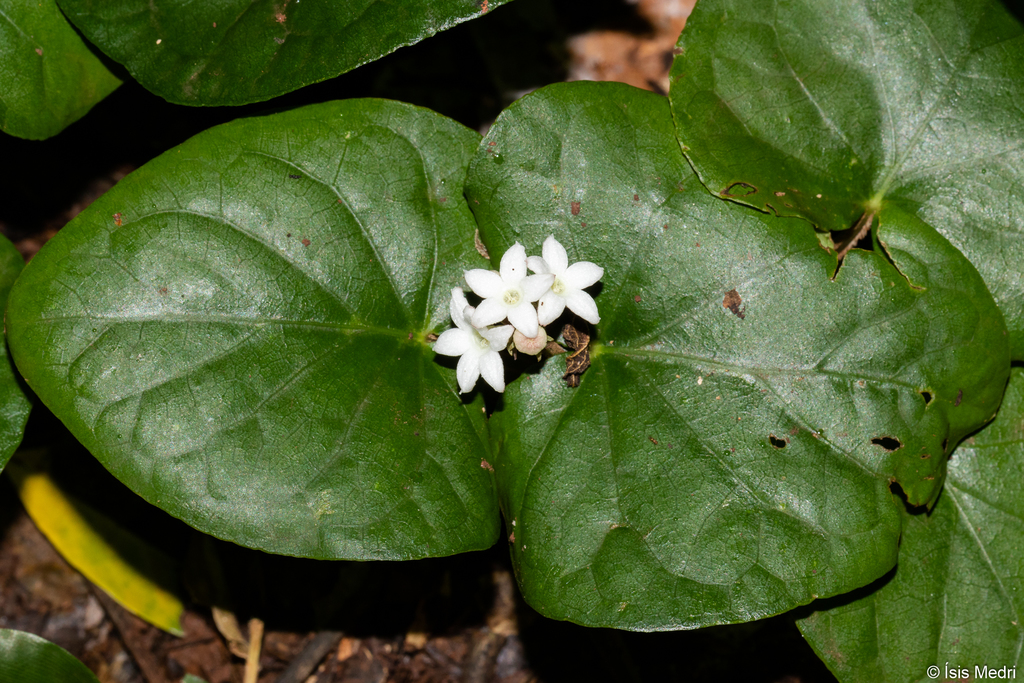
Geophila macropoda
Geophila macropoda is a species of flowering plant belonging to the Coffee, Madder or Bedstraw family, the Rubiaceae.
From the article Geophila macropoda on Wikipedia (CC BY-SA), quoted section by section
Description
Geophila macropoda is a herbaceous and perennial plant with 1-4 leaves arising opposite one another at nodes along stems which creep along the ground, rooting at the nodes. Leaves are roundish with deeply lobed bases, and up to 9cm long (~3½ inches). Rabbit-ear shaped stipules grow at the bases of leaf petioles. The species' few-flowered inflorescences are clustered in heads immediately beneath which there are two involucral bracts up to 3mm long (3⁄32 inch). Beneath the involucral bracts there's a peduncle about as long as the petioles; these grow considerably longer when fruits are ripening. Flowers within the clusters arise on very short pedicels. Corollas are white, shaped like funnels, and are hairy in their throats. Fruits are purplish black, roundish and drupe-type, with fleshy interiors, each drupe containing two "pit-" or "stone-type" seeds encased in hard coverings. The fruits are about 1cm (~½ inch) from top to bottom. Atop mature fruits there's a "calyx limb," a kind of slender crown consisting of sepals which don't fall off. At least among Peruvian species of Geophila, Geophila macropoda is distinguished from other species by its nearly hairless body (short-hairy on young petioles), and leaf blades which are broadly rounded and heart-shaped.
Range & habitat
The iNaturalist map of georeferenced records of Geophila macropoda indicate that the species occurs from southern Mexico south through Central America into northern and western South America south into southern Brazil and northern Argentina.
Wikipedia: “Distribution”
In medicine
Among the Huni Kuin people in the Peruvian Amazon, mouthwashes are made of Geophila macropoda -- mainly in the form of a decoction of the leaves -- to cure inflamed molars and abscesses of the gums. Among the Yanesha people of the Peruvian Amazon rainforest, for fungal infections between the toes, the fresh plant is crushed and applied as a poultice to the infected area. Another recipe suggests preheating the leaves by wrapping them in another leaf and placing them over a flame. When the leaves are very hot, juice is squeezed over the infected area. The same people use the plant for pimples on children's bodies. They rub the body with the fresh plant for several days in a row until the pimples disappear.
Wikipedia: “Traditional medicine”
In human culture
In the genus Geophila the Geo- is from the Ancient Greek geo-, meaning "the earth, land, a land or country". The -phila is from the Greek philein, meaning "to love," so Geophila is a "ground lover." The species name macropoda comes from the New Latin macropod-, meaning "big foot."
Wikipedia: “Etymology”
Where it lives
Recorded sightings
—
geo-referenced records in GBIF, from museums, herbaria and field observers.
Drag the globe to turn it. Dots are where records exist, not a range map; darker means more records.
In the stacks
Searching the stacks…
Every page naming Geophila macropoda in the Biodiversity Heritage Library →
This page is assembled live from iNaturalist, GBIF, Wikipedia, the Source Library and the Internet Archive. It is not yet part of the hand-edited codex. iNaturalist taxon 551062.