- Plants
- ›Vascular Plants
- ›flowering plants
- ›Dicots
- ›beeches, oaks, walnuts, and allies
- ›wax trees and shrubs
- ›Morella
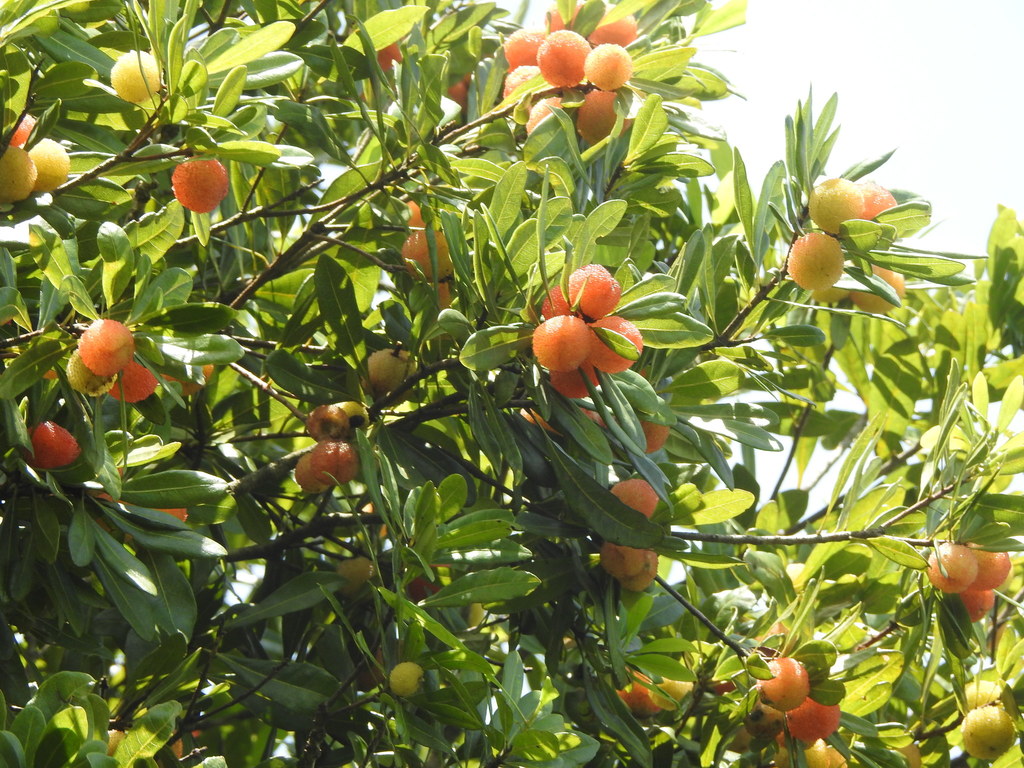
Chinese Bayberry
Morella rubra
Myrica rubra, also called yangmei (Chinese: 杨梅; pinyin: yángméi; Cantonese: yeung4 mui4; Shanghainese: ), yamamomo (Japanese: ヤマモモ, "mountain peach"), Chinese bayberry, Japanese bayberry, red bayberry, yumberry, waxberry, or Chinese strawberry (and often mistranslated from Chinese as arbutus) is a subtropical tree grown for its sweet, crimson to dark purple-red, fruit.
From the article Myrica rubra on Wikipedia (CC BY-SA), quoted section by section
Description
Myrica rubra is an evergreen tree that grows to a height of up to 10–20 m (33–66 ft) high, with smooth gray bark and a uniform spherical to hemispherical crown. Leaves are leathery, bare, elliptic-obovate to oval lanceolate in shape, wedge-shaped at the base and rounded to pointed or tapered at the apex, margin is serrated or serrated in the upper half, with a length of 5–14 cm (2.0–5.5 in) and a width of 1–4 cm (0.39–1.57 in). Leaves are alternately arranged on the branches are divided into petiole and leaf blade. The petiole is 2–10 mm (0.079–0.394 in) long. The leaf underside is pale green and sparsely to moderately golden glandular, the top surface is dark green. The species is dioecious. Male flowers with simple or unobtrusively branched bracts, are held in inflorescences individually or occasionally in groups of a few inflorescences in the leaf axils. Female flowers are 1–3 cm (0.39–1.18 in) long, in inflorescences with bare stems, the bracts almost circular with a diameter of about 1 millimeter, and have golden glands on the underside. The male flowers are accompanied by two to four egg-shaped, sparse lanceolate leaves. Each male flower contains four to six stamens with dark red, elliptical anthers. Female inflorescences are single with multi-flowered spikes of 0.5–1.5 cm (0.20–0.59 in)in length standing in the leaf axils. The rhachis is hairy and glandular. …
Range & habitat
It is native to eastern Asia, mainly in south-central China in province of Fujian, Guangdong, Guangxi, Guizhou, Hainan, Hunan, Jiangsu, Jiangxi, Sichuan, Yunnan, and Zhejiang; Japan, Korea, and the Philippines in forests on mountain slopes and valleys at elevations of 100–1,500 metres (330–4,920 ft). Seeds are dispersed by Japanese macaques and Yakushima macaques.
Wikipedia: “Distribution and habitat”
In medicine
Various species of Myrica have been studied scientifically for horticultural characteristics or its phytochemicals. Dating to 1951, the horticultural literature includes studies on nitrogen-fixing ability of the root nodules system, the presence of Frankia bacteria having nitrogen-fixing properties in root nodules, and microbial characteristics of the subcanopy soil. It has also been assessed for its niche characteristics in the forest environment, and growth of pollen tubes.
Wikipedia: “Research and phytochemicals”
How it is grown
Chinese cultivation is concentrated south of the Yangtze River, where it has considerable economic importance and has been grown for at least 2000 years. It tolerates poor acidic soils. The root system is 5–60 cm (2.0–23.6 in) deep, with no obvious taproot. Myrica rubra was first introduced into the United States by Frank Nicholas Meyer from seed purchased from the Yokohama Nursery Co. in Japan and published in the Bulletin of Foreign Plant Introductions in 1918. University of Georgia Woody Plant Research Lab has introduced and researched on this species since 2012. The lab's research includes propagation challenges, hormone signaling pathways in the fruit's development, and identifying new landscape cultivars for commercial and ornamental use. Plants from the collection were grown and fruited in Chico, California and in Brooksville, Florida by David Fairchild. M. rubra is being commercialized in California by Calmei, a California corporation. Trees are prolific producers, with a single tree yielding some 100 kilograms (220 lb) of fruit. In 2025, tissue culture Myrica rubra plants are available on the USA market. It may significantly improve the yangmei industry in United States by providing the high quality plants in container, compare to the risk of low survival rates of importing bare root plants. …
Wikipedia: “Cultivation”
In human culture
Archaeological and written evidence suggest that yangmei cultivation first took place in China over 2,000 years ago during the Han dynasty. Yangmei is mentioned throughout Chinese literature, including several appearances in Li Bai's poems. In Japan, yamamomo (山桃, lit. 'mountain peach') is the prefectural flower of Kōchi and the prefectural tree of Tokushima. The plant's name appears in many old Japanese poems.
Wikipedia: “Cultural significance”
Where it lives
Recorded sightings
—
geo-referenced records in GBIF, from museums, herbaria and field observers.
Drag the globe to turn it. Dots are where records exist, not a range map; darker means more records.
In the old herbals & bestiaries

In the stacks
Searching the stacks…
Every page naming Morella rubra in the Biodiversity Heritage Library →
This page is assembled live from iNaturalist, GBIF, Wikipedia, the Source Library and the Internet Archive. It is not yet part of the hand-edited codex. iNaturalist taxon 551083.