- Plants
- ›Vascular Plants
- ›flowering plants
- ›Dicots
- ›Mints, Plantains, Olives, and Allies
- ›figwort family
- ›Eremophila
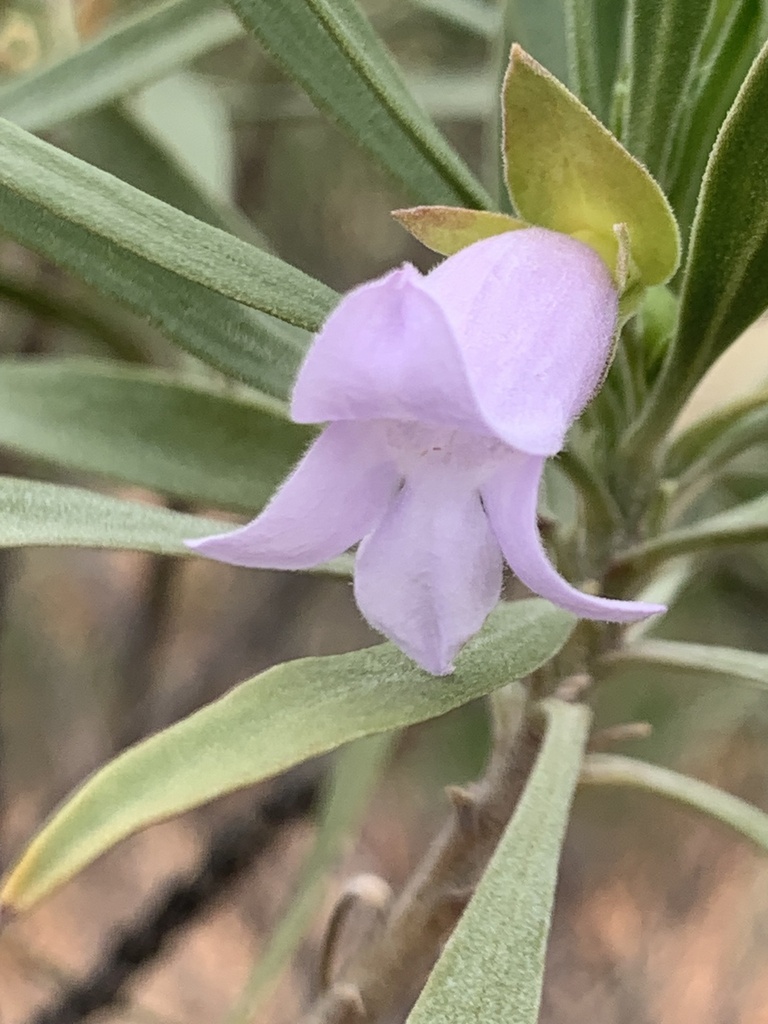
Limestone Fuchsia
Eremophila freelingii
Eremophila freelingii, commonly known as limestone fuchsia or rock fuchsia bush, is a flowering plant in the figwort family, Scrophulariaceae and is endemic to Australia. It is a shrub with sticky, hairy, lance-shaped leaves and flowers a shade of light to dark lilac and which occurs in Queensland, New South Wales and South Australia.
From the article Eremophila freelingii on Wikipedia (CC BY-SA), quoted section by section
Description
Eremophila freelingii is a small to medium shrub which usually grows to a height and width of between 0.8 and 2 m (3 and 7 ft) with branches that are covered with white hairs, and rough due to raised leaf bases. The leaves vary in size, depending on location but are mostly elliptic to lance-shaped, 35–80 mm (1–3 in) long and 5–10 mm (0.2–0.4 in) wide. They are shiny and sticky due to the presence of resin and sparsely to densely hairy with the resin sometimes obscuring the hairs. The flowers are borne singly or in groups of up to 3 in leaf axils on a stalk 8–40 mm (0.3–2 in) long. There are 5 shiny, sticky, green or purple sepals which differ from each other in size and shape, varying from egg-shaped to narrow lance shaped and 10–19 mm (0.4–0.7 in) long. The petals are 20–32 mm (0.8–1 in) long and are joined at their lower end to form a tube. The petal tube is pale to dark lilac-coloured and covered with hairs on the outside, including the outside of the petal lobes. The inside surface of the lobes is glabrous but the inside of the tube is filled with woolly hairs. The 4 stamens are fully enclosed in the petal tube. Flowering occurs throughout the year but most commonly from August to November and is followed by fruits which are dry, woody, oval shaped and 6–9 mm (0.2–0.4 in) long.
Range & habitat
Eremophila freelingii occurs in the North-western, Lake Eyre, Gairdner-Torrens, Flinders Ranges and Eastern botanical regions of South Australia where it grows in clay soils in rocky areas. In New South Wales it is found north of the Tibooburra-Milparinka area growing in rocky areas in association with mulga. It is also found in the south of the Northern Territory and far south-west of Queensland, commonly on rocky hills or stony flats.
Wikipedia: “Distribution and habitat”
At the table
Limestone fuchsia was given a range of names by different communities of Aboriginal people, including arrethe and was used for medicinal purposes such as treatment for scabies and skin lesions.
Wikipedia: “Indigenous uses”
How it is grown
This eremophila is not well known in cultivation, but some forms are worth growing. It is difficult to propagate except by grafting onto Myoporum rootstock, prefers a well-drained soil in a sunny or partially shaded position, is very drought tolerant and resistant to all but the most severe frosts.
== References ==
Wikipedia: “Horticulture”
Where it lives
Recorded sightings
—
geo-referenced records in GBIF, from museums, herbaria and field observers.
Drag the globe to turn it. Dots are where records exist, not a range map; darker means more records.
In the stacks
Searching the stacks…
Every page naming Eremophila freelingii in the Biodiversity Heritage Library →
This page is assembled live from iNaturalist, GBIF, Wikipedia, the Source Library and the Internet Archive. It is not yet part of the hand-edited codex. iNaturalist taxon 551475.