- Fungi Including Lichens
- ›Basidiomycete Fungi
- ›Higher Basidiomycetes
- ›Mushrooms, Bracket Fungi, Puffballs, and Allies
- ›Phallomycetidae
- ›Gomphales
- ›Clavariadelphaceae
- ›Clavariadelphus
- ›Clavariadelphus pistillaris
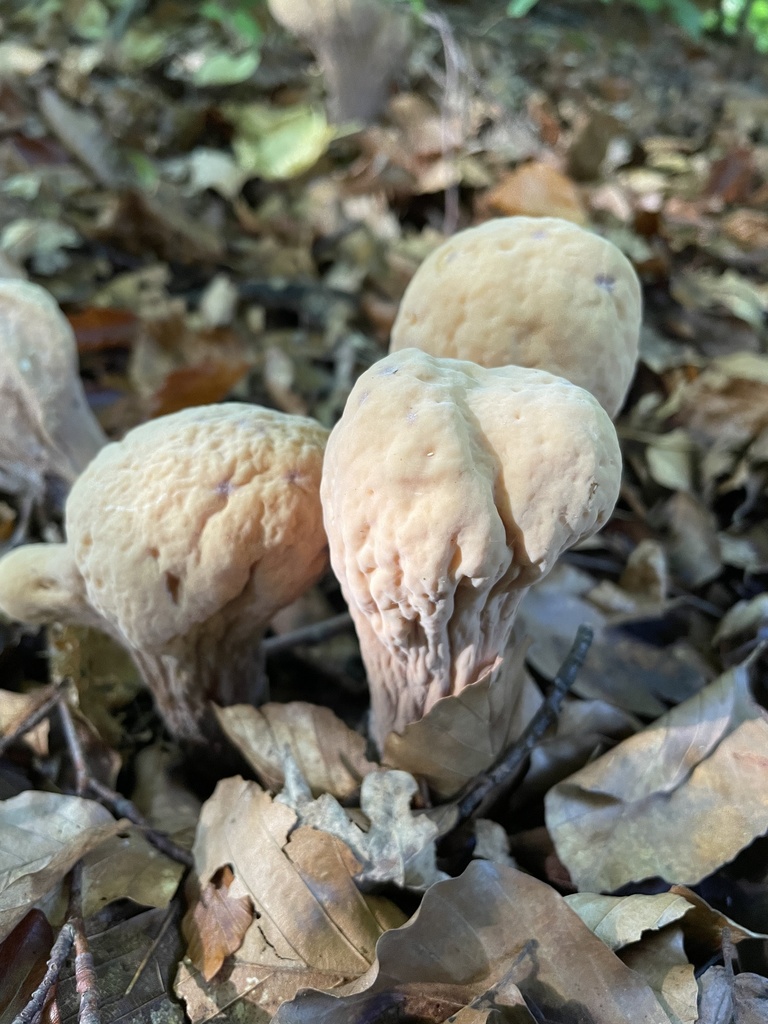
common club coral fungus
Clavariadelphus pistillaris
Clavariadelphus pistillaris, commonly known as the common club coral, is a rare species of mushroom of the family Gomphaceae native to Europe and North America.
From the article Clavariadelphus pistillaris on Wikipedia (CC BY-SA), quoted section by section
Description
The mat and wrinkled fruiting body has the shape of a club with a rounded top. Its length varies between 6 and 30 centimetres (2+1⁄2 and 12 in) and its width between 0.8 and 6 cm (1⁄4 and 2+1⁄4 in). The skin is red brown to ocher red, sometimes cinnamon brown with a lilac tint, turning brown when damaged. The spongy flesh is white. The spore print is pale yellow.
Similar species. Through its appearance it could be mistaken for C. truncatus, a species found in coniferous montane forests. C. subfastigiatus is also similar.
At the table
The species is recorded as being edible. There have been reports of the mushroom being a "nutraceutical and/or functional food" due to its high antioxidant activity and containing essential fatty acids. According to one field guide, the americana variety of the species usually does not have enough flesh to make it worthwhile to eat.
Wikipedia: “Uses”
Where it lives
Recorded sightings
—
geo-referenced records in GBIF, from museums, herbaria and field observers.
Drag the globe to turn it. Dots are where records exist, not a range map; darker means more records.
In the stacks
Searching the stacks…
Every page naming Clavariadelphus pistillaris in the Biodiversity Heritage Library →
This page is assembled live from iNaturalist, GBIF, Wikipedia, the Source Library and the Internet Archive. It is not yet part of the hand-edited codex. iNaturalist taxon 55156.