- Plants
- ›Vascular Plants
- ›flowering plants
- ›Dicots
- ›Mints, Plantains, Olives, and Allies
- ›Plantain Family
- ›Foxglove Tribe
- ›Digitalis
- ›Digitalis
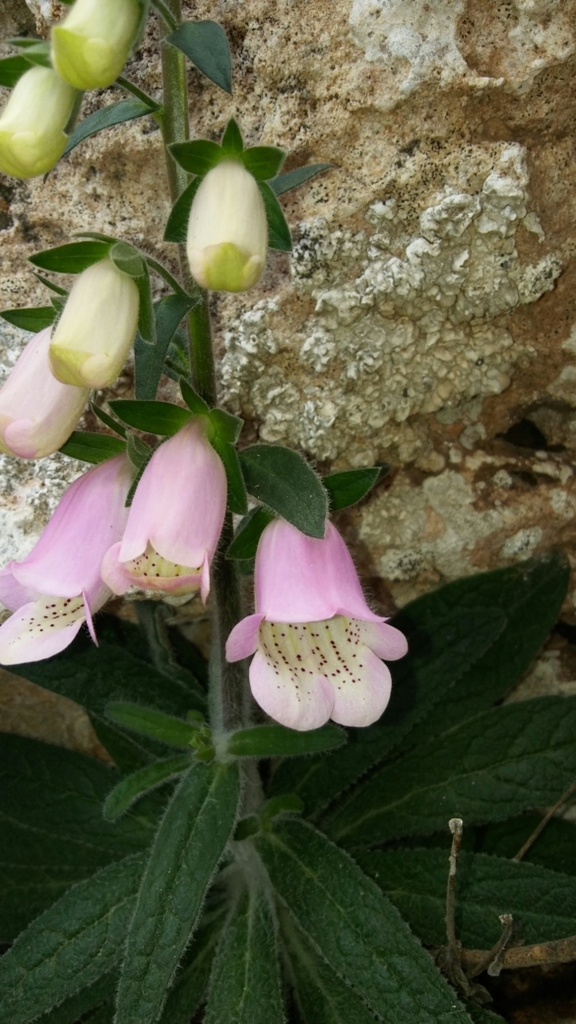
dwarf Spanish foxglove
Digitalis minor
Digitalis minor is a species of flowering plant in family Plantaginaceae, which has been called dwarf Spanish foxglove. It is a biennial or short-lived perennial species of foxglove which is endemic to the Balearic Islands with large, pendulous, pink or purple flowers. Closely related to the common purple foxglove, it is best distinguished by its small fruits. It is one of the only foxgloves to grow in calciferous, alkaline soils.
Local vernacular names in the Catalan language are: didalera, didals, didals de la Mare de Déu, boca de llop and herba de Santa Maria.
From the article Digitalis minor on Wikipedia (CC BY-SA), quoted section by section
Description
This species is a biennial or a short-lived perennial with pink, pendulous flowers. Uncommon white-flowered forms exist. The plants are somewhat caespitose, often forming a small cluster of densely arranged rosettes of leaves. The entire plant is usually covered in a tomentose indumentum of hairs (trichomes), of which only some are glandular, but on occasion glabrous plants are encountered. The base of the plant is woody, branched low at the ground or with a single rosette. Each rosette sends up an angular stem 10 to 80cm in height, coloured green or purplish. These stems have a dense indumentum of 0.4 to 0.7mm long non-glandular hairs, and very short, subsessile, glandular hairs; although sometimes (rarely) glabrous. There are few leaves on the length of these stems, most leaves are clustered at the base of the plant. The leaves are usually greyish-green. The leaves midway towards the top of the plant are not decurrent. The lowest basal leaf blades are 3 to 10cm in length by 1 to 4cm in width, elliptic to oval in shape, soft and not coriaceous (leathery) in texture, flat or sometimes somewhat revolute, with a blunt (obtuse) apex, a subentire or crenulate margin, and attenuate towards the 8-40mm long petiole. …
Range & habitat
Digitalis minor is endemic to the eastern Balearic Islands, where it occurs on the islands of Majorca, Menorca and Cabrera. At the end of the Oligocene and beginning of the Miocene, the African continent pressing against the Iberian microplate uplifted the mountains of the Baetic System, of which to the east a long peninsula was created in the Mediterranean Sea -a land bridge possibly connecting all the way to Corsica and Sardinia (then a single land mass, it later rotated to the left, with Minorca breaking off at the end of the Oligocene). During the end of the Burdigalian and the Langhian stages of this epoch, the Balearic Islands existed as two large islands, sometimes connecting to the Andalusian mainland over the next few million years. The Messinian stage was a special period in Europe: the Mediterranean connection to the Atlantic Ocean was closed off, and in a period of a million years the entire sea evaporated, leaving a vast layer of salt a kilometre in thickness and the Nile River emptying into a vast salt marsh somewhere in the middle. Corsica and the Balearic Islands were connected again, allowing the migration of species. In the Pliocene the islands were separated again from mainland as a large island, and in the Pleistocene they broke up into two large islands to the east and west. …
Wikipedia: “Distribution”
What it does
In its native environment it flowers in May and June, or exceptionally in April or July. It is a protandrous plant, with the male parts of the flower becoming mature before the female parts do so. There is much evidence for a large amount of gene flow among individuals. It is found growing in rocky areas where it inhabits cracks in rocks and cliffs, wet rocks, and rock fissures, in sunny spots and shade. It also occurs on seaside cliffs. Populations grow among calciferous rocks; it is one of the very few species of foxglove to prefer such alkaline soils. Very rarely it is found growing in siliceous soils. It grows from sea level to 1,400 metres in altitude. It grows associated with a high number of endemics or characteristic Balearics: Arabis verna, Arum pictum, Brassica balearicum, Cerastium luridum, Clypeola jonthlaspi, Crepis triasii, Delphinium pictum, Globularia majoricensis, Helichrysum lamarcki, Laserpitium gallicum, Linaria aequitriloba, L. aeruginosa, Rhamnus oleoides, Rumex intermedius, Scabiosa cretica, Sesleria coerulans subsp. insularis and Sibthorpia africana.
Wikipedia: “Ecology”
At the table
A gene taken from Arabidopsis thaliana was experimentally inserted into the genome of Digitalis minor, creating transgenic plants. This was done to explore if the amount of cardiac glycosides could be boosted, as (other) Digitalis species are still the main industrial sources for these medicines. The metabolic engineering experiment was a success, and expression of the new gene resulted in an increased sterol and cardenolide production in the resultant plants.
== References ==
Wikipedia: “Uses”
Where it lives
Recorded sightings
—
geo-referenced records in GBIF, from museums, herbaria and field observers.
Drag the globe to turn it. Dots are where records exist, not a range map; darker means more records.
In the stacks
Searching the stacks…
Every page naming Digitalis minor in the Biodiversity Heritage Library →
This page is assembled live from iNaturalist, GBIF, Wikipedia, the Source Library and the Internet Archive. It is not yet part of the hand-edited codex. iNaturalist taxon 551692.