- Animals
- ›Arthropods
- ›Hexapods
- ›Insects
- ›Winged and Once-winged Insects
- ›True Bugs, Hoppers, Aphids, and allies
- ›Plant-parasitic Hemipterans
- ›Aphids and Allies
- ›Aphidoidea
- ›Aphids
- ›Aphidinae
- ›Aphidini
- ›Aphidina
- ›Aphis
- ›Aphis fabae
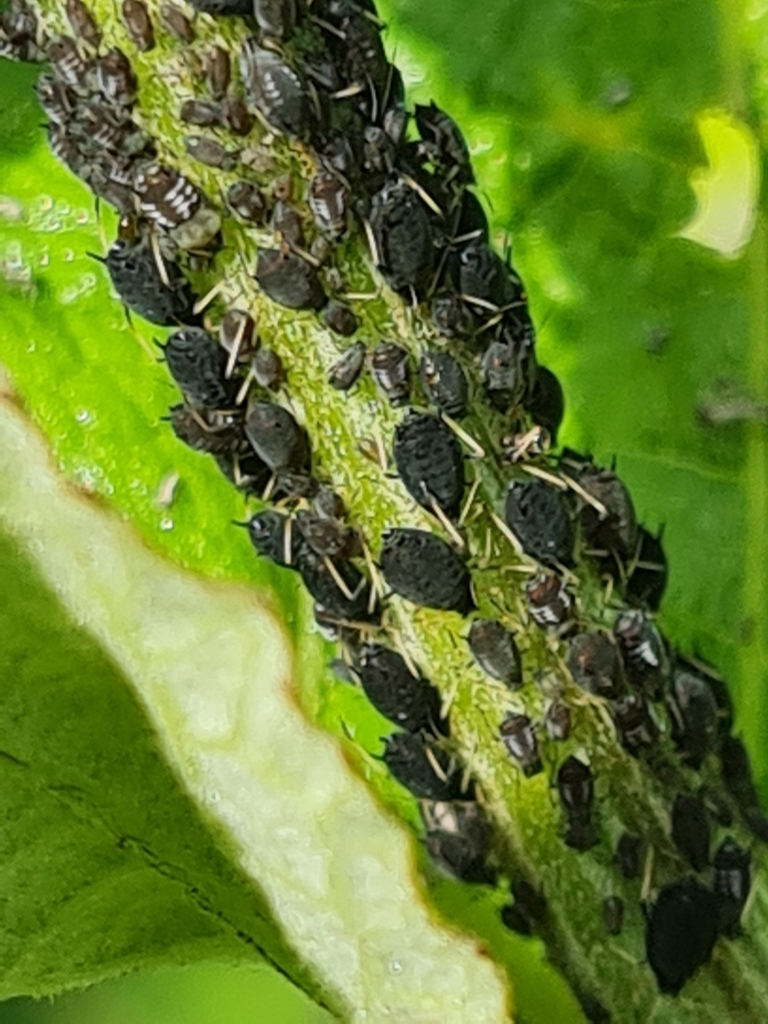
Black Bean Aphid
Aphis fabae
The black bean aphid (Aphis fabae) is a small black insect in the genus Aphis, with a broad, soft body, a member of the order Hemiptera. Other common names include blackfly, bean aphid, and beet leaf aphid. In the warmer months of the year, it is found in large numbers on the undersides of leaves and on the growing tips of host plants, including various agricultural crops and many wild and ornamental plants. Both winged and wingless forms exist, and at this time of year, they are all females. They suck sap from stems and leaves and cause distortion of the shoots, stunted plants, reduced yield, and spoiled crops. This aphid also acts as a vector for viruses that cause plant disease, and the honeydew it secretes may encourage the growth of sooty mold. It breeds profusely by live birth, but its numbers are kept in check, especially in the later part of the summer, by various predatory and parasitic insects. Ants feed on the honeydew it produces, and take active steps to remove predators. It is a widely distributed pest of agricultural crops and can be controlled by chemical or biological means. In the autumn, winged forms move to different host plants, where both males and females are produced. These mate and the females lay eggs which overwinter.
From the article Black bean aphid on Wikipedia (CC BY-SA), quoted section by section
Description
The black bean aphid is a small, soft-bodied (meaning that the exocuticle part of the exoskeleton is greatly reduced) insect that has specialised piercing and sucking mouthparts which are used to suck the juice from plants. This aphid is usually seen in large numbers and is a tiny, plump insect about two millimetres long with a small head and bulbous abdomen. The body is blackish or dark green in colour. Many adults are devoid of wings, a state known as aptery. Winged forms, known as alates, are longer and more slender than aptates and have shiny black heads and thoraxes. The membranous wings of the alates are held angled over the body. The antennae are less than two-thirds of the length of the body and both they and the legs are pale yellow in colour with black tips. The tibiae of the hind legs are swollen in egg-laying females. Near the rear of the abdomen is a pair of slender, elongated tubes known as cornicles or siphunculi. Their function is the production of a defensive waxy secretion. They are twice as long as the finger-like tail and both are brownish-black.
Range & habitat
The black bean aphid may have originated in Europe and Asia, but it is now one of the most widely distributed species of aphids. It is found throughout temperate areas of Western Europe, Asia, and North America and in the cooler parts of Africa, the Middle East, and South America. In the warmer parts of its range, apterous individuals can survive the winter and they may continue to reproduce asexually all year round. It is known to be migratory.
Wikipedia: “Distribution”
What it does
The black bean aphid has both sexual and asexual generations in its life cycle. It also alternates hosts at different times of year. The primary host plants are woody shrubs, and eggs are laid on these by winged females in the autumn. The adults then die and the eggs overwinter. The aphids that hatch from these eggs in the spring are wingless females known as stem mothers. These are able to reproduce asexually, giving birth to live offspring, nymphs, through parthenogenesis. The lifespan of a parthenogenetic female is about 50 days and during this period, each can produce as many as 30 young. The offspring are also females and able to reproduce without mating, but further generations are usually winged forms. These migrate to their secondary host plants, completely different species that are typically herbaceous plants with soft, young growth. Further parthenogenesis takes place on these new hosts on the undersides of leaves and on the growing tips. All the offspring are female at this time of year and large populations of aphids develop rapidly with both winged and wingless forms produced throughout the summer. Winged individuals develop as a response to overcrowding and they disperse to new host plants and other crops. By midsummer, the number of predators and parasites has built up and aphid populations cease to expand. …
Wikipedia: “Life cycle”
Listen
Looking for field recordings…
Where it lives
Recorded sightings
—
geo-referenced records in GBIF, from museums, herbaria and field observers.
Drag the globe to turn it. Dots are where records exist, not a range map; darker means more records.
In the stacks
Searching the stacks…
Every page naming Aphis fabae in the Biodiversity Heritage Library →
This page is assembled live from iNaturalist, GBIF, Wikipedia, the Source Library and the Internet Archive. It is not yet part of the hand-edited codex. iNaturalist taxon 55216.