- Fungi Including Lichens
- ›Ascomycete Fungi
- ›Sac Fungi and Lichens
- ›Sordariomycetes
- ›Xylariomycetidae
- ›Xylariales
- ›Xylariaceae
- ›Xylaria
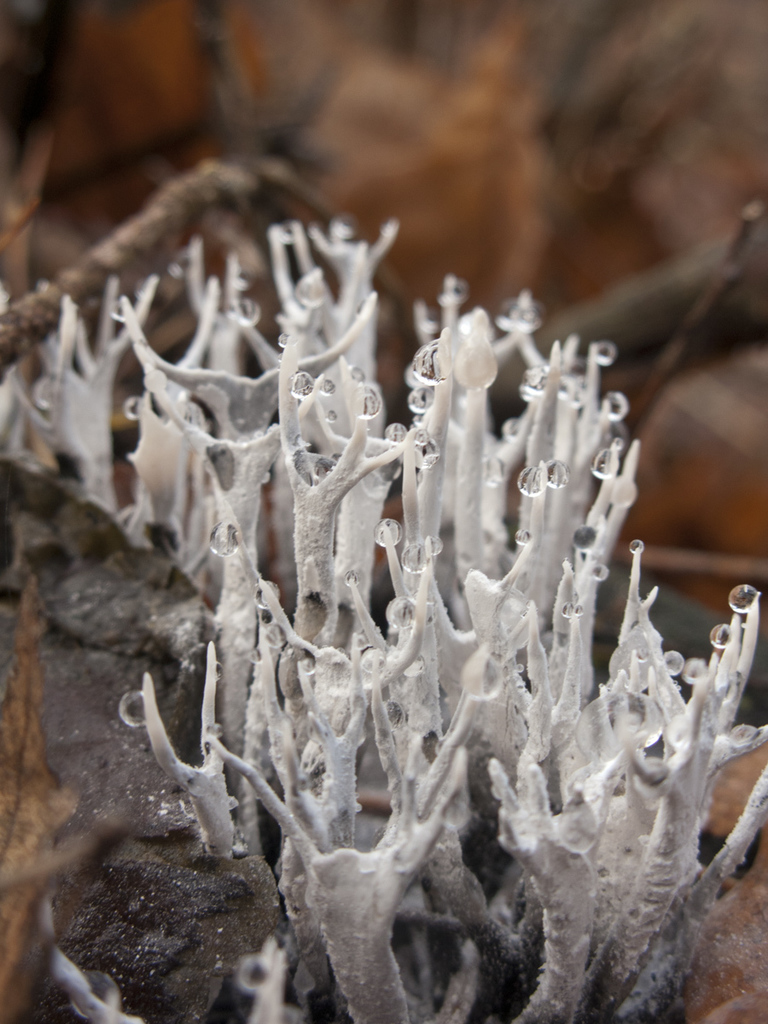
Candlesnuff Fungus
Xylaria hypoxylon
Xylaria hypoxylon is a species of bioluminescent fungus in the family Xylariaceae. It is known by a variety of common names, such as the candlestick fungus, the candlesnuff fungus, carbon antlers, or the stag's horn fungus.
The fruit bodies, characterized by erect, elongated black branches with whitened tips, typically grow in clusters on decaying hardwood. The fungus can cause a root rot in hawthorn and gooseberry plants.
From the article Xylaria hypoxylon on Wikipedia (CC BY-SA), quoted section by section
Description
Fruit bodies (ascocarps) are cylindrical or flattened with dimensions of 3–8 centimetres (1+1⁄8–3+1⁄8 in) tall × 2–8 mm thick. The erect ascocarps are often twisted or bent, and typically sparsely branched, often in a shape resembling a stag's antlers. Specimens found earlier in the season, in spring, may be covered completely in asexual spores (conidia), which manifests itself as a white to grayish powdery deposit. Later in the season, mature ascocarps are charcoal-black, and have minute pimple-like bumps called perithecia on the surface. These are minute rounded spore bearing structures with tiny holes, or ostioles, for the release of sexual spores (ascospores). The perithecia are embedded in the flesh of the ascocarp, the stroma, which is tough, elastic, and white. Within the perithecia, the asci are 100 × 8 μm. Ascospores are kidney-shaped, black, and smooth, with dimensions of 10–14 × 4–6 μm. The asexual spores (mitospores) are ellipsoid in shape, smooth, and hyaline.
Similar species. Many species of the genus resemble X. hypoxylon, including X. polymorpha, which is thicker and not as branched.
Range & habitat
The fruit bodies typically grow in clusters on decaying hardwood. The fungus can cause a root rot in hawthorn and gooseberry plants.
Wikipedia: “Distribution and habitat”
At the table
Although not poisonous, the small size and tough texture of this fungus deter consumption. It is considered inedible by some guides.
Wikipedia: “Edibility”
Where it lives
Recorded sightings
—
geo-referenced records in GBIF, from museums, herbaria and field observers.
Drag the globe to turn it. Dots are where records exist, not a range map; darker means more records.
In the old herbals & bestiaries


In the stacks
Searching the stacks…
Every page naming Xylaria hypoxylon in the Biodiversity Heritage Library →
This page is assembled live from iNaturalist, GBIF, Wikipedia, the Source Library and the Internet Archive. It is not yet part of the hand-edited codex. iNaturalist taxon 55267.