- Fungi Including Lichens
- ›Basidiomycete Fungi
- ›Higher Basidiomycetes
- ›Mushrooms, Bracket Fungi, Puffballs, and Allies
- ›Russulales
- ›Milkcaps, Brittlegills and Allies
- ›Lactarius
- ›Russularia
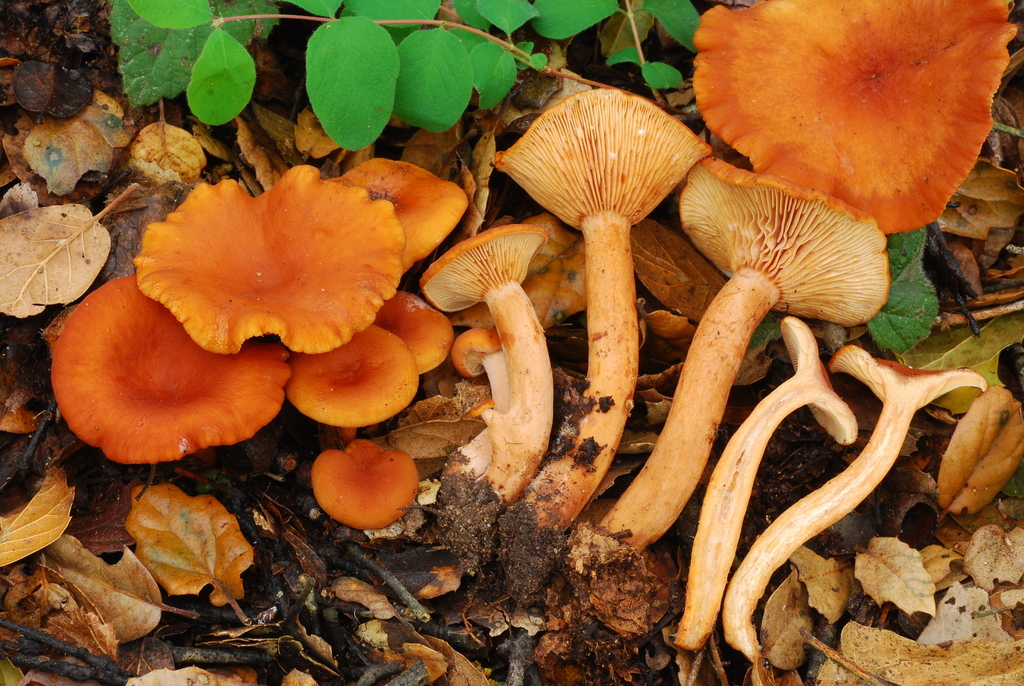
Candy Cap
Lactarius rubidus
Candy cap and curry milkcap are common names for two closely related species of Lactarius: L. camphoratus and L. rubidus. Additionally, L. rufulus is termed the southern candy cap. Many similar species are known.
Candy caps are valued for their highly aromatic qualities and are used as a flavoring.
From the article Candy cap on Wikipedia (CC BY-SA), quoted section by section
Description
Candy caps are small to medium-size mushrooms, with a pileus ranging from 2–7 centimetres (3⁄4–2+3⁄4 in) in diameter, and colored orange-brown to reddish-brown. The pileus shape ranges from broadly convex in young specimens to plane to slightly depressed in older ones; lamellae are attached to subdecurrent. The stipe is 3–6 cm (1+1⁄4–2+1⁄4 in) long. The entire fruiting body can be either firm or fragile and brittle. Like all members of Lactarius, the fruiting body exudes a latex when broken, which in these species is whitish and watery in appearance, and is often compared to whey or nonfat milk. The latex may have little flavor or may be slightly sweet, but should never taste bitter or acrid. These species are particularly distinguishable by their scent, which has been variously compared to maple syrup, camphor, curry, fenugreek, burnt sugar, Malt-O-Meal, or Maggi-Würze. This scent may be quite faint in fresh specimens, but typically becomes quite strong when the fruiting body is dried. Microscopically, they share features typical of Lactarius, including round to slightly ovular spores with distinct amyloid ornamentation and sphaerocysts that are abundant in the pileus and stipe trama, but infrequent in the lamellar trama.
Chemistry. …
Range & habitat
Near the West Coast of North America, candy caps can be found from December through March.
Wikipedia: “Distribution and habitat”
What it does
Like other species of Lactarius, candy caps are generally thought to be ectotrophic, with L. camphoratus having been identified in ectomycorrhizal root tips. However, unusually for a mycorrhizal species, L. rubidus is also commonly observed growing directly on decaying conifer wood. All candy cap species seem to be associated with a range of tree species.
Wikipedia: “Ecology”
At the table
Candy caps are not typically consumed in the same way most other edible mushrooms are consumed. Because of the strongly aromatic quality of these mushrooms, they are instead used primarily as a flavoring, much the way vanilla, saffron, or truffles are used. They impart a flavor and aroma to foods that has been compared to maple syrup or curry, but with a much stronger aroma than either of these seasonings. Candy caps are unique among edible mushrooms in that they are often used in sweet and dessert foods, such as cookies and ice cream. They are also sometimes used to flavor savory dishes that are traditionally prepared with sweet accompaniments, such as pork, and are also sometimes used in place of curry seasoning. They are usually used in dried form, as the characteristic aroma intensifies greatly upon drying. To use them as a flavoring, the dried mushrooms are either powdered or they are infused into one of the liquid ingredients used in the dish, for example, being steeped in hot milk, much the same way whole vanilla beans are. As a result of these culinary properties, candy caps are highly sought after by many chefs. Lactarius rubidus is commercially gathered and sold in California while L. camphoratus is gathered and sold in the United Kingdom and Yunnan, China. Marchand reports that some individuals use L. camphoratus as part of a pipe tobacco mix.
Wikipedia: “Uses”
Where it lives
Recorded sightings
—
geo-referenced records in GBIF, from museums, herbaria and field observers.
Drag the globe to turn it. Dots are where records exist, not a range map; darker means more records.
In the stacks
Searching the stacks…
Every page naming Lactarius rubidus in the Biodiversity Heritage Library →
This page is assembled live from iNaturalist, GBIF, Wikipedia, the Source Library and the Internet Archive. It is not yet part of the hand-edited codex. iNaturalist taxon 55276.