- Plants
- ›Vascular Plants
- ›flowering plants
- ›Dicots
- ›carrots, ivies, and allies
- ›carrot family
- ›Apioideae
- ›Bupleureae
- ›Bupleurum
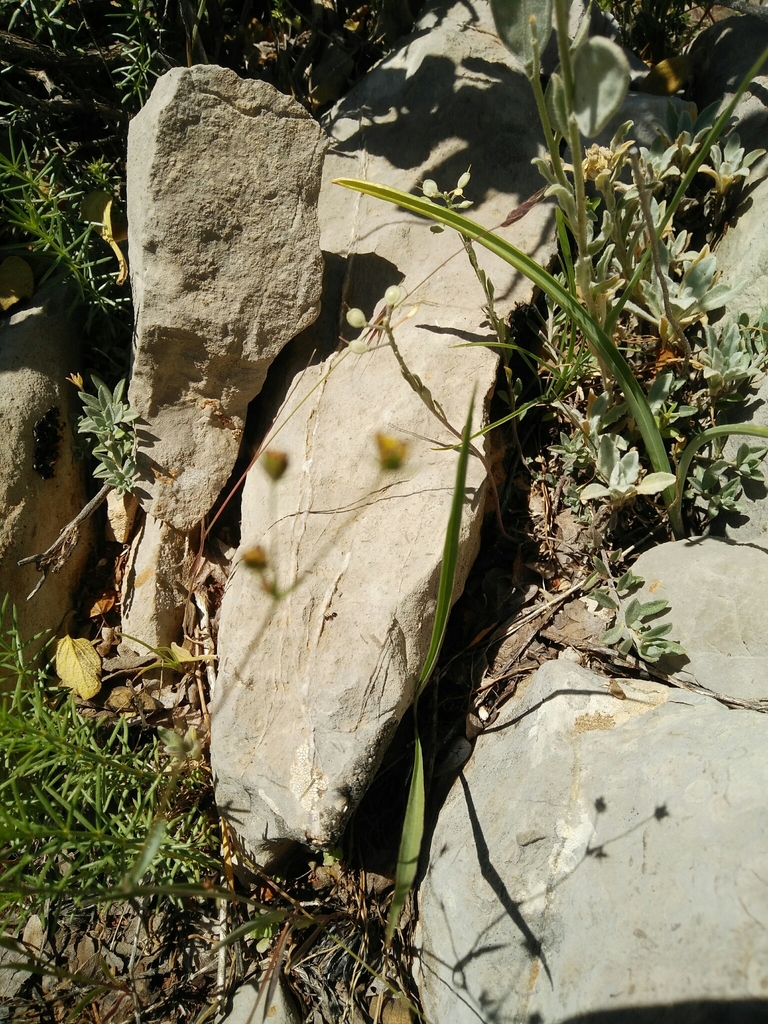
Bupleurum libanoticum
Bupleurum libanoticum (Arabic: دبيق لبناني; commonly known as the Lebanon hare's ear), is an annual herbaceous plant species in the family Apiaceae. It is native to the Eastern Mediterranean region, with a range extending through Lebanon, northwestern Syria, and southern Turkey (Anatolia). The species primarily populates high-altitude montane environments within subtropical or Mediterranean biomes.
From the article Bupleurum libanoticum on Wikipedia (CC BY-SA), quoted section by section
Description
The plant has an erect, elongated stem that typically ranges between 30 and 80 cm (12 and 31 in) in height, from which flat, spreading branches diverge. Its foliage is made of entire, linear leaves that characteristically display five distinct parallel veins running lengthwise along the lamina. In common with other members of the subfamily Apioideae, the inflorescence of B. libanoticum forms a compound umbel. The structure consists of four to five short, highly unequal rays or pedicels that support small, bright yellow flowers. Upon maturity, the flowers develop into dry, prismatic schizocarpic fruits that break apart into single-seeded mericarps.
Range & habitat
The native distribution of Bupleurum libanoticum is restricted to the Levant and southern Anatolia. Its presence is natively documented across southern Turkey, coastal western Syria, the West Syrian Mountains, the Anti-Lebanon Mountains, Central Lebanon, and coastal western Lebanon. The species is specialized to high-altitude montane environments, growing predominantly within mountainous rocky terrains and limestone slopes. Populations have been recorded within several regional protected zones, notably the Jaj Cedars Nature Reserve and the Jabal Moussa Biosphere Reserve.
Wikipedia: “Distribution and habitat”
What it does
As an annual herb, Bupleurum libanoticum completes its full life cycle from germination to senescence within a single growing period. While the species is represented inside protected reserves, ecological monitoring within the Jabal Moussa Biosphere Reserve indicates that populations situated along the margins of montane agricultural zones are vulnerable to habitat degradation. Specifically, the localized use of chemical fertilizers and pesticides in nearby commercial orchards has been identified as a modern environmental pressure affecting its surrounding ecosystem.
Wikipedia: “Ecology and conservation”
Where it lives
Recorded sightings
—
geo-referenced records in GBIF, from museums, herbaria and field observers.
Drag the globe to turn it. Dots are where records exist, not a range map; darker means more records.
In the stacks
Searching the stacks…
Every page naming Bupleurum libanoticum in the Biodiversity Heritage Library →
This page is assembled live from iNaturalist, GBIF, Wikipedia, the Source Library and the Internet Archive. It is not yet part of the hand-edited codex. iNaturalist taxon 553410.