- Animals
- ›Arthropods
- ›Hexapods
- ›Insects
- ›Winged and Once-winged Insects
- ›Grasshoppers, Crickets, and Katydids
- ›Katydids, Crickets, and Allies
- ›Katydids, wētā, and allies
- ›Tettigonioidea
- ›Katydids
- ›Shieldback Katydids
- ›Pholidopterini
- ›Pholidoptera
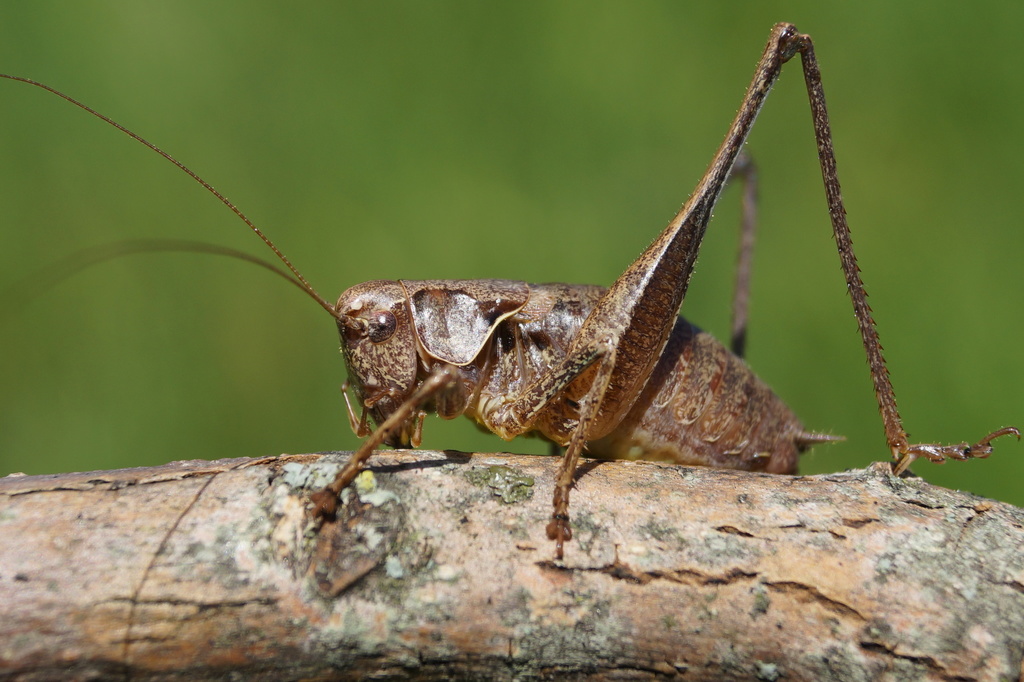
Dark Bush-cricket
Pholidoptera griseoaptera
Pholidoptera griseoaptera, the dark bush-cricket, is a flightless species of European bush-cricket; it is the type species of its genus with no subspecies.
From the article Pholidoptera griseoaptera on Wikipedia (CC BY-SA), quoted section by section
Description
Pholidoptera griseoaptera can reach a body length of 11 to 21 mm (males) and 15 to 20 mm (females), much smaller than the similar Pholidoptera aptera. The sickle-shaped and upward curved ovipositor of the females is 8 to 10 mm long, while the males have two short cerci. The antennae and the hind legs are quite long. The rounded brachypterous wings of the males are brown with light brown to ochre-coloured edges and are about 5 mm in length (about as long as the pronotum). The females are almost wingless or have half-round, grey-brown fore-wings that are 1–2 mm long. Long-winged (macropterous) forms are not recorded.
Range & habitat
This species can be found in Europe from northern Spain up to Crimea, Caucasus and the Near East. It is fairly common in Great Britain, but not recorded from Ireland. On the Isle of Man the species is legally protected under Schedule 5 of the Wildlife Act 1990, being found at only two coastal sites (Lonan and Glen Maye) at the extreme north of the species’ British Isles distribution. Adults are omnivorous, feeding primarily on small insects such as aphids and caterpillars, but eat also plants such as bramble (Rubus species), dandelion (Taraxacum species) and nettles (Urtica species). The stridulation is a brief and penetrating sound, repeatedly irregularly night and day.
Wikipedia: “Distribution and biology”
Listen
Looking for field recordings…
Where it lives
Recorded sightings
—
geo-referenced records in GBIF, from museums, herbaria and field observers.
Drag the globe to turn it. Dots are where records exist, not a range map; darker means more records.
In the stacks
Searching the stacks…
Every page naming Pholidoptera griseoaptera in the Biodiversity Heritage Library →
This page is assembled live from iNaturalist, GBIF, Wikipedia, the Source Library and the Internet Archive. It is not yet part of the hand-edited codex. iNaturalist taxon 55359.