 NL·0296
Herbarium of the Nature Library
- Name
- Buceros bicornis
- Family
- Bucerotidae
- Native to
- India, Nepal, Bhutan, Southeast Asia to Sumatra
- Habitat
- Tropical evergreen forest, Moist deciduous forest
On eBird ↗
Great Hornbill
Live sightings near you, the range map, bar charts of when it is seen, and Macaulay Library photos and recordings.
Great hornbill
Buceros bicornis
Also calledHomrai (Nepali) · Malamuzhakki vezhambal (Malayalam) · Dhanesh (Hindi) · Nok kok (Thai) · Burung enggang (Malay)
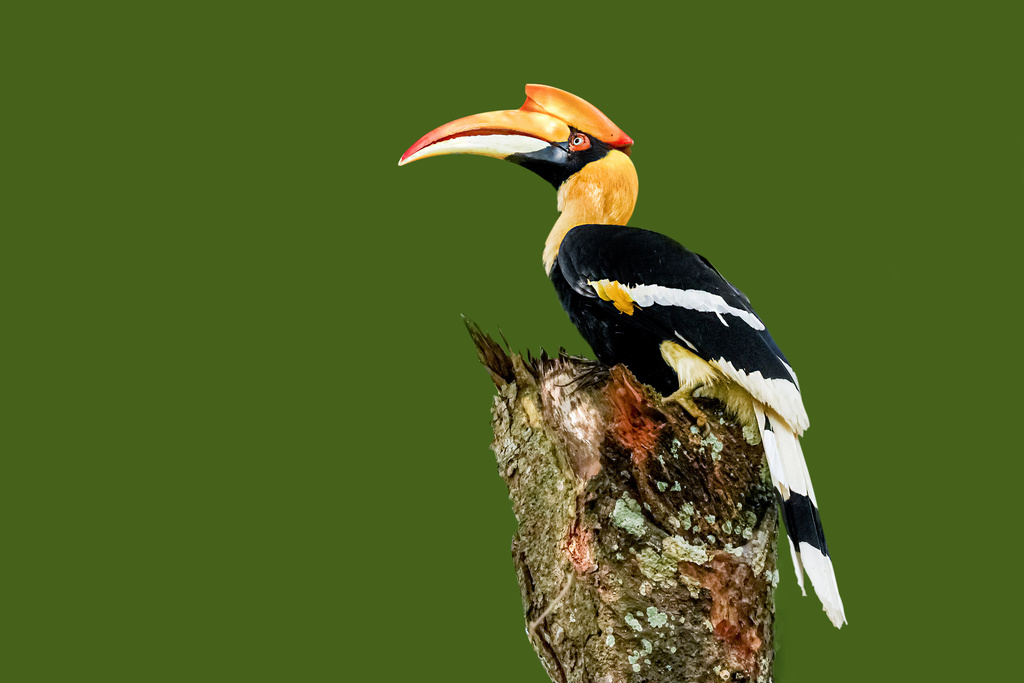
A huge hornbill of South and Southeast Asian forests, with a yellow casque atop its bill. During nesting, the female seals herself inside a tree cavity and depends on the male to feed her through a slit.
The great hornbill, also known as the concave-casqued hornbill, great Indian hornbill or great pied hornbill, is one of the larger members of the hornbill family. It occurs in the Indian subcontinent and Southeast Asia. It is predominantly frugivorous, but also preys on small mammals, reptiles, and birds. It has been listed as Vulnerable on the IUCN Red List since 2018. It is known to have lived for nearly 50 years in captivity. Due to its large size and colour, and importance in many tribal cultures and rituals, the Government of Kerala declared it as the official Kerala state bird. It is also the state bird of Arunachal Pradesh. Wikipedia
What it can do
- iFemale walls herself into the nest with mud and droppings for months
- iiMale delivers fruit regurgitated one at a time through the slit
- iiiMajor disperser of large-seeded rainforest trees, especially figs
- ivIts loud wingbeats can be heard from far away
In the field
Field marks
- aVery large black-and-white hornbill
- bHuge yellow bill with a broad, concave casque
- cWhite tail with a black band
- dLoud whooshing wingbeats
- Voice
- Pairs duet with a rapid mix of loud roars and barks, starting from a steady 'kok'
- Not to be confused with
- Rhinoceros hornbill (Sunda region) has an upturned red-and-orange casque. Wreathed hornbill has no casque and a white tail without a band.
- Where to see it
- Pakke Tiger Reserve (Arunachal Pradesh) and Valparai in the Anamalai Hills, India; Khao Yai, Thailand
- When
- Resident; breeds Jan–Apr, when pairs are most vocal
Listen
Looking for field recordings…
Life & habits
- Diet
- Mainly figs and other fruit; also small animals
- Habitat
- Tall old-growth forest
- Size
- 95–130 cm; wingspan ~1.5 m
- Lifespan
- Up to about 50 years in captivity
Birds rub preen-gland secretions onto the casque and wings, giving them their yellow colour.
Where it lives
Recorded sightings
—
geo-referenced records in GBIF, from museums, herbaria and field observers.
Native range
India, Nepal, Bhutan, Southeast Asia to Sumatra
Drag the globe to turn it. Dots are where records exist, not a range map; darker means more records.
In the old herbals & bestiaries
Woodcuts and engravings matched from the Source Library’s scanned books by name. Plates marked “relative” show a close kin rather than this exact species. Click a plate to read the page it came from, with translation.

In the stacks
Searching the stacks…
Every page naming Buceros bicornis in the Biodiversity Heritage Library →
Marginalia
It is the state bird of Kerala and Arunachal Pradesh, and Naga peoples traditionally used its feathers and casques in headdresses; Nagaland's Hornbill Festival is named for it.
Curiosity
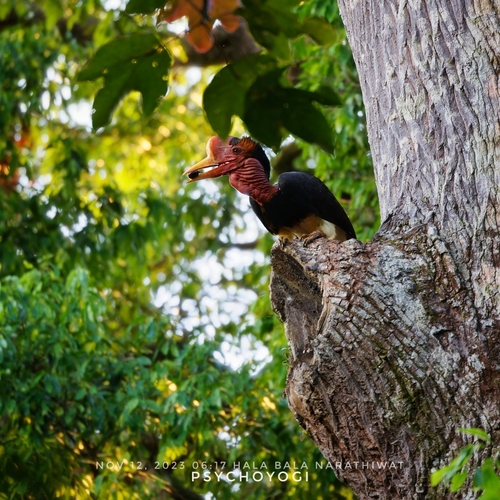
Its casque is mostly hollow and light, unlike the solid ivory-like casque of its relative the helmeted hornbill.
Kinship


Photographs: iNaturalist contributors under the licences shown. Records: GBIF.org. Historical plates: Source Library (CC BY-SA 4.0; originals public domain). Summary text: Nature Library editors and Wikipedia (CC BY-SA). Medicinal and edibility notes are historical and educational, not advice. iNaturalist taxon 5536.