- Fungi Including Lichens
- ›Basidiomycete Fungi
- ›Higher Basidiomycetes
- ›Mushrooms, Bracket Fungi, Puffballs, and Allies
- ›Agaricomycetidae
- ›Common Gilled Mushrooms and Allies
- ›Agaricineae
- ›Field Mushrooms and Allies
- ›Leucocoprineae
- ›Leucocoprinus
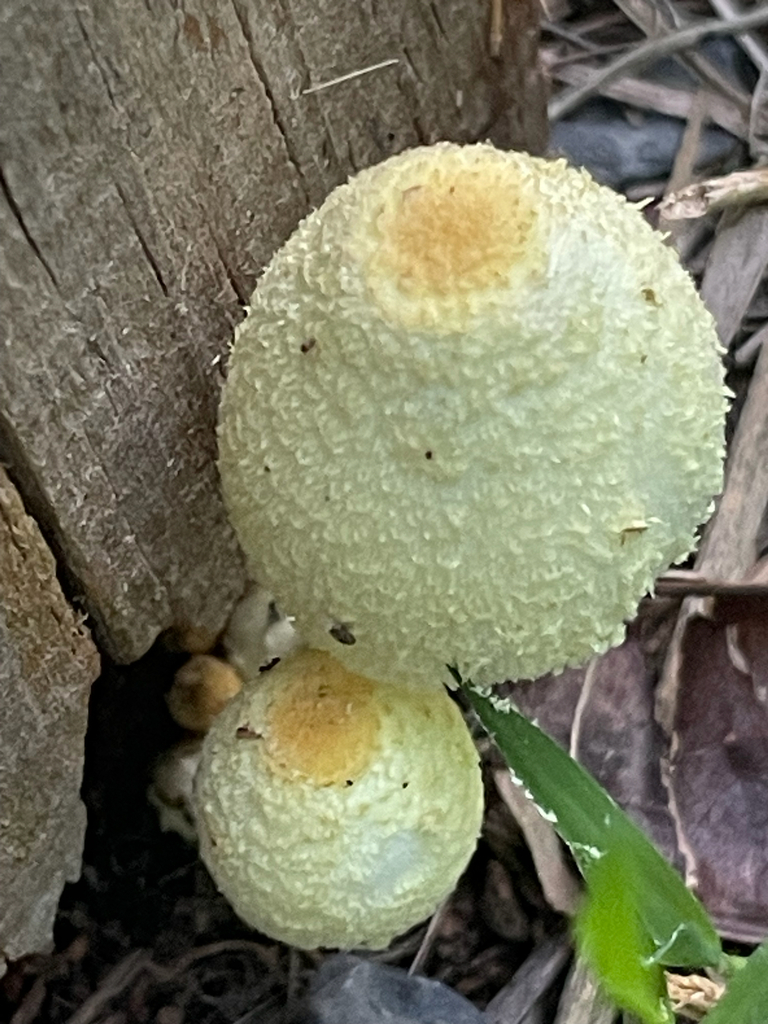
Leucocoprinus tricolor
Leucocoprinus tricolor is a species of mushroom producing fungus in the family Agaricaceae.
From the article Leucocoprinus tricolor on Wikipedia (CC BY-SA), quoted section by section
Description
Leucocoprinus tricolor is a small dapperling mushroom with thin pale yellow flesh. Cap: 1.6–6 cm wide. Ovate, campanulate or conical and flattening as it matures often with a distinct umbo but sometimes it is absent. When young, the cap surface is covered in woolly scales (floccose) or scales (squamulose) with the squamules at or around the umbo presenting as greyish brown. The rest of the cap and the squamules coating it are pale yellow. The umbo may present as orange-yellow in immature specimens before turning brown and becoming smooth with age. The cap has distinct grooves or striations towards the cap edges which may present as striate, plicate or sulcate. The cap flesh is very thin and flexible but dry feeling. It is pale yellow and does not discolour with damage. Gills: Crowded and free. Pale yellow and very thin. Stem: 1.5–8 cm long and 2-6mm thick at the top, 6-11mm at the bulbous base. Smooth or sometimes with some fine scales towards the top and woolly tufts below. Lemon yellow at the top and golden yellow at the base. Lower scales have an orange tinge and sometimes discolour greyish-brown with damage or when handling. Stem flesh is also pale yellow. The yellow stem ring is small, membranous, thin and quickly disappears. Spores: Ellipsoid to subglobose with small germ pore. 8-11 x 7.2-9 μm. Taste: Indistinct but texture dry like cotton. …
Range & habitat
L. tricolor is scarcely recorded and little known. The specimens studied were collected from greenhouses at the University of Michigan Botanical Garden in 1975 as well as in some plant pots either filled with soil or bark in subsequent years. They were growing singly or in clusters. Since botanical gardens host exotic plants from all over the world it is unclear from this study where the species originated from or is native to.
Wikipedia: “Habitat and distribution”
In human culture
The specific epithet tricolor refers to the three colour effect which is noticeable when specimens are dried.
== References ==
Wikipedia: “Etymology”
Where it lives
Recorded sightings
—
geo-referenced records in GBIF, from museums, herbaria and field observers.
Drag the globe to turn it. Dots are where records exist, not a range map; darker means more records.
In the stacks
Searching the stacks…
Every page naming Leucocoprinus tricolor in the Biodiversity Heritage Library →
This page is assembled live from iNaturalist, GBIF, Wikipedia, the Source Library and the Internet Archive. It is not yet part of the hand-edited codex. iNaturalist taxon 553820.