- Plants
- ›Vascular Plants
- ›flowering plants
- ›Dicots
- ›Mustards, Capers, and Allies
- ›mustard family
- ›Brassicoideae
- ›Brassicodae
- ›Brassiceae
- ›Crambe
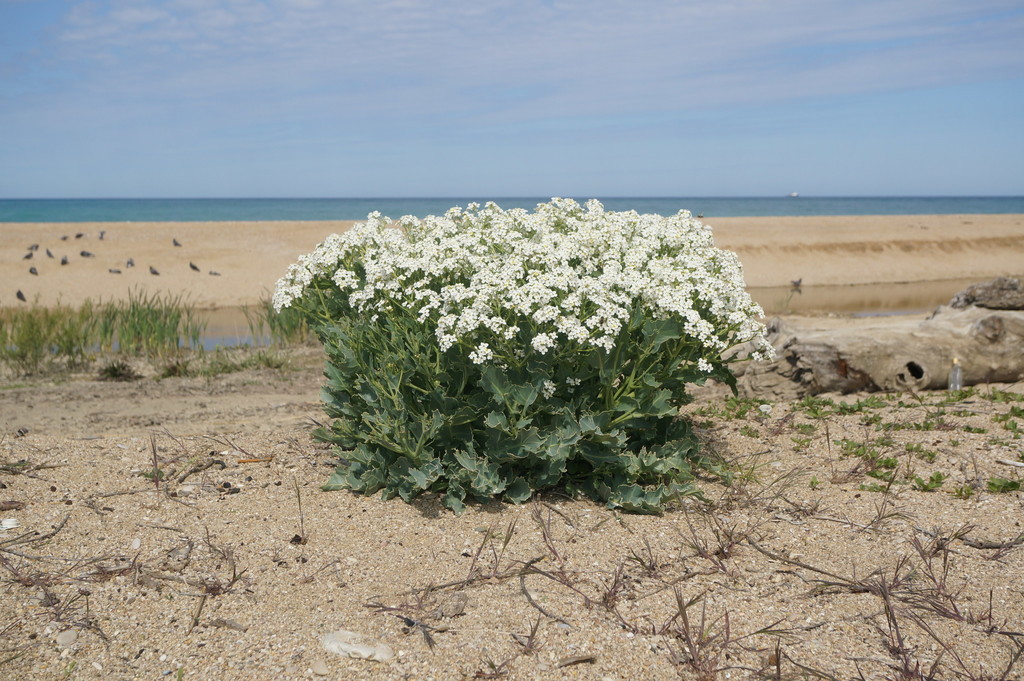
sea kale
Crambe maritima
Crambe maritima, common name sea kale, seakale or crambe, is a species of halophytic (salt-tolerant) flowering plant in the genus Crambe of the family Brassicaceae. It grows wild along the coasts of mainland Europe and the British Isles.
The plant is related to the cabbage and was first cultivated as a vegetable in Britain around the turn of the 18th century. The blanched stems are eaten as a vegetable, and became popular in the mid-19th century.
From the article Crambe maritima on Wikipedia (CC BY-SA), quoted section by section
Description
Growing to 75 cm (30 in) tall by 60 cm (24 in) wide, it is a mound-forming, spreading perennial. It has large fleshy glaucous collard-like leaves and abundant white flowers. The globular pods contain a single seed.
Range & habitat
This species appears to be a European endemic, with a distribution generally confined to two discontinuous coastal regions of Europe; the species is absent from North Africa and the Middle East. It occurs in the Black Sea coasts of Bulgaria, Romania, Turkey, and Ukraine including the Crimea, but is absent from most of the Mediterranean, recurring again from northern France and the British Isles to the Baltic Sea. In the Iberian Peninsula, Greece and Italy it is replaced by the species Crambe hispanica, with which its distribution has been confused with until quite recently; the species is absent from Portugal, Greece, Italy and Spain, but is said to occur in Croatia. Although it was once believed to be found growing in Israel and Jordan, or alternatively Lebanon and Syria, these populations are now classified as C. hispanica. It is very rare in Northern Ireland, but has been recorded in Counties Down and Antrim, and in a number of other coastal counties in the island of Ireland. In England it is primarily found on the southeast coast (extensively along Chesil Beach in Dorset), but it also occurs on stretches of the East Anglian and Cumbrian coasts. In Wales it is found on the northern beaches and in Scotland in the extreme southwest. It is uncommonly found along the coast of Norway, particularly so in the Færder National Park.
Wikipedia: “Distribution”
What it does
Crambe maritima is a halophyte, meaning that it tolerates salt and is therefore found on coastal beaches where little else thrives. It is usually found above high tide mark on beaches in which the sand includes pebbles or rock. A typical habitat for the species in Britain is vegetated shingle beaches, where it grows in association with yellow horned poppy and curled dock. It is the dominant plant species in plant communities found in fragmentary, endangered habitats on shingle beaches and bars on the southern Baltic coasts of Sweden, Finland and Estonia, east to Mecklenburg, where it grows together with Leymus arenarius, Euphorbia palustris, Honkenya peploides, Angelica archangelica subsp. litoralis, Atriplex spp., Beta vulgaris subsp. maritima, Elymus repens, Geranium robertianum subsp. rubricaule, Glaucium flavum, Isatis tinctoria, Ligusticum scoticum, Mertensia maritima, Silene uniflora, Tripleurospermum maritimum and Valeriana salina. Trapping wind-blown sand, clumps of sea kale may initiate the formation of dunes.
Wikipedia: “Ecology”
At the table
There are records from the 18th century of local people along the beaches of Kent, Sussex and Hampshire digging out and harvesting the emerging shoots as a vegetable from naturally occurring root crowns in the early springtime. This custom was first reported by Phillip Miller in his 1731 Gardener's Dictionary as practised among the people of Sussex, and it was seen once in the 18th century being sold as food at the Chichester market in 1753. John Martyn was the first to publish some practical notes on cultivating the plant in a late edition of Miller's work, but William Curtis was the first to publish a tract about his experiments of growing the plant as a vegetable crop in London in 1799, just before his death, with John Maher giving a reading before the Horticultural Society of London in 1805 which elaborated slightly on the work of Curtis. Both Curtis and Maher recommended growing the plant as a forced, blanched vegetable, growing the root crown in a ceramic cylinder which could be capped with a closed blanching pot. Over and about this pot fresh manure would be heaped a few feet deep, the heat produced when this dung rotted would be sufficient to force the plant to bolt as early as December, although later in the winter was recommended. …
Wikipedia: “Cultivation and culinary use”
Where it lives
Recorded sightings
—
geo-referenced records in GBIF, from museums, herbaria and field observers.
Drag the globe to turn it. Dots are where records exist, not a range map; darker means more records.
In the old herbals & bestiaries

In the stacks
Searching the stacks…
Every page naming Crambe maritima in the Biodiversity Heritage Library →
This page is assembled live from iNaturalist, GBIF, Wikipedia, the Source Library and the Internet Archive. It is not yet part of the hand-edited codex. iNaturalist taxon 55399.