- Plants
- ›Vascular Plants
- ›flowering plants
- ›Dicots
- ›Legumes, Milkworts, and Allies
- ›Legumes
- ›Faboideae
- ›Mirbelieae
- ›Daviesia
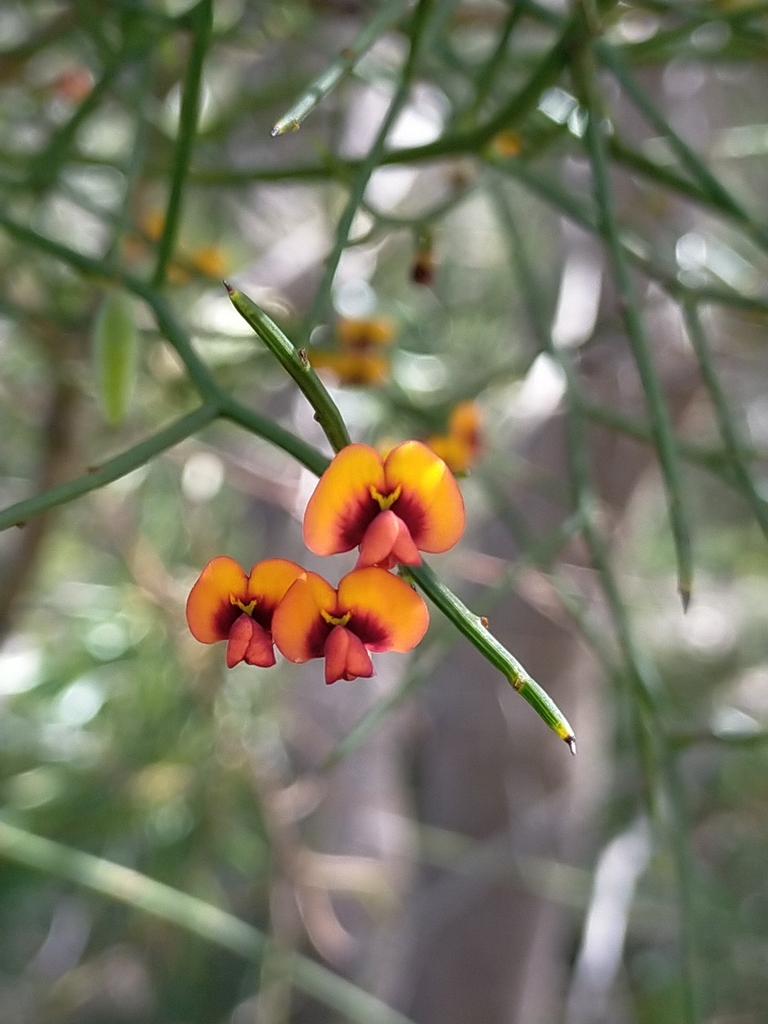
marno
Daviesia divaricata
Daviesia divaricata, common-name Marno, is a shrub in the family Fabaceae. It is endemic to Western Australia. It usually grows from 0.3–3 metres (1–10 ft) high. Bentham describes it as having no leaves, and having smooth, green, rigid stems which are circular in cross-section (terete), having grooved spines at their tips. Stems branch off from one another at a wide-angle, giving the species its name, divaricatus being the Latin for wide-spreading. Its orange pea flowers, with their
From the article Daviesia divaricata on Wikipedia (CC BY-SA), quoted section by section
Description
Daviesia divaricata is a low, spreading or erect and bushy shrub that typically grows to a height of 0.3–3 m (1 ft 0 in – 9 ft 10 in) and is mostly glabrous. Its phyllodes are reduced to keeled, triangular scales about 1 mm (0.039 in) long. The flowers are arranged in groups of up to six in leaf axils on a peduncle 1–3 mm (0.039–0.118 in) long, the rachis up to 3 mm (0.12 in), each flower on a pedicel 2–4.5 mm (0.079–0.177 in) long with bracts about 1 mm (0.039 in) long. The sepals are 4.0–4.5 mm (0.16–0.18 in) long and have five ribs, the lobes varying with subspecies. The standard petal is egg-shaped, 6.5–8.5 mm (0.26–0.33 in) long, 8–10 mm (0.31–0.39 in) wide and deep orange with a maroon base and a deeply notched tip. The wings are 5–7 mm (0.20–0.28 in) long and maroon, and the keel is 5–6 mm (0.20–0.24 in) long and maroon. Flowering occurs from May to early November and the fruit is a triangular pod 11–16 mm (0.43–0.63 in) long.
Range & habitat
Marno grows on sand, over both limestone and laterite in near-coastal sandplains and dunes from near the Hutt River to near Busselton. Subspecies lanulosa replaces the autonym in the north and occurs from near Walkaway to the Murchison River.
Wikipedia: “Distribution and habitat”
Where it lives
Recorded sightings
—
geo-referenced records in GBIF, from museums, herbaria and field observers.
Drag the globe to turn it. Dots are where records exist, not a range map; darker means more records.
In the stacks
Searching the stacks…
Every page naming Daviesia divaricata in the Biodiversity Heritage Library →
This page is assembled live from iNaturalist, GBIF, Wikipedia, the Source Library and the Internet Archive. It is not yet part of the hand-edited codex. iNaturalist taxon 554061.