- Fungi Including Lichens
- ›Ascomycete Fungi
- ›Sac Fungi and Lichens
- ›Common Lichens
- ›Shield Lichens, Sunburst Lichens, Rosette Lichens, and Allies
- ›Peltigerales
- ›Lobariaceae
- ›Lobaria
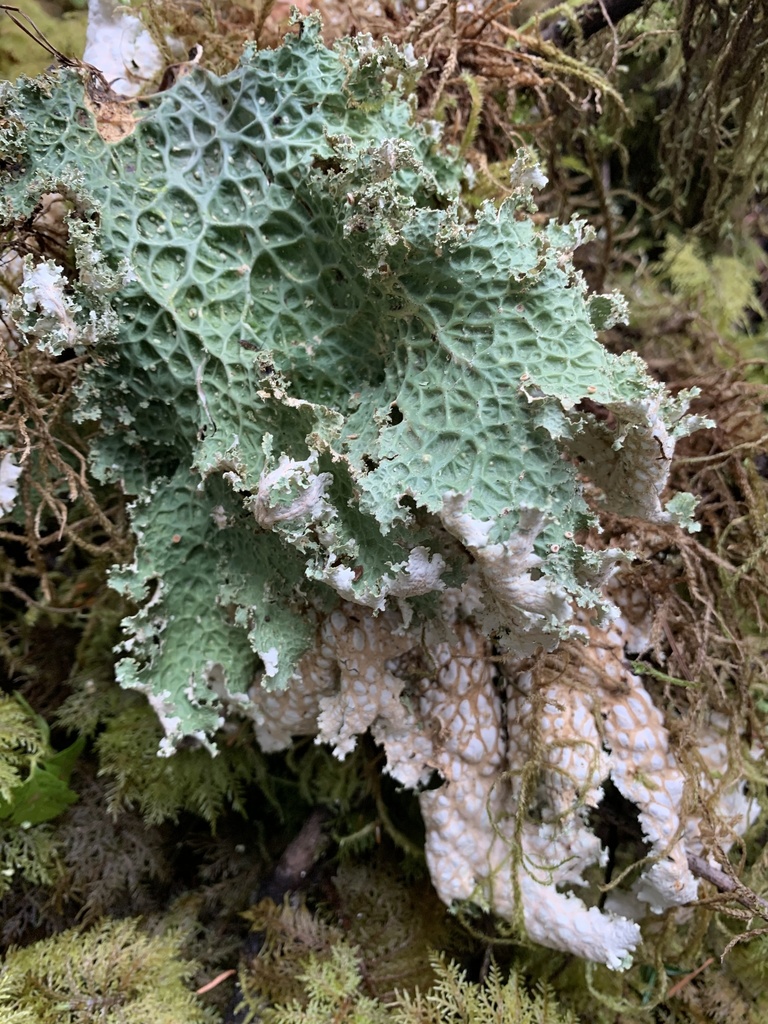
Lettuce Lichen
Lobaria oregana
Lobaria oregana, also known as lettuce lichen and as Oregon lungwort, is a species of foliose lichen occurring in North American old-growth forests, such as the Hoh Rainforest in Washington state. Taking its common name from its lettuce-like appearance, the lichen grows in the tree canopy but falls to the forest floor, where it is consumed by deer, elk, and other animals. The species was first described by American botanist Edward Tuckerman in 1874 as Sticta oregana, and later (1889) transferred to the genus Lobaria by Swiss lichen specialist Johannes Müller Argoviensis. Via cyanobacteria, it fixes nitrogen from the air, which then enters the local ecosystem when eaten or when absorbed by rootlets which the host trees extend from their own bark into the lichen.
From the article Lobaria oregana on Wikipedia (CC BY-SA), quoted section by section
Description
This lichen is a loosely attached leaf lichen. It is large, with broad lobes. Size ranges from 20mm to 35mm wide. Its upper surface is yellowish-green, and its lower surface is pale brown with fine hairs, and scattered pale, yellowish, hair free patches. This lichen has strong and deeply indented ridges. It has no soredia or isidia. The lobe margins are frilly. The frills at the end of the lobes are small.
Range & habitat
This lichen prefers to grow on large coniferous trees; especially Douglas Firs, in forests. This lichen prefers growing on Douglas Fir so much that it makes up about 5% of the weight of foliage on Douglas Fir trees. It prefers cool places, and is sensitive to living in areas that are about approximately 15 degrees Celsius. This niche prefers the coastline because of its cooler temperatures along the western side of the United States. It is often found to the west of the Cascade Mountain Range, and not to the east. This lichen spans from Southern Oregon and northern California up into Alaska, around and into the Kenai Peninsula. Due to its preferences for cool, wet climates, it does not reach very far into the Alaskan or Canadian interior. This lichen prefers very humid climates that are cool year round. This lichen is very particular and seems to grow only in old growth forests, although it appears to be going fast in many parts of its range. The lichen prefers middle elevations, and although it spans west from the Cascade and Alaskan Mountains to the ocean, it is most commonly found on the Coastal range. Although it is very rare for this species to drift far from the cool, humid west coastline, the farthest east sighting was in 2012, where two people reported seeing Lobaria Oregana in a forest near Usk, Washington. …
Wikipedia: “Habitat and range”
In human culture
Very little is known about the history of this lichen and its uses, beyond remedying the coughing of blood by the Hesquiat people of British Columbia. The Latin word lobaria means "lobed”.
Wikipedia: “History”
Where it lives
Recorded sightings
—
geo-referenced records in GBIF, from museums, herbaria and field observers.
Drag the globe to turn it. Dots are where records exist, not a range map; darker means more records.
In the stacks
Searching the stacks…
Every page naming Lobaria oregana in the Biodiversity Heritage Library →
This page is assembled live from iNaturalist, GBIF, Wikipedia, the Source Library and the Internet Archive. It is not yet part of the hand-edited codex. iNaturalist taxon 55538.