- Animals
- ›Arthropods
- ›Crustaceans
- ›Typical Crustaceans
- ›Malacostracans
- ›Decapods, Isopods, and allies
- ›Decapods and Krill
- ›Decapods
- ›Crabs, Lobsters, Shrimps, and Allies
- ›True Crabs
- ›Eubrachyuran Crabs
- ›Thoracotrematan Crabs
- ›Ghost, Fiddler, Sand Bubbler Crabs and Allies
- ›Ghost and Fiddler Crabs
- ›American Narrow-fronted and East Atlantic Fiddler Crabs
- ›Afruca
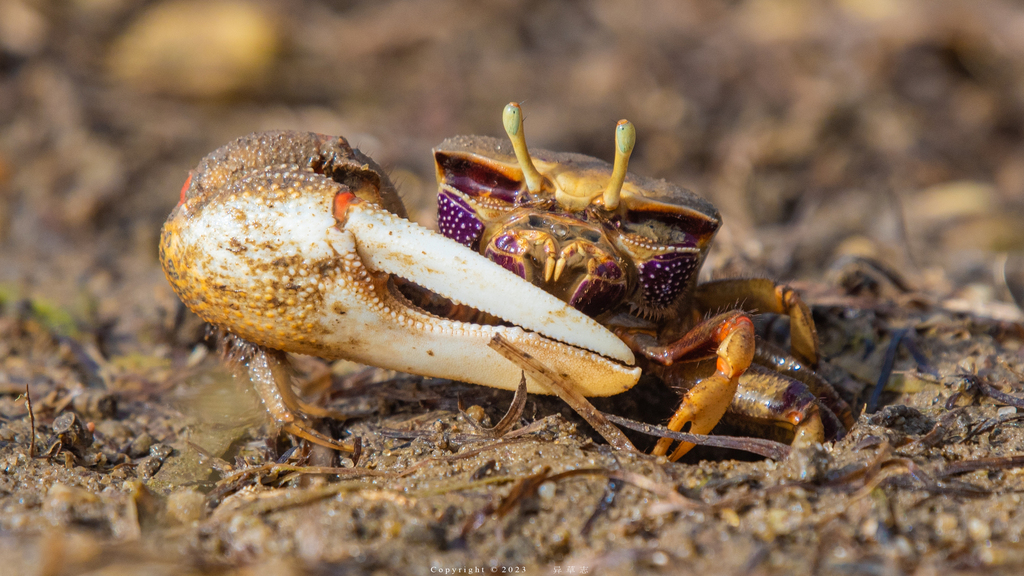
West African Fiddler Crab
Afruca tangeri
Afruca is a genus of fiddler crabs belonging to the family Ocypodidae. Afruca tangeri, the only species in this genus, lives along the Atlantic coasts of western Africa and southwestern Europe.
From the article Afruca on Wikipedia (CC BY-SA), quoted section by section
Description
Afruca tangeri is one of the largest species of fiddler crab, with a carapace up to 50 mm (2.0 in) wide and up to 25 mm (1.0 in) long. Males have one claw much larger than the other, used for communication. Body coloration is generally dull; however, some individuals display a range of colors from shades of brown to bright orange, red, or purple. In adults, the carapace typically reaches about 35 mm (1.4 in). The dorsal surface of the carapace is mainly covered with tubercles, and the species lacks posterolateral striae. The frontal region between the eyes is broad, and the cornea is round. The eyestalks are thin and elongated. The orbital floor bears a spinous tubercle near the inner corner of the eye socket, appearing as a small, pointed projection. The mouthparts are equipped with spoon-shaped setae (hair-like structures) that facilitate food handling. Additionally, a small proximal spine works in conjunction with these setae to aid in the manipulation and movement of food. Male individuals have a large claw, known as the major cheliped, which may occur on either the right or left side. The movable parts of the claws are called the fingers and are thick and strongly curved. The pollex (lower finger) has a raised ridge along its underside, enhancing strength and grip. The outer surface of the major manus (the main part of the claw) has large tubercles. …
Range & habitat
Afruca tangeri can be found anywhere from the southern Portugal southwards to Angola. The species is the only fiddler crab on the eastern Atlantic coast and the most abundant crab species in The Gambia. The general habitat of A. tangeri's consists of intertidal mudflats and estuaries. Specific microhabitats include mudflat zones, creeks and marshes. Smaller A. tangeri often cohabit near creeks, whereas larger A. tangeri more commonly reside in salt marsh zones. Young crabs are found in the middle of mudflats.
Wikipedia: “Habitat and distribution”
What it does
This organism is known for its extensive signaling and territorial behavior. Using both claw waving and substrate drumming around the entrances to their burrows, they attempt to attract females while also signaling to their rival males to retreat. As females get closer in proximity to the burrows which would demonstrate that signaling plays a significant role in both the courtship process and female choice. Research has also found that males may also build structures with mud at the entrances of their burrow as another visual signal to influence both potential female mates and to deter possible competition A. tangeri is versatile in its behaviors. Known behaviors include claw waving, burrowing, combat, feeding, and various courtship sequences. Most notably, its ability to visually signal is characteristic of this species. An example of a visual signal is claw waving. Here, males signal to females with their claws and mud balls to enhance visibility. Signal intensity increases as females get closer. This behavior is also involved in courtship sequences. Males perform a four-step courtship routine, which involves low-intensity claw waving, sequential waves and body drops, simultaneous waves and body drops, and underground drumming in burrows. This species also utilizes acoustic communication. …
Wikipedia: “Behavior”
Where it lives
Recorded sightings
—
geo-referenced records in GBIF, from museums, herbaria and field observers.
Drag the globe to turn it. Dots are where records exist, not a range map; darker means more records.
In the stacks
Searching the stacks…
Every page naming Afruca tangeri in the Biodiversity Heritage Library →
This page is assembled live from iNaturalist, GBIF, Wikipedia, the Source Library and the Internet Archive. It is not yet part of the hand-edited codex. iNaturalist taxon 555973.