- Animals
- ›Arthropods
- ›Crustaceans
- ›Typical Crustaceans
- ›Malacostracans
- ›Decapods, Isopods, and allies
- ›Decapods and Krill
- ›Decapods
- ›Crabs, Lobsters, Shrimps, and Allies
- ›True Crabs
- ›Eubrachyuran Crabs
- ›Thoracotrematan Crabs
- ›Ghost, Fiddler, Sand Bubbler Crabs and Allies
- ›Ghost and Fiddler Crabs
- ›Broad-fronted and Indo-west Pacific Fiddler Crabs
- ›American Broad-front Fiddler Crabs
- ›Minuca
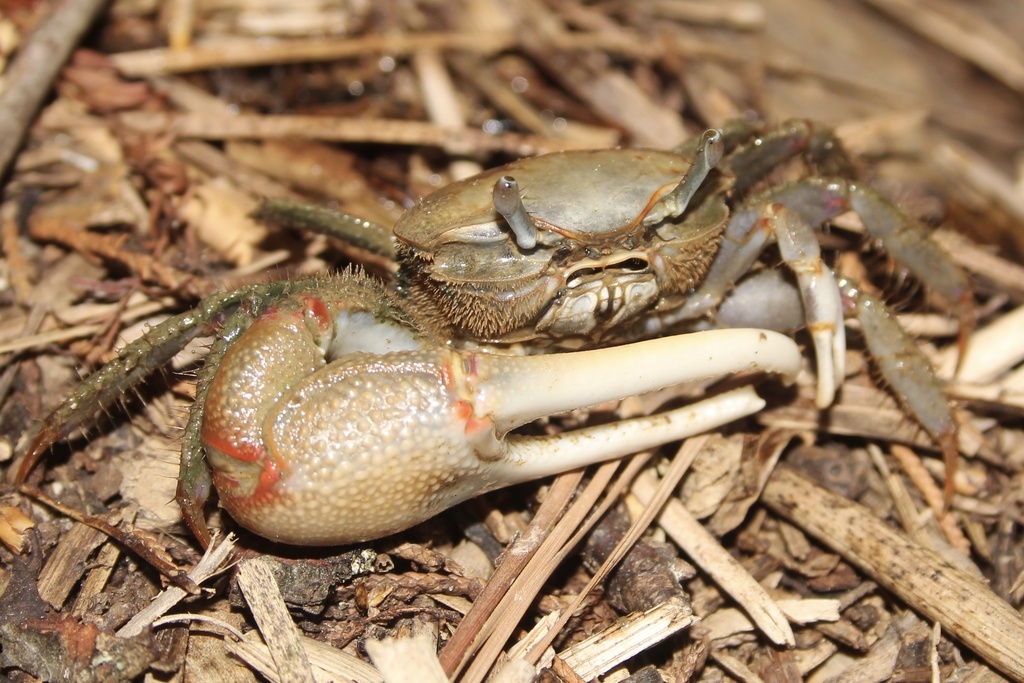
Red-jointed Fiddler Crab
Minuca minax
Minuca minax, commonly known as the red‐jointed fiddler crab or brackish-water fiddler crab, is a species of fiddler crab that is found in the United States from Massachusetts to the Gulf of Mexico. It is one of the most common macroinvertebrates in salt marshes in these states. It prefers areas of lower salinity than other fiddler crabs, and can be found in great numbers along the banks of tidal streams, even at distances greater than 50 km (31 mi) from the sea.
Minuca minax was formerly in the genus Uca, but in 2016 it was placed in the genus Minuca, a former subgenus of Uca.
From the article Minuca minax on Wikipedia (CC BY-SA), quoted section by section
Description
Like other fiddler crabs, Minuca minax males have one claw that is significantly larger than the other, while females have two equal-sized smaller claws. The joints on the claws are red, a noticeable feature that is the origin of the common name "red‐jointed fiddler crab".
What it does
Minuca minax breed for two weeks in the summer in a small round burrow dug by the male. The larvae are unable to survive in the lower-salinity brackish water preferred by adults, and the adults do not travel to the sea to release the larvae. As such, the larvae use ebb tides to travel to higher-salinity environments to develop before returning as adults.
== References ==
Wikipedia: “Reproduction”
Where it lives
Recorded sightings
—
geo-referenced records in GBIF, from museums, herbaria and field observers.
Drag the globe to turn it. Dots are where records exist, not a range map; darker means more records.
In the stacks
Searching the stacks…
Every page naming Minuca minax in the Biodiversity Heritage Library →
This page is assembled live from iNaturalist, GBIF, Wikipedia, the Source Library and the Internet Archive. It is not yet part of the hand-edited codex. iNaturalist taxon 555974.