- Animals
- ›Arthropods
- ›Hexapods
- ›Insects
- ›Winged and Once-winged Insects
- ›Ants, Bees, Wasps, and Sawflies
- ›Narrow-waisted Wasps, Ants, and Bees
- ›Ants, Bees, and Stinging Wasps
- ›Bees and Apoid Wasps
- ›Bees
- ›Honey Bees, Bumble Bees, and Allies
- ›Apine Bees
- ›Bombini
- ›Bombus
- ›Thoracobombus
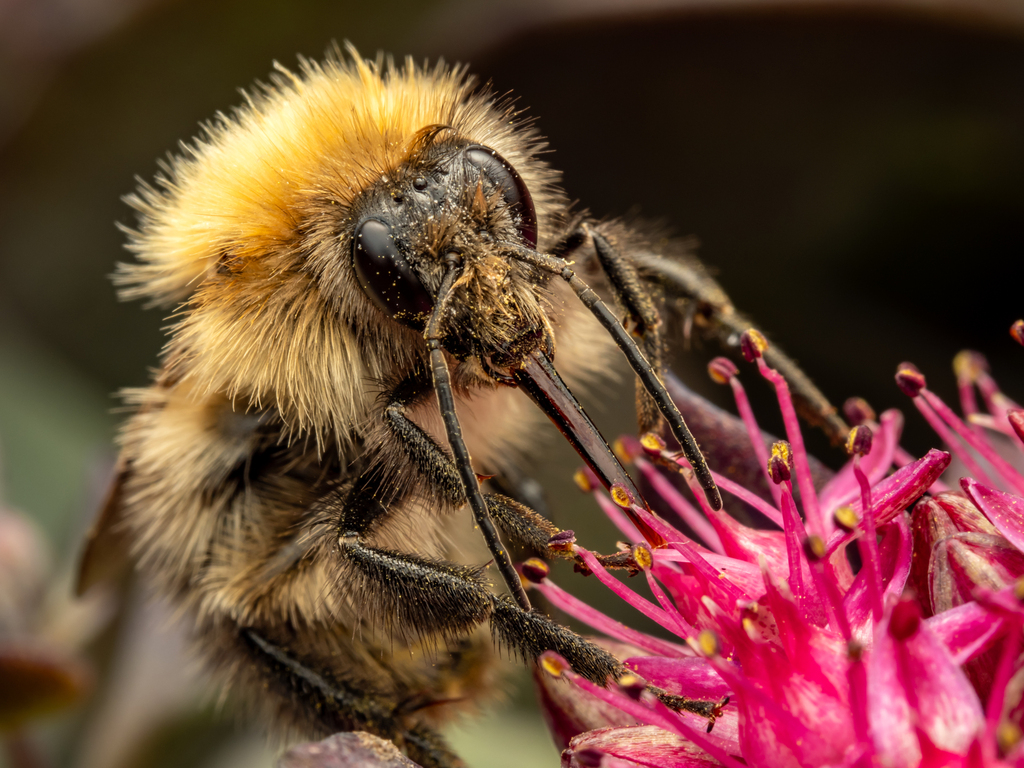
Common Carder Bumble Bee
Bombus pascuorum
Bombus pascuorum, the common carder bee, is a species of bumblebee present in most of Europe in a wide variety of habitats such as meadows, pastures, waste ground, ditches and embankments, roads, and field margins, as well as gardens and parks in urban areas and forests and forest edges. It is similar in appearance to Bombus muscorum, and is replacing the species in Northern Britain....
From the article Bombus pascuorum on Wikipedia (CC BY-SA), quoted section by section
Description
The thorax of the common carder bee is either yellowish or reddish-brown in color. The hair of the first four abdominal segments is gray, while the hair of the fifth and sixth terga is yellowish or reddish-brown. The body length of queens ranges from 15 to 18 mm (0.59 to 0.71 in) in length. The body length of female workers ranges from 9 to 15 mm (0.35 to 0.59 in) in length. The body length of males range from 12 to 14 mm (0.47 to 0.55 in) in length. Queens measure 28 to 32 mm (1.1 to 1.3 in) from wing to wing. Workers measure 24 to 27 mm (0.94 to 1.06 in) from wing to wing. Drones measure 24 to 27 mm (0.94 to 1.06 in) from wing to wing. The head of the common carder bee is of medium length and the snout is long compared to other species of bumblebee. The snout of the queen ranges between 13 and 15 mm (0.51 and 0.59 in) in length. The snout of workers ranges from 12 to 13 mm (0.47 to 0.51 in) in length. The snout of drones ranges from 10 to 11 mm (0.39 to 0.43 in) in length.
Listen
Looking for field recordings…
Where it lives
Recorded sightings
—
geo-referenced records in GBIF, from museums, herbaria and field observers.
Drag the globe to turn it. Dots are where records exist, not a range map; darker means more records.
In the stacks
Searching the stacks…
Every page naming Bombus pascuorum in the Biodiversity Heritage Library →
This page is assembled live from iNaturalist, GBIF, Wikipedia, the Source Library and the Internet Archive. It is not yet part of the hand-edited codex. iNaturalist taxon 55637.