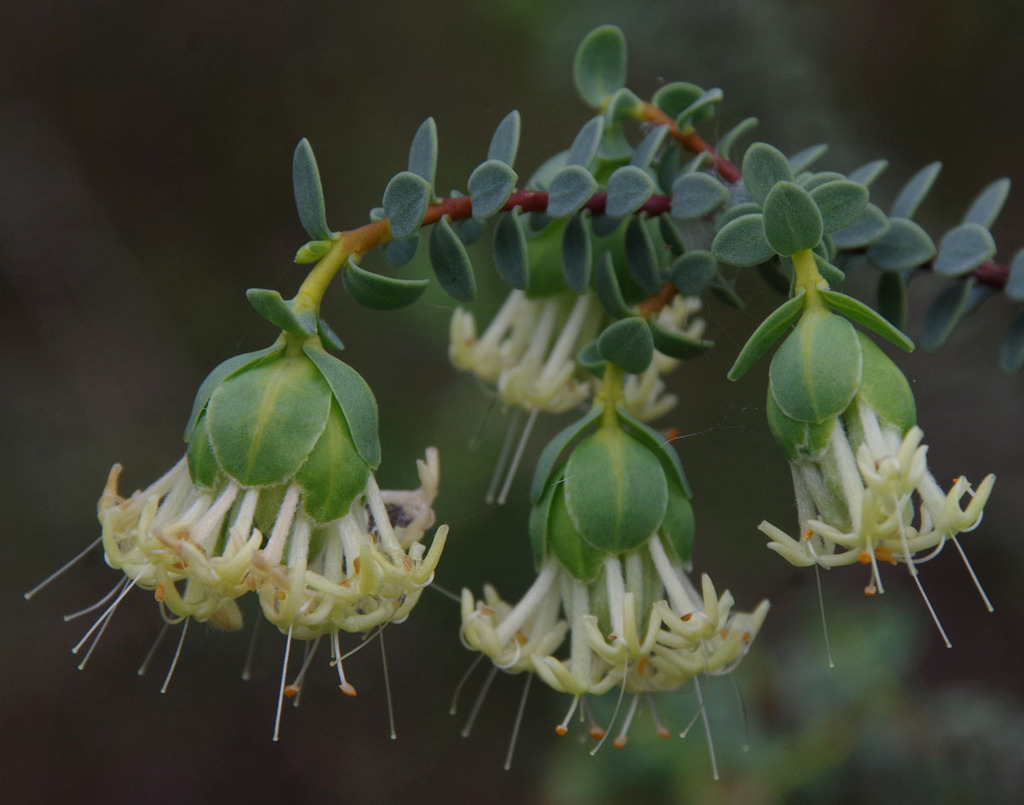
Pimelea sulphurea
Pimelea sulphurea, commonly known as yellow banjine, is a species of flowering plant in the family Thymelaeaceae and is endemic to the south-west of Western Australia. It is an erect, spindly or open shrub with narrowly elliptic to more or less round leaves, and compact heads of pendulous, yellow flowers surrounded by 3 or more pairs of green to yellowish involucral bracts.
From the article Pimelea sulphurea on Wikipedia (CC BY-SA), quoted section by section
Description
Pimelea sulphurea is an erect, spindly or open shrub that typically grows to a height of 15–70 cm (5.9–27.6 in) and has glabrous stems. The leaves are arranged in opposite pairs and are narrowly elliptic to more or less round, 2–16 mm (0.079–0.630 in) long, 1.5–9 mm (0.059–0.354 in) wide and more or less sessile. Both sides of the leaves are the same shade of green and glabrous. The flowers are usually bisexual and borne in compact, pendulous clusters of many more or less glabrous yellow flowers, surrounded by 3 or more pairs of narrowly elliptic to round involucral bracts 4–15 mm (0.16–0.59 in) and 3–10 mm (0.12–0.39 in) wide. The bracts are green or yellowish and hairy on the inside surface. The floral tube is 6.5–17 mm (0.26–0.67 in) long, and the sepals are 2–5 mm (0.079–0.197 in) long. Flowering occurs from July to November.
Range & habitat
Yellow banjine usually grows on sand in woodland or shrubland between Eneabba, Fitzgerald River National Park and Southern Cross in the Avon Wheatbelt, Coolgardie, Esperance Plains, Geraldton Sandplains, Jarrah Forest, Mallee, and Swan Coastal Plain bioregions of south-western Western Australia.
Wikipedia: “Distribution and habitat”
Where it lives
Recorded sightings
—
geo-referenced records in GBIF, from museums, herbaria and field observers.
Drag the globe to turn it. Dots are where records exist, not a range map; darker means more records.
In the stacks
Searching the stacks…
Every page naming Pimelea sulphurea in the Biodiversity Heritage Library →
This page is assembled live from iNaturalist, GBIF, Wikipedia, the Source Library and the Internet Archive. It is not yet part of the hand-edited codex. iNaturalist taxon 556856.