On eBird ↗
Auckland Islands Rail
Live sightings near you, the range map, bar charts of when it is seen, and Macaulay Library photos and recordings.
Auckland Islands Rail
Lewinia muelleri
The Auckland rail (Lewinia muelleri) is a small nearly flightless rail endemic to the Auckland Islands 460 km south of New Zealand. It is somewhat of a biogeographical anomaly, being the only species in the genus Lewinia to have reached the islands of New Zealand, skipping over the main islands to reach the remote Auckland group. Its closest relative is Lewin's rail of Australia. The species is currently restricted to two islands in the Auckland group, Adams...
From the article Auckland rail on Wikipedia (CC BY-SA), quoted section by section
Description
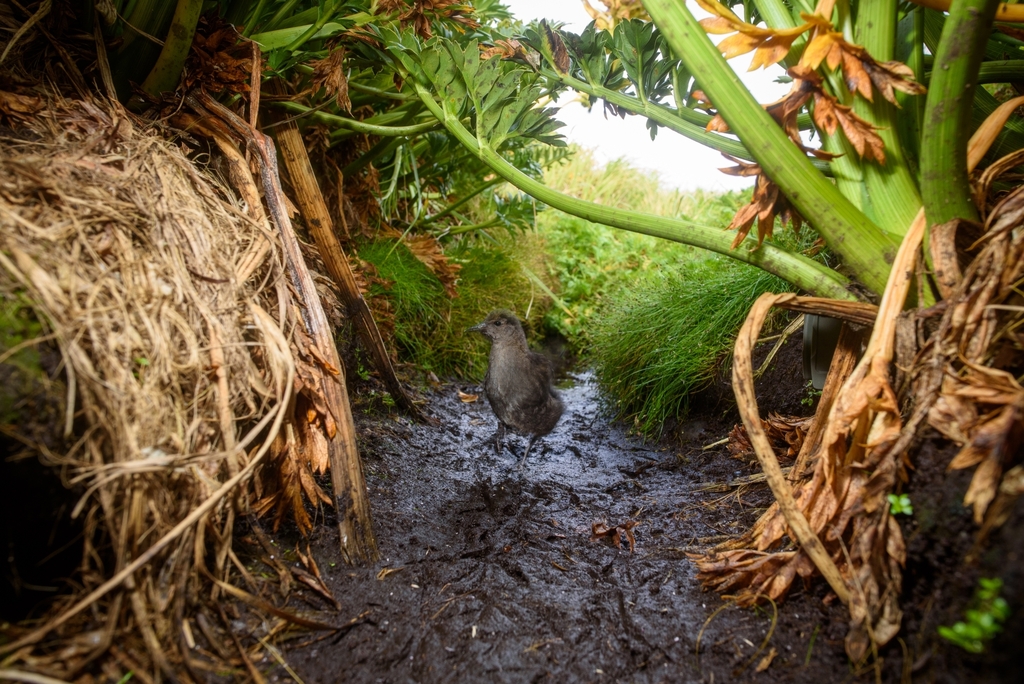
The sexes are similar, the females are possibly duller however. A small rail, the Auckland rail measures 17–20 cm (6.7–7.9 in) in length, and four adults were found to weigh 89–100 g (3.1–3.5 oz). Its head and neck are reddish-brown in colour, while it has a grey breast and a brown-black coloured back. Its characteristic call is a loud "kek" or "crek" sound, but it can also make a variety of quieter calls, as well as grunts and clicks. The Auckland rail can fly but only does so very rarely.
What it does
Its diet and foraging methods probably very similar to the Lewin's rail, and it probably feeds mainly on invertebrates.
The Auckland rail is active during daylight but may also be active for some time after sunset. It appears to be territorial. It is probably monogamous. One active nest of the Auckland rail was found in November, containing two eggs. The nest is woven of grass and/or sedges. Its incubation period is probably similar to Lewin's rail, which incubates for 19–20 days. Its eggs are cream coloured with brown, red-brown and pale grey spots and blotches. The eggs measure 34 mm × 25 mm (1.34 in × 0.98 in), on average.
Wikipedia: “Behaviour”
Listen
Looking for field recordings…
Where it lives
Recorded sightings
—
geo-referenced records in GBIF, from museums, herbaria and field observers.
Drag the globe to turn it. Dots are where records exist, not a range map; darker means more records.
In the stacks
Searching the stacks…
Every page naming Lewinia muelleri in the Biodiversity Heritage Library →
This page is assembled live from iNaturalist, GBIF, Wikipedia, the Source Library and the Internet Archive. It is not yet part of the hand-edited codex. iNaturalist taxon 557.