- Animals
- ›Arthropods
- ›Hexapods
- ›Insects
- ›Winged and Once-winged Insects
- ›Flies
- ›Brachyceran Flies
- ›Cyclorrhaphan Flies
- ›Aschizan Flies
- ›Hover Flies
- ›Drone Flies and Allies
- ›Rat-tail Maggot Flies
- ›Eristalina
- ›Eristalis
- ›Eristalis
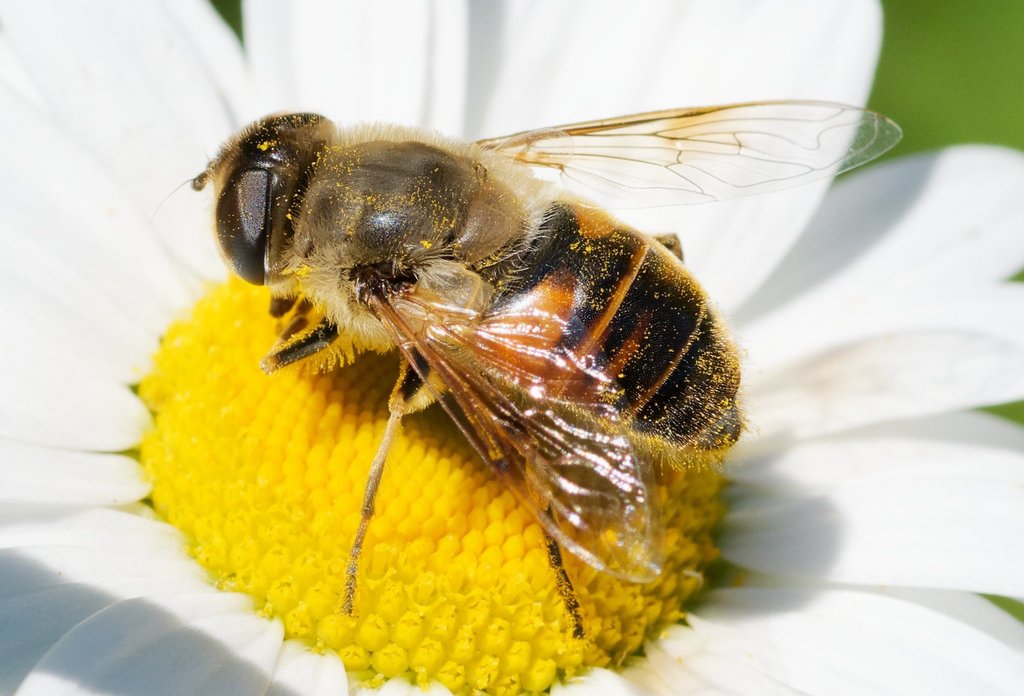
Common Drone Fly
Eristalis tenax
Eristalis tenax, the common drone fly, is a common, migratory, cosmopolitan species of hover fly. It is the most widely distributed syrphid species in the world, and is known from all regions except the Antarctic. It has been introduced into North America and is widely established. It can be found in gardens and fields in Europe and Australia. It has also been found in the Himalayas.
From the article Eristalis tenax on Wikipedia (CC BY-SA), quoted section by section
Description
Eristalis tenax is a large, stocky bee mimic. The eyes are marbled in black. Males have hovering displays. The average wing length is 9.75–13 mm and their average wingspan is 15 mm. The exact appearance of the drone fly can vary considerably. The abdomen can vary in color from dark brown to orange. Pigmentation has an important role in the control of body temperature; the black areas down the center of the drone-flies abdomen may absorb solar radiation and so warm the dorsal blood vessel, which is right underneath. Despite their variation, the orange-to-brown spots on their second abdominal segment are often more rounded than that of other drone flies. Their hind tibiae are all black or brown and thickened medially. Additionally, the setae immediately above the base of the antennae are dark.
Range & habitat
The larval form of the drone-fly, the rat-tailed maggot, is found on every continent except Antarctica, and ranges to the highest latitudes in the North. This species is not prevalent in extremely southern latitudes, neither is it common in arid areas of Europe, Asia, and Africa. In the United States, this species is found as far north as Alaska and as far south as California and Florida.
Wikipedia: “Distribution”
What it does
The eggs are normally laid on surface water and go through three distinct larval stages. The larvae are usually found in still or stagnant water, like water reservoirs or liquid dung. Just before the pupation stage, the larvae leave their aquatic environment.
Life cycle stages. There are still many gaps in the understanding of the drone fly life cycle, and more detailed research is needed.
Eggs. The eggs are deposited near the surface of foul water or decaying organic material. The eggs are laid side by side, perpendicular to the ground. It is still unknown how long it takes for the eggs to hatch.
Larvae. The larvae are aquatic, but there must be enough solid food for the larva to complete development. This is why they are found in water with high levels of organic matter. The siphon on the back of the larvae remains at the surface of the water while the larva moves throughout the water. This allows for the larva to search for food without having to go to the surface to breathe. It has been reported that the larvae can reproduce by neoteny or paedogenesis, where the larva copies itself. There has only been one observation of this happening.
Pupae. Pupation happens in a drier location than where the larvae develop. It usually happens below the soil surface, where they remain for eight to 10 days. …
Wikipedia: “Life cycle”
Listen
Looking for field recordings…
Where it lives
Recorded sightings
—
geo-referenced records in GBIF, from museums, herbaria and field observers.
Drag the globe to turn it. Dots are where records exist, not a range map; darker means more records.
In the stacks
Searching the stacks…
Every page naming Eristalis tenax in the Biodiversity Heritage Library →
This page is assembled live from iNaturalist, GBIF, Wikipedia, the Source Library and the Internet Archive. It is not yet part of the hand-edited codex. iNaturalist taxon 55719.