- Plants
- ›Vascular Plants
- ›flowering plants
- ›Dicots
- ›Roses, Elms, Figs, and Allies
- ›rose family
- ›brambles, roses, strawberries, and allies
- ›agrimonies and burnets
- ›burnet subtribe
- ›Sanguisorba
- ›Poterium
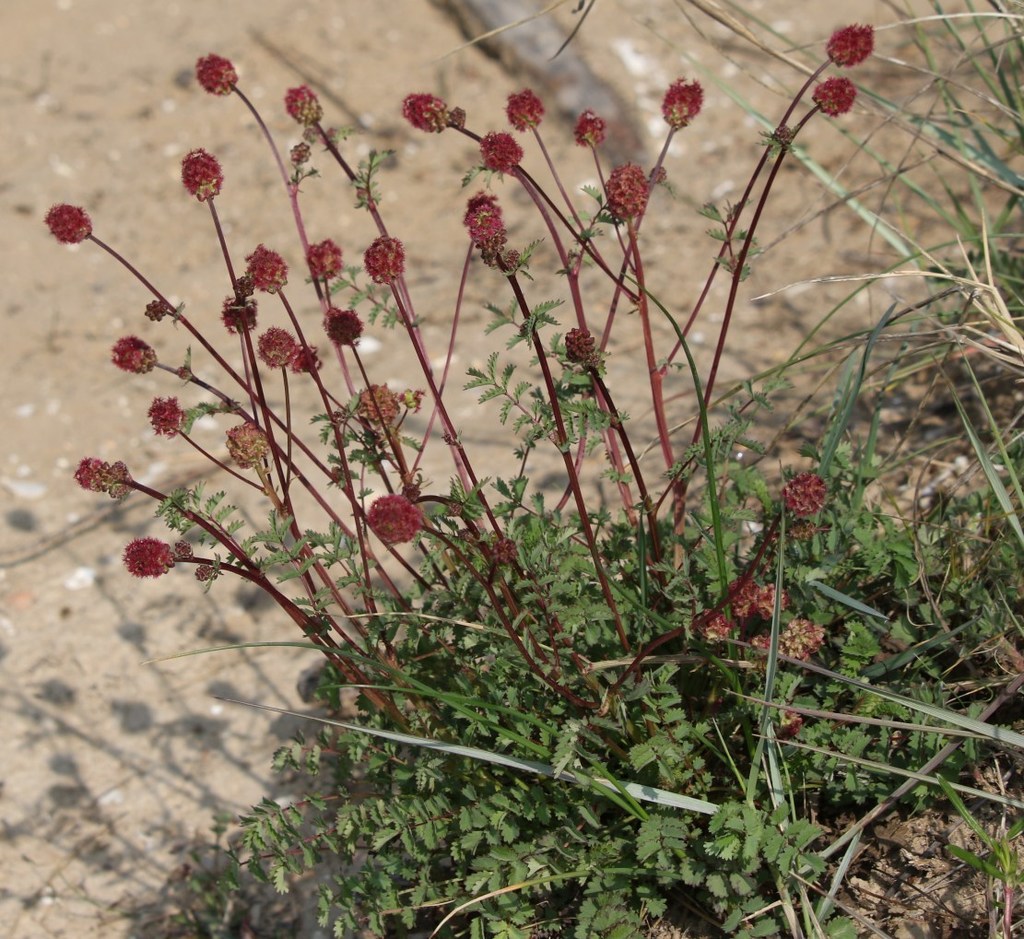
Salad Burnet
Sanguisorba minor
Sanguisorba minor, the salad burnet, garden burnet, small burnet, burnet (also used for Sanguisorba generally), pimpernelle, Toper's plant, and burnet-bloodwort, is an edible perennial herbaceous plant in the family Rosaceae. It has ferny, toothed-leaf foliage; the unusual crimson, spherical flower clusters rise well above the leaves on thin stems. It generally grows to 25–55 cm (9.8–21.7 in) tall (moisture-dependent; as short as 2 cm in dry areas). The large, long (sometimes 1m/3-foot), taproots store water, making it drought-tolerant.
It is evergreen to semi-evergreen; in warmer climates grows all year around, and in cold climates it stays green until heavy snow cover occurs. Plants may live over 20 years, though 7–12 is more usual; it lives longer if sometimes permitted to set seed. Burnet flowers in early summer.
From the article Sanguisorba minor on Wikipedia (CC BY-SA), quoted section by section
At the table
Young burnet leaves are used as an ingredient in salads, dressings, sauces, summer drinks, and in claret. It is also used to flavour vinegar, butter, and cream cheese. It has a flavor described as "mildly cucumber, a bit tart, a little hot" and is considered interchangeable with mint leaves in some recipes, depending on the intended effect. Typically, the youngest leaves are used, as they tend to become bitter as they age; old leaves are cut back to encourage new growth. Salad burnet was called a favorite herb by Francis Bacon, was brought to the New World with the first English colonists, and was given special mention by Thomas Jefferson. It declined in popularity as a kitchen herb, but as of 2022, is becoming more popular again, for food and as an ornamental.
Wikipedia: “Culinary”
In medicine
Salad burnet has in the past been used medicinally in Europe to control bleeding. Salad burnet has the same medicinal qualities as medicinal burnet (Sanguisorba officinalis). It was used as a tea to relieve diarrhea in the past.
Wikipedia: “Medicinally”
How it is grown
It is grown in containers, wildflower meadows, ornamental gardens, and kitchen gardens, usually in sunny or very slightly shady spaces with an equator-facing or west-facing aspect. In North America, it is grown on dry rangelands. It is used for grazing, erosion control, post-fire weed control, firebreaks, and landscape rehabilitation. Because it tends to stay green, it is considered fire-resistant.
Wikipedia: “Cultivation”
Where it lives
Recorded sightings
—
geo-referenced records in GBIF, from museums, herbaria and field observers.
Drag the globe to turn it. Dots are where records exist, not a range map; darker means more records.
In the old herbals & bestiaries

Notable Commentaries on the History of Plants
Leonhart Fuchs · 1542 · p.823

Notable Commentaries on the History of Plants
Leonhart Fuchs · 1549 · p.821

Commentaries on the Six Books of Pedanius Dioscorides on Medical Matter
Pietro Andrea Mattioli · 1565 · p.1206

Six Groups of the History of Plants
Rembert Dodoens · 1583 · p.125

Herbarium Portatile, Oder Behendes Kräuter- und Gewächs-Buch: Darinn nicht allein 1363. so wol Einheimische als Außländndische Kräuter mit Lateinisch und Deutscher Benennung abgebildet, sondern auch die meisten, so in der Medicin gebräuchlich, kürtzlich erkläret werden
Panckow, Thomas · 1656 · p.269
In the stacks
Searching the stacks…
Every page naming Sanguisorba minor in the Biodiversity Heritage Library →
This page is assembled live from iNaturalist, GBIF, Wikipedia, the Source Library and the Internet Archive. It is not yet part of the hand-edited codex. iNaturalist taxon 55736.