- Plants
- ›Vascular Plants
- ›flowering plants
- ›Dicots
- ›beeches, oaks, walnuts, and allies
- ›Sheoaks
- ›Allocasuarina
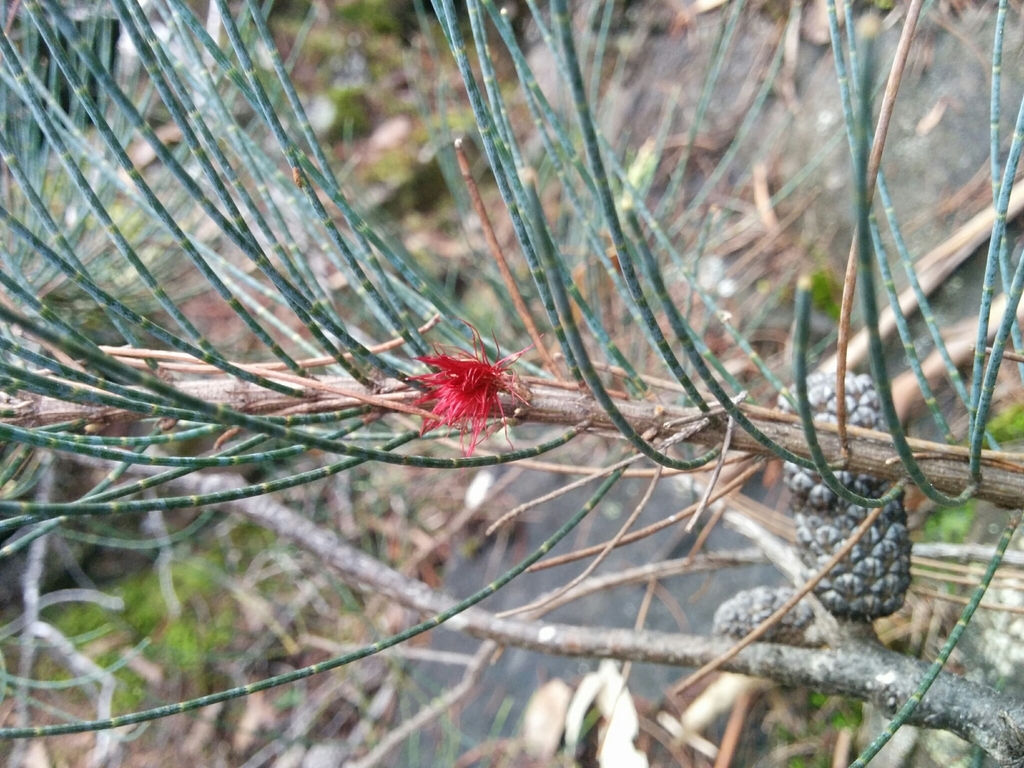
Allocasuarina duncanii
Allocasuarina duncanii, commonly known as Duncan's sheoak, or conical sheoak, is a species of flowering plant in the family Casuarinaceae and is endemic to Tasmania. It is a small dioecious tree that has branchlets up to 200 mm (7.9 in) long, the leaves reduced to scales in whorls of seven to nine, and the fruiting cones 15–60 mm (0.59–2.36 in) long containing winged seeds (samaras) 6–10 mm (0.24–0.39 in) long.
From the article Allocasuarina duncanii on Wikipedia (CC BY-SA), quoted section by section
Description
Allocasuarina duncanii is a small, erect, dioecious tree that typically grows to a height of up to 8 m (26 ft). Its branchlets are up to 200 mm (7.9 in) long, the leaves reduced to scale-like teeth 0.8–1.5 mm (0.031–0.059 in) long, arranged in whorls of seven to nine around the branchlets. The sections of branchlet between the leaf whorls (the "articles") are 4–17 mm (0.16–0.67 in) long and 0.9–1.4 mm (0.035–0.055 in) wide. Male flowers are arranged in head-like spikes 7.5–13 mm (0.30–0.51 in) long, with six to eight whorls per centimetre (per 0.39 in.), the anthers about 1 mm (0.039 in) long. Female cones are cylindrical, on a peduncle 4–10 mm (0.16–0.39 in) long. Mature cones are 15–60 mm (0.59–2.36 in) long and 12–25 mm (0.47–0.98 in) in diameter, the samaras dark brown to black and 6–10 mm (0.24–0.39 in) long. This sheoak is similar to A. monilifera that is mostly monoecious, and lacks the "conifer-like" habit of A duncanii.
Range & habitat
Duncan's sheoak grows in shallow soil over dolerite, usually at altitudes above 500 m (1,600 ft), on Mount Dromedary, the Wellington Range, Snug Tiers and on South Bruny Island.
Wikipedia: “Distribution and habitat”
Where it lives
Recorded sightings
—
geo-referenced records in GBIF, from museums, herbaria and field observers.
Drag the globe to turn it. Dots are where records exist, not a range map; darker means more records.
In the stacks
Searching the stacks…
Every page naming Allocasuarina duncanii in the Biodiversity Heritage Library →
This page is assembled live from iNaturalist, GBIF, Wikipedia, the Source Library and the Internet Archive. It is not yet part of the hand-edited codex. iNaturalist taxon 557533.