- Animals
- ›Molluscs
- ›Bivalves
- ›Autobranchia
- ›Pteriomorphia
- ›Mytilida
- ›True Mussels
- ›mussels
- ›Crenellinae
- ›Choromytilus
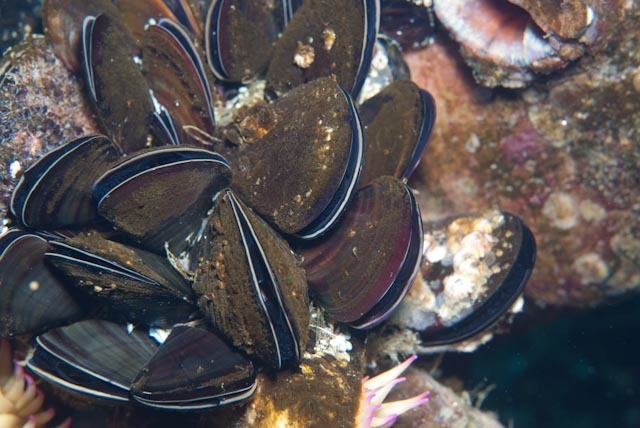
Black Mussel
Choromytilus meridionalis
Choromytilus meridionalis, the black mussel, is a species of bivalve. It is a marine mollusc in the family Mytilidae. They are part of the Phylum Mollusca which is the second-largest phylum of invertebrates with around 85,000 species. In this article, we will be discussing the taxonomy, morphology, ecology, reproduction, and distribution of Choromytilus meridionalis.
From the article Choromytilus meridionalis on Wikipedia (CC BY-SA), quoted section by section
Description
This animal grows up to 150 mm in length. It is a shiny black mussel that grows clustered in groups on rocks and in sandy areas. It is narrower and blacker than the Mediterranean mussel, Mytilus galloprovincialis, with which it is often confused. The family mytilldae is known for narrow, elliptical, fan-shaped, thin valves which are of the same size, the absence of prominent hinge teeth, and the presence of byssal threads that hang off the hinge area for anchoring on rigid substrates.
Wikipedia: “Morphology”
Range & habitat
This species is found in lagoonal, coastal, inner shelf, outer shelf, oceanic, brackish, seawater This species is found only around the southern African coast, from central Namibia to Port Elizabeth, in the sublittoral and lower littoral of rocky areas. The population density of C. meridionalis varied significantly among tidal levels, with the highest densities found at the mid-tidal level. The tidal levels also influenced the growth rates of C. meridionalis, in which the individuals found around the mid-tidal levels exhibited the highest growth rates. The most important environmental factors affecting the distribution of the species are temperature and sediment type. They do well in temperatures of 12.5-30 °C. Salinity seems to have little effect on the distribution and abundance of the species.
Wikipedia: “Distribution”
What it does
The black mussel is a filter feeder that eats floating scraps of algae and phytoplankton. It is threatened by the invasion of the fast-growing and hardy Mediterranean mussel, which outcompetes it for space. Particulate organic matter is the major food source of many filter-feeding bivalves including C. meridionalis. Choromytilus meridionalis utilizes bacteria as a nitrogen resource, which is important for its growth and survival in the intertidal zone. The bacterial nitrogen uptake by C. meridionalis was highest when mussels were exposed to high tide and lowest during low tide. The bacterial nitrogen uptake by C. meridionalis is influenced by the availability of other nitrogen sources such as dissolved inorganic nitrogen. This suggests that species have the ability to adjust their nitrogen uptake strategy based on the availability of different nitrogen sources. C. meridionalis may co-exist with the bivalve Aulacomya ater in the field.
Wikipedia: “Ecology”
Where it lives
Recorded sightings
—
geo-referenced records in GBIF, from museums, herbaria and field observers.
Drag the globe to turn it. Dots are where records exist, not a range map; darker means more records.
In the stacks
Searching the stacks…
Every page naming Choromytilus meridionalis in the Biodiversity Heritage Library →
This page is assembled live from iNaturalist, GBIF, Wikipedia, the Source Library and the Internet Archive. It is not yet part of the hand-edited codex. iNaturalist taxon 557852.