- Plants
- ›Vascular Plants
- ›flowering plants
- ›Dicots
- ›Mints, Plantains, Olives, and Allies
- ›Mint Family
- ›Nepetoideae
- ›Mentheae
- ›catmints, ground ivies, and hyssops
- ›Glechoma
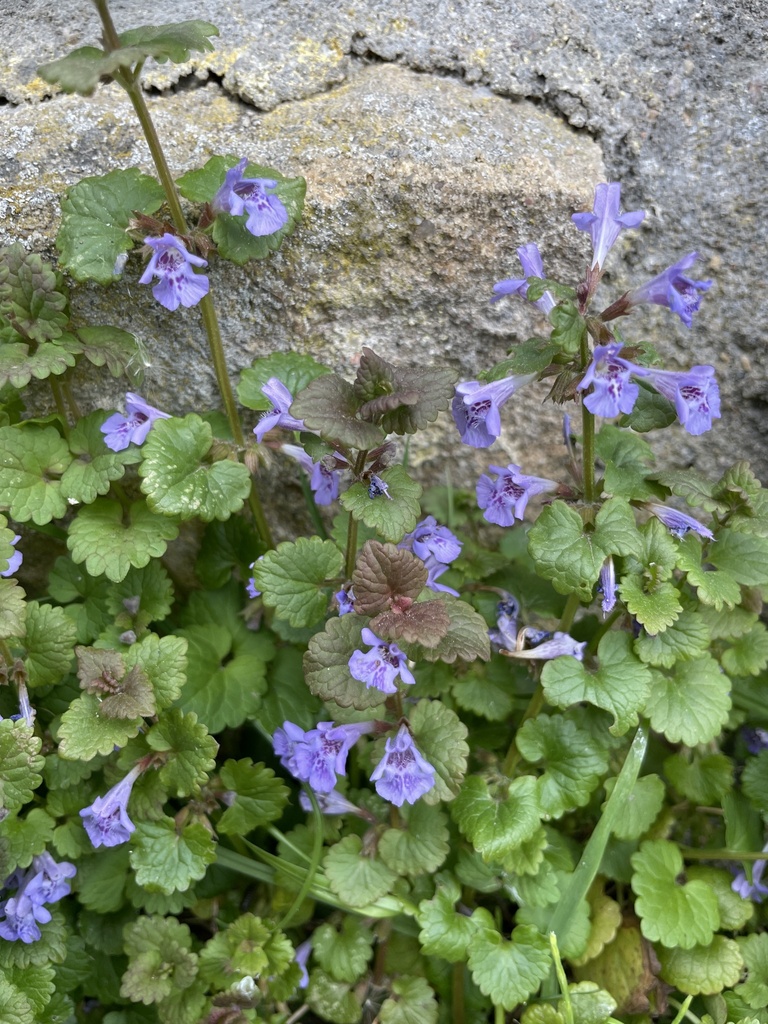
ground-ivy
Glechoma hederacea
Glechoma hederacea is an aromatic, perennial, evergreen creeper of the mint family Lamiaceae. It is commonly known as ground-ivy, gill-over-the-ground, creeping charlie, alehoof, tunhoof, catsfoot, field balm, and run-away-robin. It is also sometimes known as creeping jenny, but that name more commonly refers to Lysimachia nummularia. It is used as a salad green in many countries.
European settlers carried it around the world, and it has become a well-established introduced and naturalized plant in a wide variety of localities. It is also considered an aggressive invasive weed of woodlands and lawns in some parts of North America. In the absence of any biological control research conducted by the United States Department of Agriculture, herbicides are relied upon (despite their drawbacks) particularly for woodland ecosystems. The plant's extensive root system makes it difficult to eradicate by hand-pulling.
From the article Glechoma hederacea on Wikipedia (CC BY-SA), quoted section by section
Description
Glechoma hederacea can be identified by its round to reniform (kidney- or fan-shaped), crenate (with round-toothed edges) opposed leaves 2–3 cm (3⁄4–1+1⁄4 in) diameter, on 3–6 cm (1+1⁄4–2+1⁄4 in) long petioles attached to square stems that root at the nodes. The plant spreads either by stolon or seed, making it exceptionally difficult to eradicate. It is a variable species, its size being influenced by environmental conditions, from 5–50 cm (2–19+1⁄2 in) tall. It is creeping in habit, with its stems growing a long as 1 m in length. As a seedling, G. hederacea has glabrous kidney-shaped cotyledons with a small notch at the tip. The flowers of G. hederacea are bilaterally symmetrical, funnel shaped, blue or bluish-violet to lavender, and grow in opposed clusters of two or three flowers in the leaf axils on the upper part of the stem or near the tip. It usually flowers in the spring. The fruits are dry and indehiscent with small, dark brown, flat dry nuts 1.0 to 2.0 mm in length and 1.0 mm wide.
Reproduction. Glechoma hederecea is gynodioecious, with genets being either female or hermaphrodite. The females depend upon pollen from hermaphrodites for pollination. Female flowers tend to be smaller than hermaphrodite flowers. Disagreement exists among biologists as to whether hermaphrodite flowers can pollinate themselves. …
Range & habitat
European settlers carried it around the world, and it has become a well-established introduced and naturalized plant in a wide variety of localities. It is also considered an aggressive invasive weed of woodlands and lawns in some parts of North America, being considered a non-native plant in the United States, and invasive in some U.S. states. It has invaded wild areas, sometimes choking out native wildflowers. G. hederacea thrives in moist shaded areas, but also tolerates sun very well. It is a common plant in grasslands and wooded areas or wasteland. It also thrives in lawns and around buildings, since it survives mowing. Part of the reason for its wide distribution is its rhizomatous method of reproduction.
Wikipedia: “Distribution and habitat”
What it does
A number of wild bees collect pollen from this plant, including Anthophora furcata, Anthidum manicatum, Anthophora plumipes, Anthophora quadrimaculata, Osmia aurulenta, Osmia caerulentes, and Osmia uncinata. The plant is also galled by several insects, including Rondaniola bursaria (lighthouse gall), Liposthenes glechomae or Liposthenes latreillei (Kieffer, 1898) (a gall wasp). It forms dense mats that can take over areas of lawn and woodlands, thus is considered an invasive or aggressive weed in suitable climates where it is not native.
Control. A non-native invasive in North America, Glechoma is familiar to a large number of people as a weed, a property it shares with many others of the mint family. It can be a problem in heavy, rich soils with good fertility, high moisture, and low boron content. It thrives particularly well in shady areas where grass does not grow well, such as woodlands, although it can also be a problem in full sun. Because the plant is stoloniferous and continues to spread from its roots or bits of stem which reroot, even small infestations resist repeated hand weeding. Like crabgrass, G. hederacea's root has a tough-to-remove ball (unbelied by its delicate wide leaves). No biological control agents are known to help to reduce its spread in North America. Commercial herbicides containing triclopyr are used to control the plant. G. …
Wikipedia: “Ecology”
At the table
It is grown as a garden plant in pots and occasionally as a groundcover. Easily cultivated, it grows well in shaded places. A variegated variety is commercially available; in many areas, this is the dominant form, which has escaped cultivation and become established as an aggressive, adventitious groundcover. The pre-bloom leaves can be cooked as a vegetable or made into tea. G. hederacea was also widely used by the Saxons in brewing ale as flavoring, clarification, and preservative, and later by the English, before the introduction of hops into brewing in the late 15th century. From this, the brewing-related names arose for the herb, e.g. alehoof, tunhoof, and gill-over-the-ground. In the 18th century, beer brewed with ground ivy was known as gill ale and was said to have medicinal properties. It was made by infusing the herb in strong ale and was sold at coffee and victualling houses. Enzymes similar to chymosin in G. hederacea have been used in the cheese-making process as a substitute for animal rennet.
Traditional medicine. G. hederacea has been used in the traditional medicine of Europe going back thousands of years; Galen recommends the plant to treat inflammation of the eyes. John Gerard, an English herbalist, recommended it to treat tinnitus, and as a "diuretic, astringent, tonic, and gentle stimulant. …
Wikipedia: “Uses”
Where it lives
Recorded sightings
—
geo-referenced records in GBIF, from museums, herbaria and field observers.
Drag the globe to turn it. Dots are where records exist, not a range map; darker means more records.
In the old herbals & bestiaries


In the stacks
Searching the stacks…
Every page naming Glechoma hederacea in the Biodiversity Heritage Library →
This page is assembled live from iNaturalist, GBIF, Wikipedia, the Source Library and the Internet Archive. It is not yet part of the hand-edited codex. iNaturalist taxon 55830.