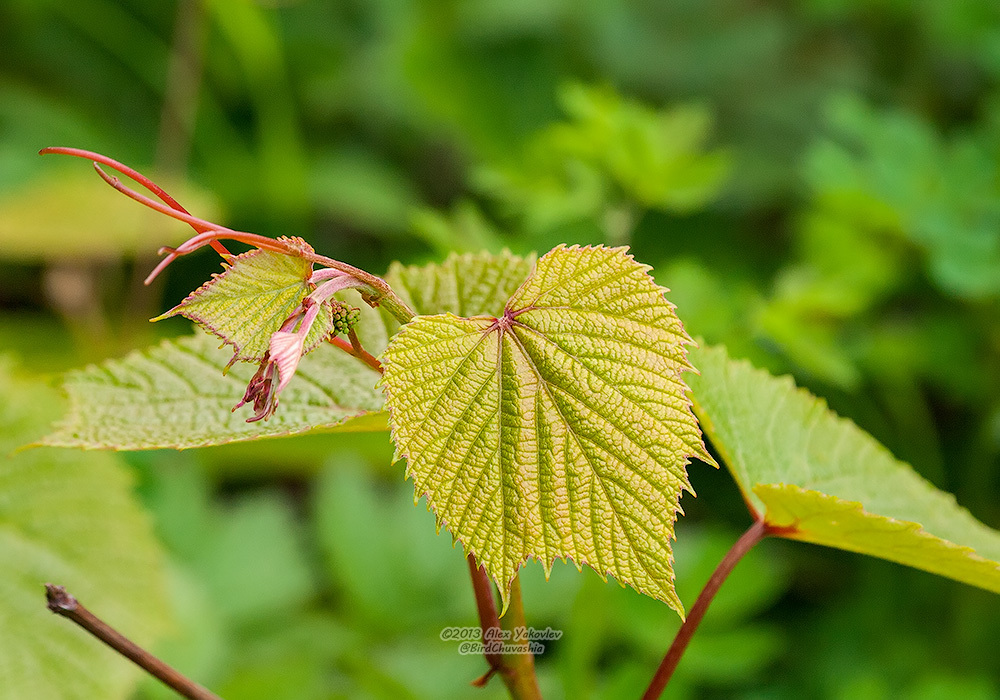
Crimson Glory Vine
Vitis coignetiae
Vitis coignetiae, commonly called crimson glory vine, is a species of grapevine belonging to the family Vitaceae. Is native to the temperate climes of Asia and can be found in the Russian Far East (Sakhalin), Korea, and Japan (Hokkaido, Honshu, Shikoku). It was described botanically in 1883. It is called meoru (머루) in Korean and yama-budo (ヤマブドウ) in Japanese.
From the article Vitis coignetiae on Wikipedia (CC BY-SA), quoted section by section
Description
The vine is very vigorous, with grey-brown, tomentose shoots. The deciduous leaves are large (10-25 cm in diameter), simple, orbicular, toothed, with 5-15 cm long petiole. Dark green during the growing season, they turn red-orange in autumn. Wild vines can be male, female or hermaphrodite. Clusters are large with small, purple-black, seeded berries. It is found in the mountainous regions of Japan and up to 1300 m altitude in Korea.
At the table
In East Asia it is grown as an ornamental plant for its crimson autumn foliage; and as a traditional medicine. It is a recipient of the Royal Horticultural Society's Award of Garden Merit. It is used to produce wines in Korea and Japan. These are at first bitter, but softened with the addition of sugar.
Wikipedia: “Uses”
In human culture
The species name is dedicated to Marie Coignet, née Sisley, who reportedly brought seeds back from a trip to Japan with her husband in 1875. This vine was also reported in 1884 snowy regions of Japan by Henri Degron sent to East Asia to seek wild vines resistant to Phylloxera. Degron sent specimens to a Professor Planchon of Montpellier who named them Vitis coignetiae but did not retain them due to their low resistance to phylloxera. Degron planted a vineyard in Crespières, Île-de-France where one of the vines reached a length of 32.8 meters and a height of 2.8 meter. In the cooler Norman climate the vine produces a bitter wine, rich in color and extract.
Wikipedia: “History”
Where it lives
Recorded sightings
—
geo-referenced records in GBIF, from museums, herbaria and field observers.
Drag the globe to turn it. Dots are where records exist, not a range map; darker means more records.
In the stacks
Searching the stacks…
Every page naming Vitis coignetiae in the Biodiversity Heritage Library →
This page is assembled live from iNaturalist, GBIF, Wikipedia, the Source Library and the Internet Archive. It is not yet part of the hand-edited codex. iNaturalist taxon 559123.